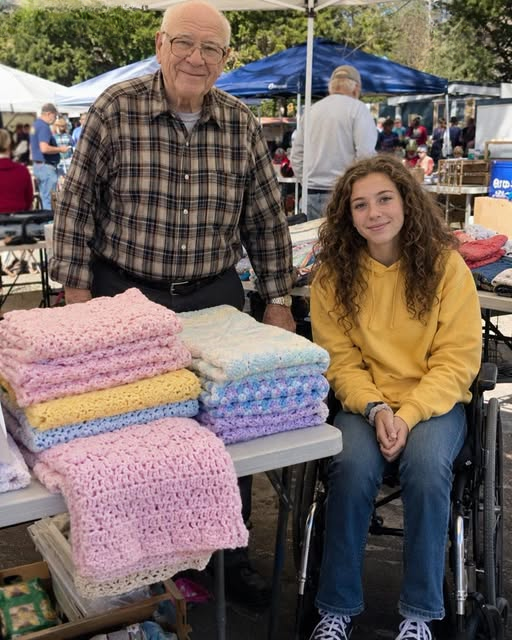
I am fifteen years old, and I was raised entirely by my grandfather, Arthur. I never knew my parents. My mother tragically passed away from medical complications during my birth, and my father vanished shortly afterward, leaving my grandfather to raise me completely on his own.
Arthur became my father, my mother, and my guardian all wrapped into one. He was a patient, warm-hearted man who worked tirelessly to ensure I had a happy, stable childhood filled with encouragement and care.
Then, fourteen months ago, disaster struck our small family.
A high school friend was driving me home on a rainy afternoon when another vehicle lost traction on the slick road, skidded across the centerline, and plowed directly into the side of our car. The impact forced our car off the shoulder, causing it to flip down a steep embankment. While we miraculously survived the crash, the structural impact caused severe trauma to my spine, leaving me unable to walk.
The medical specialists at the rehabilitation clinic delivered a heavy prognosis: there was a realistic chance that I could regain full mobility and walk again, but it would require an intensive, specialized physical therapy program over two years.
The financial cost was overwhelming. Our basic health insurance covered less than half of the required treatment, leaving us with a balance far beyond what an elderly retiree could ever dream of affording.
When I wept in my hospital bed, telling my grandfather to accept the reality that I would spend the rest of my life in a wheelchair, Arthur took my hands in his, wiped away my tears, and made a firm, unwavering vow.
“My dear,” Arthur whispered, holding my hands tightly, “I am going to do whatever it takes to ensure you get that therapy. We are not giving up.”
At seventy-six years old, Arthur took on a grueling daily schedule that would have exhausted a man half his age. He took a job working double shifts stocking shelves at a local grocery store during the day. Then, when he returned home late at night, he sat at his vintage sewing machine, stitching hand-crafted, colorful quilts and children’s blankets until the early hours of the morning.
I felt immense guilt watching him push his body to the limit for my sake. But Arthur would simply wrap a warm blanket around my shoulders, give me a loving hug, and reassure me that we were a team. I helped him as much as my condition allowed—cutting fabric patterns, organizing thread spools, and stitching labels. On weekends, I accompanied him to the community flea market, where we set up a small folding table to sell his handmade creations.
Then came a bright Saturday morning that changed the course of our lives forever.
I was sitting in my wheelchair beside my grandfather behind our wooden display table when a man walked directly toward us from the parking lot. He was in his early forties, broad-shouldered, wearing a worn leather motorcycle vest over a black shirt, with a bandana tied around his head and dark tattoos covering both arms. He had just parked a heavy touring motorcycle at the edge of the market lot.
He stopped at our booth, his sharp eyes scanning the neat stacks of handmade blankets on our table. Arthur offered him a polite, welcoming smile, stepping forward to assist him.
“Good morning, sir,” Arthur said kindly. “Looking for a warm blanket today?”
The biker didn’t answer immediately. Instead, he looked up from the table, locking his gaze directly onto my grandfather’s face. He stood motionless for a long moment before reaching into the inner pocket of his leather vest and pulling out a thick, weathered yellow envelope.
He held the envelope out toward my grandfather, his voice raspy and intense.
“It’s you,” the biker said, his voice carrying across the quiet aisle. “I know it’s you. I’ve been looking for you for twenty years. I know what you did back then, Arthur. You won’t fool anyone else.”
My heart leaped into my throat, and my hands began trembling against the armrests of my wheelchair. Beside me, I saw Arthur’s hands shake as well.
With hesitation, Arthur accepted the envelope, unsealed the top flap, and pulled out a faded, laminated newspaper article from two decades prior, accompanied by an old photograph.
Arthur’s face turned pale as he stared at the clipping, his breath hitching sharply in his chest.
“No… is that really you?” Arthur stammered, his eyes widening in shock as he looked back up at the biker. “This can’t be. How in the world did you find me?”
The man in the leather vest took off his sunglasses, revealing eyes filled with deep emotion rather than anger.
“Twenty years ago,” the man said softly, stepping closer to our table, “I was a troubled nineteen-year-old kid who made terrible choices. I tried to rob a small neighborhood convenience store where you were working the night shift. You could have easily called the police and had me thrown in prison for years. Instead, you saw how terrified and desperate I was. You took the money out of your own wallet to pay for my meal, talked to me for three hours, and bought me a bus ticket to a youth rehabilitation program in Ohio.”
The biker gestured toward his motorcycle and the leather vest he wore.
“That night saved my life, Arthur,” the man continued, his voice cracking. “I turned my life completely around. I built a successful custom motorcycle shop, started a family, and founded a regional motorcycle club dedicated to charitable causes. For twenty years, I’ve been searching for the man who believed in me when no one else did.”
The man then reached into his vest again and pulled out a certified bank check, placing it gently on top of Arthur’s handmade blankets.
“Word reached our riding group last week that a seventy-six-year-old man was working double shifts and selling handmade quilts at this market to fund his grandchild’s medical therapy,” the man explained, looking down at me with a warm smile. “When I saw the name on the market registry, I knew I had to come see for myself. My club raised this money to pay for your grandchild’s entire rehabilitation program in full.”
I looked down at the check on the table. The amount covered the entire two-year physical therapy bill, with additional funds set aside for equipment.
Arthur collapsed back into his folding chair, burying his face in his hands as deep, relieved sobs shook his shoulders. The heavy burden of endless work and financial fear that he had carried on his elderly shoulders for fourteen months evaporated in a single moment.
I reached out and grabbed the man’s hand, tears streaming down my cheeks. “Thank you,” I choked out. “Thank you for saving my grandfather.”
The man knelt down beside my wheelchair, offering a firm, comforting squeeze. “Your grandfather saved me first, kiddo. Now it’s time for us to help you walk again.”
Over the next two years, members of the motorcycle club checked in on us regularly, attending every major milestone of my physical therapy. With hard work, dedication, and the incredible support of a community brought together by a twenty-year-old act of kindness, I eventually took my very first unassisted steps across our living room floor—walking directly into the waiting arms of my hero, my grandfather.