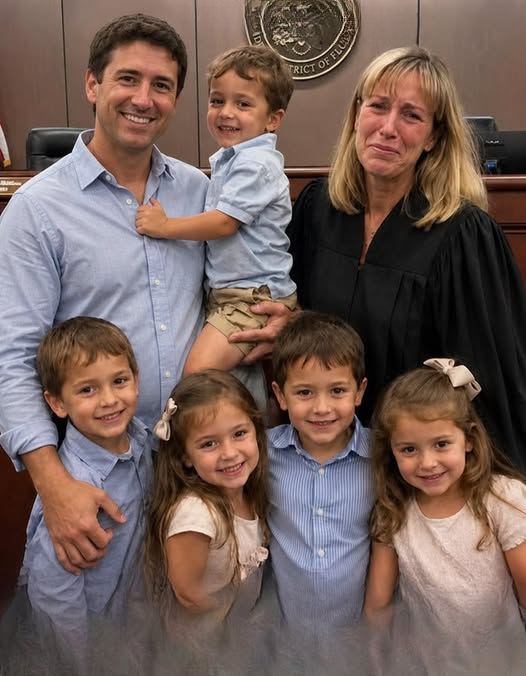
The courthouse was quieter than Daniel expected.
Outside, the city moved as it always had. Cars rolled through intersections, people hurried toward work with coffee cups in hand, and children laughed as they walked to school. But inside the old stone building, every minute felt heavier than the last.
Daniel adjusted his tie for what seemed like the tenth time that morning. Across the hallway, the five children sat together on a wooden bench. Emma, the oldest at fourteen, held six-year-old Noah’s hand while Lucas tried to distract his younger sisters with a simple card game.
No one spoke much.
They all knew what was at stake.
If today’s hearing didn’t go well, the children could be placed in separate foster homes until a permanent decision was reached.
That thought alone had kept Daniel awake for weeks.
Months of Preparation
The hearing hadn’t arrived overnight.
For nearly seven months, Daniel had worked harder than he ever imagined possible.
He accepted overtime shifts.
He completed parenting classes.
He renovated every bedroom in the small house he had recently purchased.
Neighbors volunteered weekends to help paint walls, build bunk beds, and create a safe backyard where the children could play together.
Teachers wrote letters describing how much the children had improved since living with Daniel.
Counselors documented fewer nightmares, better grades, and brighter attitudes.
Even the children’s pediatrician submitted a report noting improvements in their health and emotional well-being.
Every piece of evidence pointed toward one simple truth.
The children weren’t just surviving.
They were finally beginning to heal.
Inside the Courtroom
When everyone entered the courtroom, the atmosphere felt respectful but serious.
The judge carefully reviewed several folders before looking toward Daniel.
“You understand the responsibilities involved?” she asked.
“Yes, Your Honor.”
“Raising five children is a lifelong commitment.”
Daniel nodded.
“I understand.”
“What happens if circumstances become difficult?”
Daniel smiled softly.
“They already have.”
The courtroom grew quiet.
“I’ve learned that families don’t become stronger because life is easy. They become stronger because they choose each other when life isn’t.”
Several people quietly wiped away tears.
Evidence Beyond Paperwork
Over the next several hours, professionals shared their observations.
A school principal explained that attendance had become nearly perfect.
Teachers described children who once avoided classmates now participating confidently in class projects.
A counselor spoke about emotional progress.
“When these children first arrived, every session focused on fear.”
“And now?”
“Now they talk about birthdays, vacations, homework, and soccer practice.”
The difference wasn’t simply academic.
It was hope.
Community Support
One after another, members of the community offered testimony.
A neighbor explained how Daniel organized weekend barbecues so the children could make friends.
Another described watching him coach youth soccer after working ten-hour shifts.
The local librarian smiled while recalling weekly visits.
“They never leave without books.”
The courtroom laughed gently.
“They argue over who gets to check out the mystery novels first.”
Even small moments mattered.
Because together they painted the picture of an ordinary family.
And ordinary was exactly what the children had always wanted.
The Children’s Voices
The judge requested private conversations with each child.
No cameras.
No audience.
Just quiet conversations.
Later, portions of those interviews were summarized for the record.
Emma explained that she finally slept through the night.
Lucas said he no longer worried about where his siblings would wake up.
Sophia proudly shared pictures she had drawn of their house.
Noah offered only one sentence.
“I don’t want another goodbye.”
There wasn’t a dry eye in the courtroom.
Daniel’s Final Statement
When it was his turn, Daniel stood slowly.
He hadn’t prepared a speech.
Instead, he spoke from the heart.
“I never planned to become a father.”
“I certainly never expected to become responsible for five children.”
“But life doesn’t always ask whether we’re ready.”
“Sometimes it simply places someone in our path.”
He looked toward the children.
“They’ve taught me patience.”
“They’ve taught me courage.”
“They’ve reminded me that family isn’t defined only by biology.”
“It’s built through trust, consistency, and love.”
“If this court allows us to stay together, I promise one thing.”
“They will always know they’re home.”
A Difficult Decision
The judge recessed for several hours.
Waiting felt endless.
The children colored quietly while Daniel stared through the courthouse windows.
Finally, everyone was called back.
The room became silent.
The judge reviewed the legal requirements, acknowledged the extensive evaluations, and thanked everyone involved for their professionalism.
Then she smiled.
“This court finds overwhelming evidence that remaining together serves the children’s best interests.”
Daniel held his breath.
“The petition for permanent guardianship is approved.”
For a brief second, nobody moved.
Then Emma burst into tears.
Lucas hugged his sisters.
Little Noah wrapped both arms around Daniel’s waist.
“We get to go home?”
Daniel could barely speak.
“Yes.”
“We’re all going home.”
A New Beginning
The months that followed weren’t perfect.
There were still homework battles.
There were muddy shoes.
Broken dishes.
Late-night science projects.
Soccer tournaments.
Parent-teacher meetings.
Dentist appointments.
Ordinary challenges filled every week.
And Daniel welcomed every single one.
Because ordinary life was something the children had once believed they might never have.
The first holiday in their new home became unforgettable.
Instead of expensive gifts, everyone exchanged handwritten letters describing what family meant to them.
Emma wrote that home was “the place where nobody has to earn their place.”
Lucas described family as “people who stay.”
Sophia simply drew six stick figures holding hands beneath a bright yellow sun.
Daniel framed the drawing.
Years later, it still hung in the hallway.
Looking Ahead
As the children grew older, each found new dreams.
Emma earned a scholarship to study education.
Lucas discovered a passion for engineering.
Sophia became an artist.
The younger children excelled in music and athletics.
Every graduation, birthday, and family dinner became another reminder of what had been preserved.
Not just five childhoods.
An entire family.
The Legacy of One Decision
People often asked Daniel whether he regretted taking on such enormous responsibility.
His answer never changed.
“The hardest decision of my life became the greatest blessing.”
He believed families are not measured by perfection.
They’re measured by commitment.
By showing up every day.
By choosing love repeatedly, even when circumstances become difficult.
Years after the courtroom hearing, the family returned to the courthouse—not for another case, but to celebrate a community volunteer event supporting foster children.
Walking through those familiar doors, Daniel realized how much had changed.
Once, they had entered filled with uncertainty.
Now, they returned filled with gratitude.
The building had witnessed one decision that altered six lives forever.
And as the family walked outside together—laughing, talking, and planning dinner—Daniel understood something he had learned long ago.
Sometimes the greatest victories aren’t about winning a legal battle.
They’re about giving people a place where they know they belong.
For these six individuals, that place would always be home.