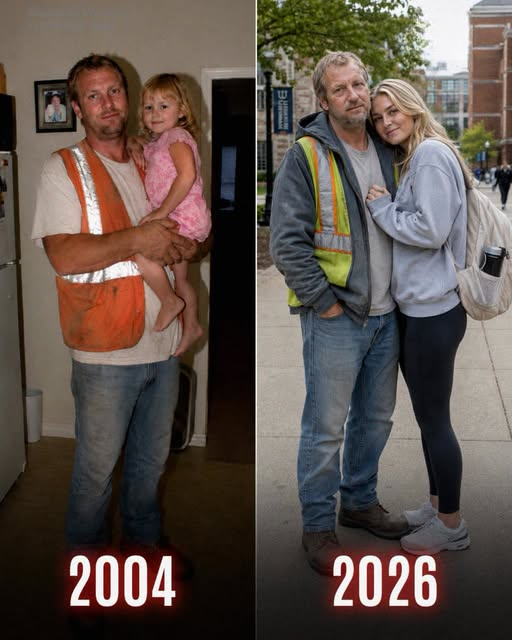
My earliest memories of my father all contain the same details.
His steel-toe boots sat beside the apartment door. A faded orange construction vest hung over the back of a kitchen chair. His hands were so rough from work that they felt like sandpaper whenever he tucked me into bed.
Dad had been studying engineering when I was born. He was halfway through his degree and dreamed of designing bridges.
Then, on an ordinary Tuesday afternoon, my mother kissed me on the forehead, picked up her purse, and said she was going to the grocery store for milk.
She never came home.
I was only three years old, so most of what I knew about that day came from the story Dad repeated whenever I asked about her.
He called the police and contacted every friend and relative he could think of. Eventually, he learned that she had left town by choice. She did not want to be found.
Dad withdrew from college the following week.
There was no dramatic speech about sacrificing his future. He simply packed his textbooks into a cardboard box, borrowed a hard hat, and accepted a job with a construction company.
He never returned to school.
We spent my entire childhood in a small rented apartment with thin walls and unreliable heating. Money was always carefully counted.
Dad worked long days, sometimes leaving before I woke and returning after sunset. When a neighbor could not watch me, he took me to the construction site office and gave me paper to draw on while he finished his shift.
During difficult months, dinner might consist of canned soup, toast, or pasta without much sauce. Dad always insisted he had eaten earlier.
I believed him until I was old enough to notice that he said the same thing every time there was only enough food for one person.
His work boots were repaired with glue long after they should have been replaced. He wore the same winter coat for more than a decade. I cannot remember him buying anything expensive for himself.
At Christmas, he somehow found a way to place gifts beneath our small artificial tree. When I asked why there were no presents with his name on them, he always gave me the same answer.
“Watching you open yours is everything I want.”
I promised myself that one day I would repay him.
I imagined buying him a comfortable home with a porch where he could drink coffee in the morning. I planned to take him on a vacation because he had never seen the ocean. Most of all, I wanted to give him permission to rest.
Whenever I asked why he worked so hard, he kissed the top of my head.
“Because you’re worth every sore muscle, Daddy’s Bug.”
That was his nickname for me.
Daddy’s Bug.
As a child, I assumed it came from the ladybugs I used to collect in the park. When I became a teenager and asked him about it, he smiled and said I had been small, determined, and impossible to ignore.
Dad attended every important event he could. He arrived at school concerts wearing dusty work clothes and stood in the back so he would not make a mess. He learned how to braid my hair by practicing on pieces of rope. When I started dating, he tried to appear strict but offered every nervous boy coffee and asked about his plans for college.
He was not perfect. He could be stubborn and excessively protective. Whenever I asked new questions about my mother, he shut down.
“She chose to leave,” he would say. “That is all you need to know.”
“Did she ever contact you?”
“No.”
“Do you know where she is?”
“No.”
“Do you think she remembers me?”
At that question, his expression always changed.
“I remember you,” he said. “You have me.”
I learned to stop asking.
After high school, I earned a scholarship to a university two hours away. Dad cried when he helped me carry boxes into the dormitory, although he blamed the tears on dust.
I studied architecture partly because it made me feel connected to the engineering future he had abandoned. When I graduated, he sat in the front row and cheered louder than anyone else.
I found a job and began saving money. My plan was finally taking shape. I would move Dad out of the old apartment, replace his worn truck, and take him somewhere he could see the ocean.
I never got the chance.
When I was twenty-five, Dad began complaining about pain in his back and unexplained exhaustion. He blamed decades of physical labor.
A medical examination revealed late-stage cancer.
The doctors discussed treatment options, but they were honest about the seriousness of his condition. Dad approached the diagnosis with the same quiet determination he had shown throughout my childhood.
He continued making jokes. He insisted on repairing a loose cabinet door while barely able to stand. He worried more about my meals than his own.
Eight months after his diagnosis, I sat beside his hospital bed and held the rough hand that had guided me through every difficult moment of my life.
“Don’t be afraid,” he whispered.
“How can I not be afraid?”
“Because you know how to build things.”
I tried to smile.
“You taught me.”
“No,” he said. “You taught me.”
Those were among the final words he spoke clearly.
Dad died the following morning.
After the funeral, his attorney asked me to remain behind.
“There is something your father instructed me to give you,” he said.
He placed an ordinary plastic grocery bag on the table.
Seeing it immediately reminded me of the story about my mother. She had left to buy milk and never returned. I wondered if Dad had chosen the bag for that reason or if it was merely the nearest container he could find.
A sealed envelope rested on top. My name was written in his familiar handwriting.
My fingers shook as I unfolded the note.
“Daddy’s Bug,” it began, “I hope you can forgive me after you see what is inside.”
The bag contained letters.
There were dozens of them, arranged by year and tied together with faded blue ribbon. Some envelopes carried birthday decorations. Others had been mailed around Christmas or the first day of school.
Every one was addressed to me.
The sender’s name was printed in the upper-left corner.
Laura Bennett.
My mother.
The oldest letter had been sent when I was six years old. The newest was dated only three months before Dad’s death.
I looked at the attorney.
“He told me she never contacted us.”
The attorney lowered his eyes.
“Your father left a longer statement inside the final envelope.”
I opened Dad’s second letter.
He wrote that my mother had not disappeared forever.
She had left during a period when she was struggling with serious personal problems and felt unable to care for me safely. Instead of asking for help, she ran away.
For the first two years, Dad truly did not know where she was.
Then a letter arrived.
My mother said she had entered treatment, found stable employment, and wanted to contact me. Dad refused.
He believed I was too young and emotionally vulnerable. I had only recently stopped asking whether every woman at the grocery store might be my mother. He worried that allowing her back into my life would expose me to another abandonment.
My mother continued writing.
Dad responded privately, telling her that he would keep the letters and give them to me when I was older.
But he never did.
“I kept waiting for the right time,” Dad wrote. “When you were ten, you seemed too young. When you were sixteen, you were angry with the world, and I was afraid this would break your trust. When you left for college, I told myself you needed freedom rather than another family burden.”
He admitted that his reasons eventually changed.
At first, he was trying to protect me.
Later, he was protecting himself.
“I was afraid you would find her and discover that you did not need me anymore,” he wrote. “That fear was selfish. You deserved the truth, and I took away your opportunity to decide for yourself.”
I could barely continue reading.
Dad wrote that my mother had never asked him for money or attempted to force her way into our lives. She respected the boundaries he established because she believed he knew what was best for me.
She sent letters, photographs, and birthday cards through him, trusting that he would eventually deliver them.
“I loved you more than anything,” Dad wrote. “But loving someone does not give you the right to control every part of their story. I understand that now.”
At the bottom of the grocery bag was a small wooden box.
Inside it, I found a stack of money orders my mother had sent over the years. Dad had never cashed them. There was also a photograph of a woman in her early fifties standing beside a garden.
I recognized my own eyes in her face.
The final item was a card containing her current address and telephone number.
I felt as though I had lost both parents on the same day.
My grief for Dad became mixed with anger. Every memory remained real—his sacrifices, his exhausting work, his unconditional presence—but now another truth existed beside them.
He had lied to me.
For several weeks, I could not open my mother’s letters. I kept the grocery bag in the corner of my apartment and walked past it every day.
Part of me wanted to throw everything away. Another part wanted to read every word immediately.
Eventually, I began with the first letter.
My mother had written it on my sixth birthday.
She did not ask me to forgive her. She described where she lived, the work she was doing, and the ladybug card she had chosen because Dad told her about my nickname.
That was when I learned the real origin of “Daddy’s Bug.”
My mother had called me “Little Bug” before she left. Dad changed it to “Daddy’s Bug” because he wanted me to feel that I still belonged to someone.
I read the letters in order.
On my tenth birthday, she described seeing a school photograph Dad had mailed to her. When I turned thirteen, she wrote that she understood if I hated her. On my high-school graduation day, she sent a letter saying she had watched a recording Dad provided and cried when my name was announced.
Dad had maintained more contact with her than he admitted.
He had sent photographs and occasional updates. He wanted her to know I was safe, but he could not bring himself to let me know she still existed.
The newest letter was different from the others.
My mother knew Dad was sick.
She wrote that she was grateful to him for raising me and would never attempt to diminish what he had done. She also said she would accept my decision if I never wanted contact.
I waited another month before calling.
A woman answered after three rings.
“Hello?”
I could not speak at first.
Then I said, “My name is Rebecca.”
There was a long silence.
“My little girl,” she whispered.
“I’m not a little girl anymore.”
“I know.”
She did not offer excuses. She acknowledged that leaving had been wrong and that the fear and instability she experienced did not erase the damage she caused.
“I should have asked for help,” she said. “Your father had every reason not to trust me.”
“Did you agree that he should hide the letters?”
“At first, I did. You were very young, and I had not yet proven that I could remain stable. Later, I asked him repeatedly to tell you. He always said he needed more time.”
“Why didn’t you come anyway?”
“Because I had already disrupted your life once. I was afraid forcing my way into it would hurt you again.”
We spoke for nearly two hours.
I did not call her Mom. I did not forgive her immediately or invite her to visit.
Forgiveness is not a switch that can be activated during one emotional conversation.
Several months later, we met in a quiet restaurant halfway between our cities. She brought no gifts and made no demands.
We looked at photographs, discussed the letters, and cried over the years that could not be recovered.
Our relationship developed slowly. Some conversations were warm; others were uncomfortable. I asked difficult questions, and she answered them without blaming Dad.
She never tried to replace him.
My feelings about my father also became more complicated.
For a while, anger made me question everything he had done. Eventually, I understood that one serious mistake did not erase twenty-two years of devotion.
Dad had abandoned his education, worked through illness and exhaustion, and built his entire life around giving me stability. He had loved me completely.
He had also allowed fear to make an important decision that should eventually have belonged to me.
Both truths could exist at the same time.
On the first anniversary of Dad’s death, I traveled to the coast. I brought his photograph and sat on the beach at sunrise.
He had spent his life constructing buildings he never designed and creating opportunities he never received. Yet the most important thing he built was the foundation beneath my life.
I still wish he had trusted that foundation enough to tell me the truth.
Before leaving, I read his final note again.
“Daddy’s Bug, I hope you can forgive me.”
I looked at the ocean he never had the chance to see.
“I’m trying, Dad,” I whispered.
Forgiving him did not mean pretending the secret was harmless. It meant recognizing the frightened, imperfect man inside the father I had once believed could do no wrong.
He had taught me how to build.
His final letter taught me that sometimes love requires rebuilding too.