Preparing broccoli for dinner is usually a simple and predictable task. A shopper takes the vegetable from the refrigerator, removes the packaging, washes it, and begins cooking.
For one family in England, however, that ordinary routine led to an extremely unusual discovery.
In June 2023, 63-year-old Neville Linton reportedly purchased a package of broccoli from an Aldi supermarket in Stourbridge, West Midlands. He placed it in his refrigerator and left it there for several days.
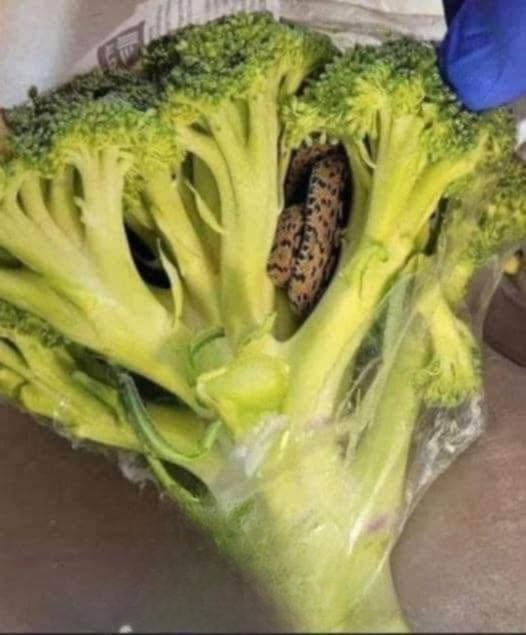
When he later removed the broccoli to prepare a meal, he noticed something nestled near the stem. At first, the object did not immediately appear to be a snake. Once it moved, however, the situation became clear.
A live reptile had apparently remained inside the packaged broccoli.
The incident understandably surprised Linton, who said he was particularly uncomfortable around snakes. It also raised questions about how a wild animal could have passed through harvesting, packaging, transportation, and retail processes without being detected.
The snake was eventually identified as a ladder snake and transferred to Dudley Zoo. Aldi apologized to the customer and said it was investigating what it described as an isolated incident.
The story attracted international attention because it combined an everyday grocery purchase with an outcome few shoppers could reasonably anticipate. However, the event should be described accurately rather than exaggerated into a mysterious “culinary adventure.”
It was a rare food-packaging incident that ended without a reported injury.
The Discovery in the Refrigerator
According to reporting from Sky News, Linton bought the broccoli at an Aldi branch in Stourbridge and stored it in his refrigerator.
When he was ready to prepare the vegetable, he saw the snake tucked close to the broccoli’s stem.
The discovery was especially distressing for him because he had a strong fear of snakes. He was also concerned about other people living in his household, including family members he described as vulnerable.
A reptile loose inside a home can create uncertainty, even when it belongs to a species that is not considered venomous. At the time of discovery, an average shopper would not be expected to identify the species or determine whether handling it would be safe.
Linton received help securing the package and returned it to the store. The animal was later transferred to professionals at Dudley Zoo, where it could be handled appropriately.
No bite or physical injury was reported.
What Is a Ladder Snake?
The animal was reportedly identified as a ladder snake, scientifically known as Zamenis scalaris.
The species is native to southwestern Europe, including areas of Spain, Portugal, and southern France. Younger ladder snakes often display markings along their backs that resemble the horizontal and vertical lines of a ladder, which is how the species received its common name.
As the snake matures, those markings may change into two darker lines running along the length of its body.
Ladder snakes are not considered venomous. However, a nonvenomous snake can still defend itself by biting if it feels trapped, threatened, or handled.
The fact that the animal was identified as nonvenomous afterward does not mean Linton should have attempted to touch it. Until an expert identifies an unfamiliar animal, the safest assumption is that it should be left alone.
The snake’s exact journey into the broccoli package was not publicly established. Because ladder snakes live in agricultural regions of southwestern Europe, one possibility is that the young reptile entered or remained near the vegetable during harvesting or packing.
That remains an explanation rather than a confirmed account. Without the results of the supplier’s investigation, articles should not claim to know precisely where or when the snake entered the package.
Aldi’s Response
Aldi acknowledged the customer’s complaint and apologized.
A company representative told Sky News that the supplier had not previously received a complaint of that nature and had established procedures designed to prevent such incidents. Aldi said it was investigating and recognized that its usual standards had not been met.
Linton was reportedly offered compensation but believed the amount did not fully reflect the distress and potential household risk created by the incident.
Consumer compensation is separate from a food-safety investigation. A retailer may address refunds or goodwill payments directly, while environmental-health officials examine whether the incident represents a wider safety concern.
The presence of one highly unusual item does not automatically prove that an entire product line is unsafe. At the same time, a complaint involving a live animal deserves careful review so the retailer and supplier can examine every stage of handling and identify possible weaknesses.
How Could an Animal Reach Packaged Produce?
Fresh vegetables begin their journey outdoors, where they share an environment with insects, birds, reptiles, and other wildlife.
Broccoli grows close to the ground and contains tightly clustered florets with many small spaces. Those spaces may provide temporary cover for insects or small animals in the field.
Commercial produce usually passes through several stages before reaching a store:
- Harvesting
- Initial inspection
- Trimming and sorting
- Cleaning or preparation
- Packaging
- Refrigerated storage
- Transportation
- Retail display
Quality-control systems are designed to identify contamination, damage, insects, and unwanted material. However, no process is completely incapable of error.
A small animal hidden deep within a vegetable could potentially be difficult to detect, especially if cold conditions reduced its activity. That does not establish what happened in this particular case, but it illustrates why agricultural products may occasionally contain unexpected natural material.
The rarity of such stories is also important. Millions of packages of vegetables are processed and sold without a comparable discovery. When an unusual case occurs, it attracts attention precisely because it is not an ordinary experience.
What Should You Do If You Find a Live Animal in Food?
Discovering a live animal inside packaged food can be alarming. The safest response is to remain calm and avoid direct contact.
If the animal is still contained:
- Do not open the package further
- Keep children and pets away
- Do not shake, squeeze, or place your face near the packaging
- Move away from the immediate area if the animal could escape
- Contact local animal control, wildlife rescue, or emergency services for advice
- Follow the instructions of trained professionals
If the package can be isolated without touching or approaching the animal, close the room and prevent others from entering. Do not attempt to capture a snake with household tools.
Advice will vary depending on the country and type of animal. A local wildlife organization or emergency dispatcher can direct the caller to the appropriate service.
Personal safety is more important than preserving the item as evidence. Do not risk being bitten simply to obtain a photograph, return a product, or save the packaging.
What to Do After the Immediate Risk Is Controlled
Once professionals have safely removed or secured the animal, contact the retailer and provide the relevant product details.
Useful information may include:
- The name and address of the store
- The date and approximate time of purchase
- The product name
- The use-by or best-before date
- The batch or lot number
- Photographs taken from a safe distance
- The receipt or other proof of purchase
- A description of how the product was stored
- The date and time the issue was discovered
Keep the packaging if authorities say it is safe to do so. Product codes may help a retailer or supplier trace the item through the distribution system.
In the United Kingdom, consumers can report foreign objects or potentially unsafe food through their local council’s food-safety team. The UK government’s food-safety service directs consumers to the correct local authority.
Local guidance generally recommends retaining the receipt, packaging, and affected product when this can be done safely. A live animal is different from an ordinary foreign object, so wildlife professionals should manage the immediate situation first.
If a Snake Bites Someone
Any suspected snake bite should be treated as a medical emergency, even if the snake is believed to be nonvenomous.
A person may identify the species incorrectly, and bites can cause pain, tissue injury, infection, or allergic reactions.
The NHS advises calling emergency services or going immediately to an emergency department after a suspected snake bite. The person should not drive themselves.
While waiting for help:
- Remain as calm and still as possible
- Keep the bitten area still
- Remove watches, rings, or tight clothing near the bite
- Follow instructions from emergency professionals
- Do not cut the wound
- Do not attempt to suck out venom
- Do not apply an improvised tourniquet
- Do not try to capture the snake
If it can be done from a safe distance, a photograph may help experts identify the animal. No one should approach the snake solely to take a picture.
Should Consumers Inspect Fresh Produce?
It is sensible to look at fresh produce before preparing it, but shoppers should not become unnecessarily fearful.
Check vegetables for:
- Mold or decay
- Unusual odor
- Damaged packaging
- Excessive moisture
- Insects or unexpected material
- Signs that the package seal is broken
- A use-by date that has passed
Wash fresh produce under clean running water unless the label provides different preparation instructions. Follow storage and cooking guidance printed on the packaging.
If a live animal is visible, do not consume the product or attempt to wash it away. Isolate the area and seek professional assistance.
Inspecting food is a practical habit, but it cannot guarantee that every possible issue will be identified. Retailers, growers, packers, regulators, and consumers all have different roles in maintaining food safety.
Why Responsible Reporting Matters
An event involving a live snake inside a food package naturally attracts attention. However, headlines can easily become more dramatic than the known facts.
The incident does not prove that Aldi broccoli was generally unsafe. It also does not show that snakes are commonly found in packaged vegetables.
Aldi described the case as isolated and said its supplier had not received a similar complaint. The company investigated and apologized to the customer.
It is equally important not to dismiss Linton’s concern simply because the ladder snake was later identified as nonvenomous. He did not know the species when he discovered it, and attempting to handle an unfamiliar snake could have caused injury.
A balanced report can acknowledge both points: the discovery was genuinely concerning for the household, but it was also an exceptionally rare occurrence rather than evidence of a widespread problem.
An Ordinary Purchase With an Unusual Outcome
Neville Linton expected to prepare a serving of broccoli. Instead, he found a live ladder snake hidden near the vegetable’s stem after the package had spent several days in his refrigerator.
With help, the animal was secured and ultimately transferred to Dudley Zoo. No injury was reported. Aldi apologized and began investigating how the snake could have reached the store.
The incident serves as a reminder that fresh produce originates in a natural environment and passes through a complex supply chain before arriving in a kitchen.
It also offers a practical safety lesson. If a live or potentially dangerous animal is discovered in food, avoid direct contact, keep other people and pets away, and contact trained professionals.
The story was certainly surprising, but it does not need exaggerated claims to be interesting. Its verified facts—a routine grocery trip, an unexpected reptile, a safe response, and an investigation—are unusual enough on their own.