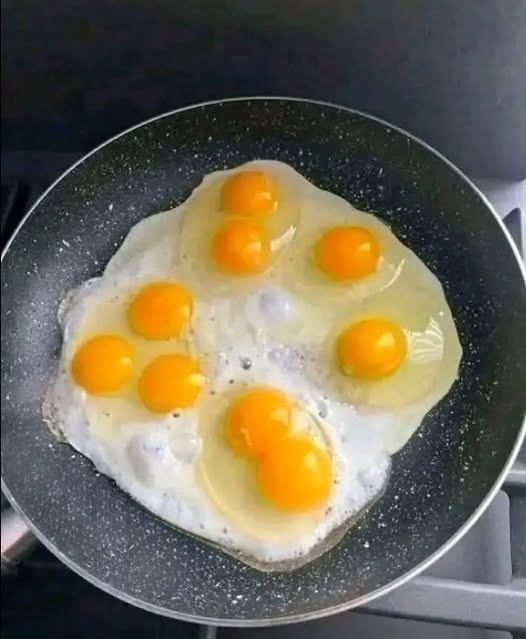
Counting eggs sounds like one of the easiest challenges imaginable. If the eggs are arranged in a straight row, almost anyone can look at them and identify the correct total within seconds.
But what happens when the eggs are stacked in several layers?
That is where this entertaining visual puzzle becomes more difficult than it initially appears. Some eggs can be seen clearly, while others are partially covered by the layers above them. A person who counts only what is immediately visible may finish quickly, but the result may not be correct.
Before reading the explanation, take a careful look at the arrangement.
Imagine a square pyramid of eggs made from four separate layers. The bottom layer measures four eggs across and four eggs deep. Above it is a smaller layer measuring three eggs by three eggs. The third layer measures two eggs by two eggs, and one final egg sits at the top.
How many eggs are in the complete pyramid?
Do not rush to answer. The challenge is not simply identifying the eggs that can be seen from the front. You must account for every egg needed to support the structure, including those that may be partly or completely hidden.
Why This Puzzle Can Be Deceptive
The human brain is excellent at recognizing familiar objects quickly. When we see a group of eggs, we do not usually inspect every object one by one. Instead, the brain attempts to understand the overall pattern and estimate the total.
That mental shortcut is useful in everyday life. It helps us process crowded scenes, recognize objects at a distance, and make decisions without analyzing every small detail.
However, the same shortcut can cause mistakes in visual puzzles.
When several objects overlap, people tend to focus on the ones they can see most clearly. Objects positioned behind or below others may receive less attention, even when the structure could not exist without them.
In this egg pyramid, the top egg is obvious. The eggs around the outside are also easy to identify. The hidden eggs near the middle of the lower layers are the ones most likely to be forgotten.
Some people may count only the visible eggs and report an answer in the teens. Others may recognize that more eggs are hidden but attempt to estimate the total rather than calculating it systematically.
The most reliable method is to stop treating the pyramid as one complicated image. Instead, separate it into simple layers.
Counting the Bottom Layer
The bottom layer measures four eggs across and four eggs deep.
To calculate the total number of eggs in a square layer, multiply the number of eggs in each row by the number of rows:
4 × 4 = 16
Therefore, the bottom layer contains 16 eggs.
This is where many incorrect answers begin. From a front or angled view, all 16 eggs may not be visible. Some could be covered by the upper layers, while others may sit behind the eggs closest to the viewer.
Nevertheless, a complete four-by-four square requires 16 eggs. There are four rows, and each row contains four eggs.
Writing the rows separately can make the calculation even clearer:
- First row: 4 eggs
- Second row: 4 eggs
- Third row: 4 eggs
- Fourth row: 4 eggs
Adding them gives:
4 + 4 + 4 + 4 = 16
Once the base is counted correctly, move to the next level.
Counting the Second Layer
The second layer is slightly smaller. It measures three eggs across and three eggs deep.
The calculation is:
3 × 3 = 9
This layer therefore contains nine eggs.
Once again, not every egg may be fully visible. The egg in the center of the layer could be almost completely covered by the eggs positioned around it and above it.
That hidden center egg is one of the most common reasons people arrive at an incorrect answer. They count the eight eggs around the outside but forget that a three-by-three square also includes one in the center.
The rows are:
- First row: 3 eggs
- Second row: 3 eggs
- Third row: 3 eggs
Together, those rows contain nine eggs.
At this point, the first two layers contain:
16 + 9 = 25 eggs
But the pyramid is not finished yet.
Counting the Third Layer
The third layer measures two eggs across and two eggs deep.
The calculation is:
2 × 2 = 4
Because the layer is small, it is usually easier to visualize. It consists of two rows containing two eggs each.
2 + 2 = 4
Adding this layer to the previous total gives:
25 + 4 = 29 eggs
Only the top of the pyramid remains.
Counting the Final Egg
The highest layer contains one egg.
Adding it to the total gives:
29 + 1 = 30
The correct answer for this four-layer square egg pyramid is therefore:
30 Eggs
The complete calculation is:
16 + 9 + 4 + 1 = 30
This can also be written as:
4² + 3² + 2² + 1² = 30
Each square represents one level of the pyramid.
Why People Get Different Answers
Visual counting challenges frequently produce a wide range of answers. That does not necessarily mean people lack basic mathematics. More often, they are interpreting the image in different ways.
One person may count only the eggs that are fully visible. Another may include partially hidden eggs but overlook the centers of the larger layers. Someone else may accidentally count the same egg twice when moving from one side of the image to another.
A person might also assume that the pyramid is hollow. If the arrangement were only an outer shell, the total would be different. However, the version described here is a complete, solid stack in which each level forms a filled square.
That is why a good puzzle should clearly explain its assumptions. Without knowing whether the structure is solid or hollow, two careful viewers could use different methods and arrive at different totals.
For this challenge, each layer is complete:
- A filled four-by-four base
- A filled three-by-three second layer
- A filled two-by-two third layer
- One egg at the top
Under those conditions, the answer is 30.
A Better Way to Approach Visual Puzzles
The egg challenge demonstrates a useful problem-solving strategy: divide a complicated image into manageable sections.
Instead of moving your eyes randomly around the picture, use a structured method.
First, identify the overall shape. Is it arranged in rows, columns, circles, clusters, or layers?
Second, count one section at a time. If the arrangement has levels, begin with the bottom and work upward. If it has rows, move consistently from left to right.
Third, write down each subtotal. Trying to remember several numbers while continuing to count makes accidental repetition more likely.
Fourth, check for partially hidden objects. Ask whether the visible structure requires additional objects for support.
Finally, repeat the calculation using a different method. In this puzzle, you can count the rows in each layer and then verify the answer by using square numbers.
When two independent methods produce the same total, the answer is more likely to be correct.
Speed Is Not the Same as Accuracy
The original version of a social-media puzzle may claim that only a genius can solve it. That description is entertaining, but it is not an accurate measure of intelligence.
Someone who answers quickly may have recognized the pattern immediately. Another person may take longer because they are carefully checking every layer. A third viewer may misunderstand the perspective of the illustration.
These differences do not determine who is intelligent.
Visual puzzles are best treated as enjoyable exercises in observation, pattern recognition, and logical thinking. The goal should be to examine the details and explain the reasoning—not to label people based on one answer.
In many situations, taking a few extra seconds produces a better result than responding immediately. The same principle applies outside puzzles. Whether someone is reviewing a document, calculating expenses, assembling furniture, or checking an important message, a systematic approach can prevent avoidable errors.
The Mathematics Behind the Pyramid
This puzzle introduces a simple mathematical pattern involving square numbers.
A square number is created when a whole number is multiplied by itself:
- 1 × 1 = 1
- 2 × 2 = 4
- 3 × 3 = 9
- 4 × 4 = 16
The egg pyramid uses all four of these squares. When they are added, the result is 30.
1 + 4 + 9 + 16 = 30
If the pyramid contained another bottom layer measuring five eggs by five eggs, that additional level would contain 25 eggs.
The new total would be:
25 + 16 + 9 + 4 + 1 = 55
This shows how quickly the total increases as the pyramid becomes larger. Adding one layer does not add only a few eggs. It adds an entire square.
The pattern can continue with six-by-six, seven-by-seven, and larger layers. What begins as a simple counting game can therefore become a useful introduction to sequences and three-dimensional reasoning.
Why These Challenges Are Enjoyable
Counting puzzles appeal to a wide audience because the instructions are simple. A person does not need specialized knowledge to begin. Children, adults, friends, relatives, and coworkers can all participate.
The discussion after the puzzle is often as enjoyable as the challenge itself. People compare methods, explain what they noticed, and discover why certain objects were overlooked.
These puzzles can also be useful educational activities. Teachers may use them to introduce multiplication, square numbers, spatial reasoning, and the importance of showing one’s work. Parents can encourage children to explain how they reached an answer rather than simply guessing.
The explanation matters because it reveals whether the solver understood the arrangement.
Final Answer
The pyramid contains four complete square layers:
- Bottom layer: 16 eggs
- Second layer: 9 eggs
- Third layer: 4 eggs
- Top layer: 1 egg
Adding them together gives:
16 + 9 + 4 + 1 = 30
Therefore, the correct answer is 30 eggs.
If your first answer was different, look at the structure again and identify which layer may have caused the confusion. You may have counted only the visible outside eggs or missed one positioned near the center.
The challenge is a good reminder that the most obvious answer is not always the correct one. Careful observation, an organized method, and a quick verification can turn a confusing image into a straightforward solution.