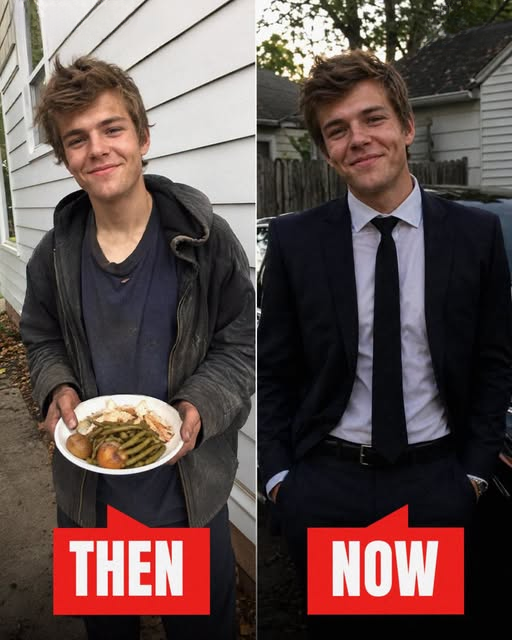
I was eight years old when Luke first appeared near the abandoned lot behind our house.
He looked much older to me then, but he could not have been more than eighteen. His clothes were worn, his hair was unwashed, and he carried everything he owned in a faded backpack. Someone in the neighborhood said he had been sleeping inside an old storage structure near the edge of the property.
I never learned exactly where he came from. When I asked my mother, she only said that Luke had lost his family and needed help.
My father had died only a few weeks earlier, so my mother and I were struggling ourselves. His death left us emotionally devastated and financially uncertain. Mom worked long hours at a local grocery store, carefully stretching every dollar to cover our mortgage, electricity, and food.
Some evenings, our dinner was nothing more than soup and bread. Mom often claimed she was not hungry so there would be enough for me, although I eventually understood that she was simply hiding how worried she was.
Despite our circumstances, she prepared a meal for Luke almost every day.
Sometimes she packed sandwiches in a paper bag. On colder evenings, she filled an old container with soup, stew, or pasta and carried it to the abandoned lot. She also gave him blankets, clean shirts that had belonged to my father, and whatever other supplies she could manage.
I did not understand her generosity.
From my perspective, Luke was a stranger receiving things that we could barely afford for ourselves. I was grieving my father and terrified that I might lose my mother too. Every moment she spent worrying about Luke felt like time and attention being taken from me.
One afternoon, I found Mom standing in the kitchen with an apple pie. It was my favorite dessert, and we had not enjoyed anything special since Dad’s funeral.
“Is that for dinner?” I asked eagerly.
Mom hesitated.
“It’s for Luke.”
The disappointment was more than my eight-year-old emotions could handle. I started crying.
“Why does he always get everything?” I demanded. “We don’t even have enough for ourselves!”
My mother’s expression changed immediately.
“Never speak about Luke that way again,” she said firmly.
Her tone shocked me. Mom rarely raised her voice, especially after Dad died.
“But you care about him more than me,” I replied.
“That isn’t true.”
“Then why are you giving him my favorite pie?”
She closed her eyes briefly, as though trying to control an emotion she could not explain.
“Because today is important to him,” she said. “One day, I hope you’ll understand.”
But she refused to tell me anything more.
From that moment, I resented Luke.
Whenever he tried to speak to me, I walked away. Once, he repaired the broken chain on my bicycle and left it beside our porch. I rode the bicycle without thanking him.
Another time, he brought me a small wooden bird he had carved from a scrap of wood. I placed it in a drawer and pretended I did not care about it.
Luke never became angry. He continued greeting me politely, even when I ignored him.
After about a year, he stopped sleeping near the abandoned lot. My mother said he had found work at an auto-repair shop and was renting a small room above someone’s garage.
I thought that meant he would disappear from our lives.
Instead, he began visiting Mom regularly. Sometimes he came for dinner. Other times, he repaired something around the house or drove her to the store. As the years passed, his clothes became cleaner and his posture more confident, but I continued to see him as the person who had taken food and attention from us when we were struggling.
By the time I entered high school, Luke had earned his high-school equivalency certificate and begun taking evening classes at a community college. Mom spoke about his accomplishments with pride.
I found that pride difficult to accept. My father was gone, yet Luke seemed to occupy a place in our family that no one had explained to me.
“Why are you so invested in him?” I asked Mom more than once.
“He needed someone,” she always answered.
“So did I.”
“You had me.”
Her answer only increased the distance between us.
As soon as I graduated from high school, I moved to another city for college. After completing my degree, I found a job and built a life several hours away.
Mom and I stayed in contact, but our relationship was never as close as it had been during my childhood. We spoke on the phone every few weeks and visited on holidays. Whenever she mentioned Luke, I changed the subject.
Nearly twenty years after he first appeared behind our house, I received a call from one of Mom’s neighbors.
My mother had suffered a serious stroke.
By the time I reached the hospital, she was extremely weak. She could barely move and struggled to form words. I sat beside her bed, holding her hand and apologizing for every call I had ended too quickly and every visit I had postponed.
Luke was not in the room.
That made me angrier than I wanted to admit. My mother had devoted years to helping him, yet he was absent when she needed support.
Mom opened her eyes and tried to speak. I leaned closer.
“Don’t abandon Luke,” she whispered. “Promise me.”
Even at the end, she was thinking about him.
A familiar resentment rose inside me, but I could not argue with my dying mother.
“I promise,” I said.
She passed away later that evening.
The days that followed were filled with arrangements, documents, telephone calls, and condolences. I planned the funeral almost entirely by myself. Luke did not call me, and I did not see him at the service, although many people attended and I may simply have overlooked him.
After the burial, I returned to my hotel feeling exhausted and confused. I kept hearing Mom’s final request.
Don’t abandon Luke.
The next evening, I prepared a container of food and drove to my childhood home. I felt foolish, but I had made a promise. I assumed Luke still lived somewhere nearby and that one of the neighbors could tell me how to find him.
When I turned onto our old street, I noticed a polished black SUV parked near the curb.
Beside it stood a tall, clean-shaven man wearing a dark coat. His hair was neatly trimmed, and he carried himself with quiet confidence.
For a moment, I thought he was a real-estate agent or one of the attorneys handling my mother’s estate.
Then he stepped closer.
“I thought you might not come,” he said.
I recognized his eyes before I recognized the rest of his face.
“Luke?”
He gave me an uncertain smile.
“I brought dinner,” I said, lifting the container awkwardly. “I promised Mom I wouldn’t abandon you, but I clearly misunderstood something. What happened? Where have you been?”
Luke looked at the container and then back at me. Tears filled his eyes.
“She knew you would come,” he said.
“I don’t understand.”
“There is something your mother never told you.”
He unlocked the front door with his own key and led me into the house. Everything looked almost exactly as Mom had left it. Her reading glasses were beside the chair, and a half-finished knitting project remained folded in a basket.
Luke placed a worn envelope on the kitchen table.
“Your mother asked me to keep this secret while she was alive,” he said. “She always hoped she would find the courage to tell you herself.”
My heart started pounding.
“What secret?”
Luke sat across from me and pushed the envelope in my direction.
Inside was an old letter written in my father’s handwriting. I recognized it immediately from the birthday cards and notes he had given me when I was little.
The letter was addressed to my mother.
“If you ever meet a young man named Luke,” it began, “please listen to him before you turn him away. Luke is my son.”
I stopped reading.
For several seconds, I could hear nothing except the refrigerator humming behind me.
“That isn’t possible,” I whispered.
Luke’s voice was gentle.
“I’m your half-brother.”
The letter explained that my father had been nineteen when Luke was born. It happened years before he met my mother. He and Luke’s mother separated soon afterward, and my father failed to accept the responsibilities of parenthood.
For years, he sent occasional money but remained largely absent. He never told my mother about Luke because he was ashamed.
Shortly before my father died, he learned that Luke’s mother had passed away and that Luke was struggling. Dad wrote the letter intending to explain everything to Mom, but he died before he could give it to her.
Mom found it among his belongings after the funeral.
Luke arrived in town several weeks later, searching for the father he barely knew. By then, Dad was already gone. Luke had no stable home, no savings, and nowhere else to go.
“That’s why she fed you,” I said.
Luke nodded.
“She said your father had failed both of us in different ways. Helping me was her way of making sure his failure didn’t become hers.”
“Why didn’t she bring you into the house?”
“She offered. I refused. You were eight years old and had just lost your dad. I could see how frightened and angry you were. I didn’t want to arrive and announce that I was his son too.”
I looked down at the letter.
“What about the apple pie?”
A sad smile appeared on Luke’s face.
“That day was my nineteenth birthday. It was the first birthday after my mother died. Your mom remembered.”
The memory returned with painful clarity. I saw myself crying in the kitchen, accusing my mother of caring more about a stranger than her own daughter.
“She could have told me,” I said.
“She wanted to protect the way you remembered your father. She thought you were too young to understand, and then the longer she waited, the harder it became.”
Luke explained what had happened after he left the abandoned lot. Mom had persuaded a local mechanic to give him an opportunity. Luke worked during the day and studied at night. Eventually, he became a certified mechanic and later opened a small repair shop.
The business grew slowly. He eventually owned three service centers and employed more than forty people. The black SUV belonged to his company.
“So you haven’t needed my mother to feed you for years,” I said.
“No. For a long time, I was the one bringing dinner to her.”
He had driven Mom to medical appointments, repaired the house, and helped with expenses when she retired. He had been at the hospital after her stroke, but Mom asked him to leave when she learned I was coming.
“She wanted time alone with you,” Luke said. “She also wanted to tell you the truth, but the stroke took away most of her speech.”
“Why weren’t you at the funeral?”
“I was there. I stood in the back. I didn’t know whether I had the right to stand with the family.”
His words affected me more deeply than I expected.
For most of my life, I had believed Luke had taken something from me. In reality, he had remained at a distance because he thought that was what I needed.
Mom’s final request had not been about making sure a helpless man received another meal. She had been asking me not to reject my brother after learning the truth.
“I treated you terribly,” I said.
“You were a grieving child.”
“I continued treating you badly after I grew up.”
Luke looked down at his hands.
“I never blamed you. You didn’t know.”
I opened the food container and placed it between us. The meal was still warm.
“I don’t know what happens next,” I admitted.
“Neither do I.”
“But we can eat dinner.”
Luke smiled.
“That sounds like a beginning.”
In the months that followed, we took our relationship slowly. There was no instant transformation and no attempt to pretend that the missing years did not matter.
We exchanged messages, shared photographs, and told each other stories about our lives. Luke showed me the wooden objects he had learned to carve while he was homeless. I admitted that I still had the little wooden bird he had made for me when I was a child.
Eventually, we visited our parents’ graves together. Luke placed flowers on his mother’s grave, and I stood beside him. Then we visited Mom and Dad.
I still had complicated feelings about my father. He had loved me, but he had failed Luke. Accepting one truth did not require denying the other.
My mother had made mistakes too. Her silence created years of misunderstanding. Yet I finally understood why she could not turn away an eighteen-year-old boy who had arrived hungry, grieving, and alone.
On the first anniversary of Mom’s death, Luke came to my home for dinner. For dessert, I baked an apple pie.
When I placed it on the table, he looked at me and immediately understood.
“This time,” I told him, “it’s for both of us.”
We ate the pie while sharing memories of the woman who had connected us long before I knew the truth.
My mother’s secret had separated us for years, but her compassion had also kept Luke alive long enough for us to find each other.
Her final request was not asking me to continue feeding a stranger.
She was asking me to welcome my brother home.