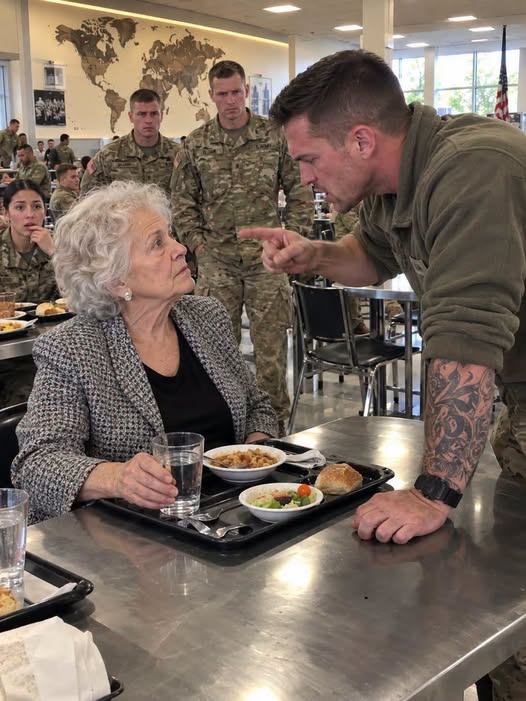
The Old Woman in the Army Dining Hall: The Sergeant Who Made a Terrible Mistake
I was eighty-one years old when a young Army sergeant decided that I did not belong in his dining hall.
I was sitting alone, enjoying a bowl of chili, when he approached my table with two other soldiers following closely behind him. He was tall, broad-shouldered, and carried himself with the confidence of someone who had rarely been questioned.
He looked at my gray hair, my modest coat, and my walking shoes before giving a short, dismissive laugh.
“Hey, Grandma,” he said loudly. “What was your rank back in the Stone Age?”
His two companions laughed.
I continued eating.
The dining hall was crowded with soldiers finishing their lunch. Conversations filled the room, trays clattered against tables, and the smell of freshly prepared food lingered in the air. But as the sergeant continued speaking, the atmosphere gradually changed.
People began paying attention.
Some soldiers lowered their heads. Others glanced toward my table and quickly looked away. Nobody seemed particularly interested in becoming involved in a confrontation with a senior noncommissioned officer.
The sergeant leaned closer.
“Ma’am, I’m talking to you.”
I placed my spoon beside the bowl.
My name is Quinn Braddock. I am eighty-one years old, and I live alone in a small yellow house in Clarksville, Tennessee. The house has a narrow staircase, an old-fashioned kitchen, and a backyard where my late husband once spent countless weekends growing tomatoes.
I spent thirty-one years working as a school nurse.
Before that, however, my life had taken a very different direction.
There was a time when I wore a uniform every morning, answered to a commanding officer, and served alongside people whose courage I still remember.
That part of my life was more than half a century behind me.
Or at least, that was what most people assumed.
On that particular Thursday, I had driven approximately forty minutes to Fort Campbell, Kentucky. I was wearing my favorite gray coat, a simple white blouse, and the black shoes I usually reserved for church.
I had been invited to attend a small veterans’ appreciation gathering later that afternoon. Before the event, I decided to stop at the dining facility for lunch.
I had visited the installation many times over the years, and I had followed the proper visitor procedures. My identification and visitor pass were safely tucked inside my handbag.
There was nothing unusual about my presence.
Yet the young sergeant standing beside my table seemed determined to make it a problem.
“This is a military installation,” he said. “You need permission to be here. You can’t just walk into a dining hall whenever you feel like it.”
I looked at him calmly.
“I understand that, Sergeant.”
He seemed surprised that I had answered him.
“Then perhaps you can explain what you’re doing here.”
“I’m having lunch.”
One of his companions laughed again.
The sergeant did not.
“Do you have a pass?”
“Yes.”
“Then show it to me.”
I took another small sip of water.
His expression tightened.
“Ma’am, I’m trying to be respectful, but you’re making this difficult.”
I almost smiled.
Respectful.
It was an interesting word coming from someone who had begun the conversation by comparing an elderly woman to someone who belonged in the Stone Age.
I had encountered difficult people throughout my life. Some were frightened, some were angry, and some simply believed that wearing a uniform gave them permission to treat everyone else as inferior.
Age had taught me that arguing with such people rarely changed anything.
So I remained seated.
The sergeant moved his tray onto the neighboring table and placed both hands against its surface.
He had a large eagle tattoo on his forearm.
“Look at me when I’m speaking to you,” he said. “We have standards here. We don’t allow unauthorized visitors to wander around the installation.”
A young female soldier sitting nearby looked up from her lunch.
She appeared to be in her early twenties. Her name tape was partially hidden by her jacket, but I could see that she was watching the conversation carefully.
She opened her mouth as though she wanted to say something.
Then she noticed the sergeant’s rank insignia and hesitated.
I understood her hesitation.
Military life teaches people to respect the chain of command. It also teaches them that challenging someone above you can have consequences.
But respect and fear are not the same thing.
I turned toward the sergeant.
He was probably twenty-seven or twenty-eight years old. He had a strong build, a confident expression, and the unmistakable appearance of someone accustomed to giving orders.
His name tape read REESE.
Staff Sergeant Reese.
I glanced at the unit patch on his shoulder.
It was a blue shield bearing a white bird.
I had seen that symbol many times before.
In fact, I knew it better than he could possibly imagine.
I looked down at my coat.
Pinned near the collar was a small brass insignia. The metal had darkened over the