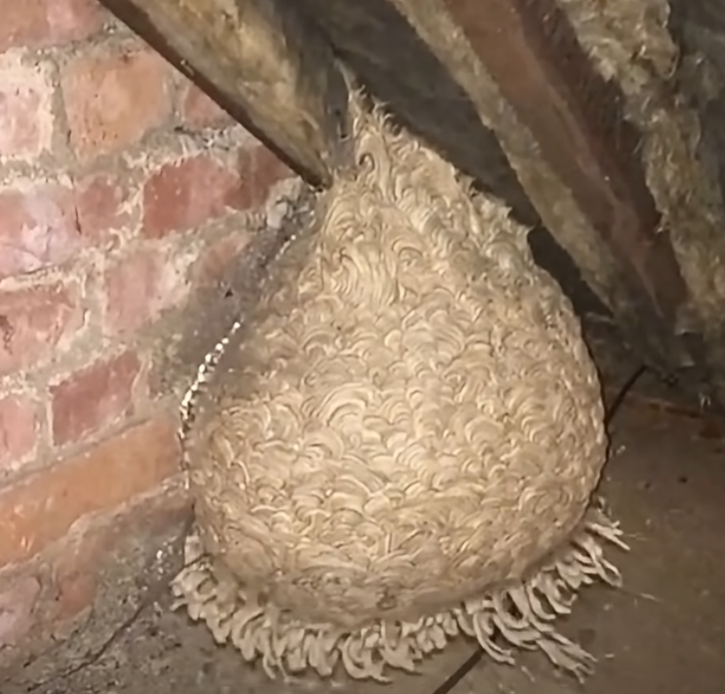
An Unusual Discovery Inside a Home
Attics are among the most overlooked areas of a house. Often used for storage, they can remain undisturbed for months or even years. During that time, insects and other small animals may find opportunities to enter through gaps in roofing, ventilation openings, or damaged sections of the building.
For homeowners, discovering a large nest in an attic can be surprising. From a distance, a structure made from paper-like material may resemble a hornet or wasp nest. However, not every unusual shape or collection of material found in a roof space has the same origin.
Correctly identifying a nest is important because different insects have different behaviors, and the safest response depends on the species, the location, and the size of the colony.
An unexpected discovery in an attic can therefore become an opportunity to learn more about local wildlife, household maintenance, and the precautions needed when dealing with potentially stinging insects.
Rather than approaching an unfamiliar nest out of curiosity, homeowners should prioritize safety and seek professional assistance when necessary.
Why Do Wasps and Hornets Build Nests in Attics?
Wasps and hornets may establish nests in sheltered locations where they can find protection from rain, wind, and certain predators.
Depending on the species, suitable locations may include roof spaces, wall cavities, sheds, garages, and other enclosed or partially enclosed areas.
Attics can be attractive because they often provide stable shelter and have relatively little human activity, particularly during the early stages of nest construction.
Some species build exposed nests that can be seen hanging from beams or roof structures. Others establish colonies inside cavities, making their presence less obvious until insect activity increases.
The nest itself may be constructed from a paper-like material produced when certain wasps chew wood fibers and mix them with saliva. The resulting material can form layers or cells that provide space for developing offspring.
Different species construct nests in different ways, so appearance alone may not be enough to identify the insect responsible.
A nest that looks unusually large may also have developed gradually over time. In many species, colony activity changes with the seasons, and a nest can become more noticeable as the colony grows.
Understanding these patterns can help homeowners recognize why regular property inspections are useful, especially in areas where stinging insects are common.
How Can You Tell Whether a Nest Belongs to Wasps or Hornets?
Identifying an insect nest from a photograph or a quick glance can be difficult. Several species have similar nesting habits, and their appearance may vary according to the location and stage of development.
Paper wasps, yellowjackets, and hornets are examples of insects that may create nests in or around buildings. However, they do not all use the same nesting sites or display identical behavior.
Some nests have visible layers of papery material, while others are concealed inside wall spaces or beneath roofing. Certain species build open structures with visible cells, whereas others create enclosed nests with an outer covering.
The insects entering and leaving the nest may provide useful identification clues, but homeowners should not approach closely to examine them.
Color alone is not a reliable method of identification. Lighting, distance, and individual variation can affect how an insect appears.
If a nest is located in a difficult-to-reach area, a qualified pest management professional can assess it and determine what type of insect may be involved.
Correct identification is important because not every insect nest requires the same treatment. Some solitary insects pose relatively little risk, while a mature social colony may defend its nest if disturbed.
The best approach is to avoid disturbing the structure until its identity and the appropriate response have been established.
Why an Attic Nest Should Not Be Disturbed
A nest hidden in a roof space may seem harmless when no insects are visible. However, insects may be active inside the structure even when movement is difficult to observe.
Disturbing a nest can cause defensive behavior in certain social species. This may happen when someone strikes the structure, attempts to remove it, or accidentally blocks the insects’ usual entrance.
Attics can make the situation more difficult because they often have narrow walkways, limited visibility, exposed beams, and restricted exit routes.
A person who encounters a nest unexpectedly may also be startled and lose their footing while trying to move away.
For these reasons, attempting to knock down, crush, burn, or otherwise remove an unfamiliar nest is not advisable.
Household sprays and improvised treatments may also be unsuitable, particularly when the nest is inside a wall cavity or close to electrical equipment.
A professional can evaluate the location, identify the likely species, and select an appropriate method that takes the building and its occupants into account.
If insects are entering a living space, residents should keep away from the affected area and seek qualified assistance rather than attempting to seal an active entrance without advice.
What Should Homeowners Do After Finding a Nest?
The appropriate response depends on the nest’s location, the level of insect activity, and whether people in the household are at risk.
The first step is to avoid touching or disturbing the nest. Homeowners should keep children and pets away from the affected area and avoid unnecessary movement around the insects’ entrance.
If the nest is inside an attic, it may be sensible to restrict access to that part of the building until the situation has been assessed.
A homeowner should not climb unstable ladders or move stored items around a suspected nest in an attempt to obtain a better look.
If insects are entering bedrooms, hallways, or other occupied areas, professional assistance may be particularly important because the risk of an unexpected encounter is greater.
A qualified pest management provider can examine the situation and explain the available options.
Where a person has a known severe allergy to insect stings, additional caution is warranted. Anyone experiencing signs of a serious allergic reaction after a sting, such as difficulty breathing, swelling of the tongue or throat, or collapse, should seek emergency medical assistance immediately.
It is also important to avoid assuming that every flying insect near a building is aggressive. Many insects play valuable roles in the environment, and accurate identification helps determine the appropriate response.
The Difference Between Removing a Nest and Preventing Future Problems
Dealing with an existing nest is only one part of maintaining a home. Preventing future nesting opportunities can also help reduce the likelihood of similar discoveries.
Regular inspections of roofs, attic spaces, soffits, vents, and other accessible building features may reveal gaps that allow insects to enter.
Damaged screens and broken ventilation covers can sometimes provide access points. Repairing these problems, where appropriate, helps maintain the building and may reduce opportunities for unwanted pests.
However, repairs should be carried out only when it is safe to do so. If insects are actively entering a gap, sealing the opening without professional guidance could create additional problems, including directing insects into occupied areas.
Homeowners should also avoid blocking ventilation systems or making changes that interfere with the building’s normal airflow.
Keeping storage areas organized can make routine inspections easier. Items stored in attics should be arranged so that the roof structure and accessible corners can be checked without disturbing potentially hazardous areas.
These measures cannot guarantee that insects will never build a nest, but they can help homeowners notice potential problems earlier.
Why Some Insects Are Important to the Environment
Although stinging insects can create safety concerns around homes, many species play important ecological roles.
Some wasps help control populations of other insects by hunting them or using them as hosts for their developing offspring. Other species visit flowers and may contribute to pollination.
Their ecological importance varies by species, and not every wasp or hornet has the same role.
Understanding these differences helps explain why identification matters. A nest should not automatically be treated as evidence of a dangerous infestation simply because it belongs to an insect that can sting.
At the same time, the presence of an insect nest in a busy household area may require professional management to protect residents and visitors.
The goal is to respond appropriately to the actual situation rather than relying on fear or assumptions.
When nests are located away from people and do not create a safety concern, the best response may differ from the approach needed for a colony inside an occupied building.
Qualified professionals can help determine which option is appropriate under local conditions and regulations.
Why Unusual Home Discoveries Attract So Much Attention
Stories about unexpected discoveries in attics, basements, and other hidden areas often attract attention because they reveal parts of a home that people rarely see.
An ordinary maintenance inspection can uncover old belongings, damaged materials, signs of wildlife activity, or structures created by insects.
These discoveries may appear surprising, but many have straightforward explanations connected to the age of the building, its design, or the surrounding environment.
Online photographs and videos can make such discoveries appear more dramatic than they are. Camera angles, poor lighting, and a lack of scale can make a small structure look much larger or more unusual.
A photograph may also leave important questions unanswered, including when the image was taken, where the discovery occurred, and whether the structure has been correctly identified.
Readers should therefore be cautious about assuming that a dramatic caption accurately describes the underlying event.
When sharing a genuine home maintenance story, it is better to explain what has been confirmed and distinguish it from details that remain uncertain.
This approach makes the content more informative and helps readers learn practical lessons that apply to their own homes.
The Importance of Professional Pest Management
Professional pest management can be useful when a nest is large, concealed, difficult to access, or located near frequently used areas.
A trained provider can assess the risks, identify the likely species, and recommend an appropriate response.
The assessment may consider whether the nest is active, how the insects are entering the building, and whether other people or animals could be exposed.
The provider may also explain what precautions residents should take before any work begins.
Choosing a reputable service is important. Homeowners should look for providers who explain their approach clearly, follow applicable safety requirements, and use treatments appropriate to the situation.
People should be cautious about advice that recommends dangerous improvised methods, including setting fires, applying flammable substances, or attempting to reach inaccessible nests without suitable training and equipment.
These actions can create serious risks to people, property, and the surrounding environment.
A measured response based on proper identification is generally more useful than acting quickly on the assumption that every nest presents the same danger.
Final Thoughts: A Surprising Discovery Is a Reminder to Put Safety First
Finding an unfamiliar nest in an attic can be an unexpected experience, especially when the structure resembles a hornet or wasp nest. However, the most important step is not to guess what is inside or attempt an immediate removal.
Homeowners should keep a safe distance, prevent children and pets from approaching the area, and seek professional assistance when the nest may pose a risk.
Understanding insect behavior, maintaining the property, and recognizing the value of accurate identification can help people respond more effectively to these situations.
It is equally important to approach online stories with care. Without reliable evidence, a headline should not present an unusual discovery as a confirmed event or claim that a particular person experienced something that has not been established.
The most useful home and wildlife stories combine curiosity with practical information. They explain why an event might occur, what readers can learn from it, and how similar situations can be handled responsibly.
By prioritizing safety, reliable information, and respect for the environment, homeowners can better manage unexpected discoveries while protecting themselves, their families, and the wildlife around them.