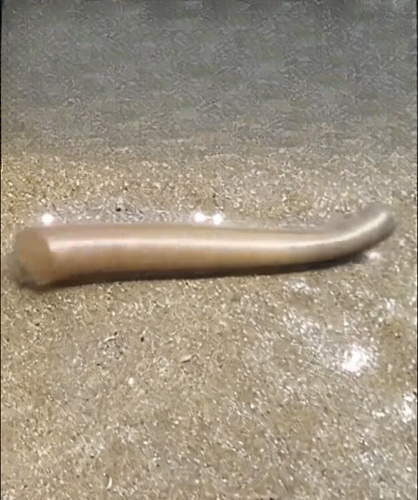
Trumpet Worm Nests: The Amazing Sand Sculptures That Reveal Nature’s Hidden Ingenuity
A Childhood Discovery That Can Stay With You for Years
Some childhood memories remain vivid long after the details of everyday life have faded. A strange object discovered along the beach, a peculiar shape hidden beneath a rock, or an unfamiliar structure scattered across wet sand can become the beginning of a lifelong fascination with nature.
For many people, the most memorable discoveries are not necessarily the largest or most dramatic. Sometimes, they are the smallest things that raise the biggest questions.
Imagine walking along a quiet shoreline as the tide retreats. The sand is damp, small pools of seawater glisten in the sunlight, and fragments of shells lie scattered across the beach. Then something unusual catches your eye: a tiny, cone-shaped structure made almost entirely of sand.
It resembles a miniature trumpet, an upside-down ice cream cone, or a delicate sculpture carefully assembled by hand. The surface looks surprisingly orderly, with individual grains fitted together to create a shape that seems far too precise to have formed by chance.
You pick it up and turn it over, wondering whether it is a piece of a shell, an unusual seed pod, or something left behind by another beach visitor.
But the explanation may be even more fascinating.
The object could be the protective tube of a marine worm commonly known as a trumpet worm or ice cream cone worm. These small marine animals create remarkably intricate structures from the very material surrounding them: sand.
What looks like a miniature work of art is actually a functional shelter built by a living animal.
This discovery opens the door to a larger story about marine life, animal behavior, natural engineering, and the many extraordinary things that can be found in seemingly ordinary places.
It also offers a reminder that nature does not need complicated machinery or human hands to produce structures with remarkable precision.
What Are Trumpet Worms?
Trumpet worms are marine segmented worms associated with sandy or muddy coastal environments. The common name can refer to worms that construct distinctive, tapered tubes, including species in the family Pectinariidae.
One well-known example is Pectinaria gouldii, sometimes called Gould’s trumpet worm or the ice cream cone worm.
These animals belong to a large group of marine invertebrates known as polychaetes. Polychaetes are segmented worms that occupy a wide range of marine habitats, from shallow coastal sediments to deeper ocean environments.
Unlike the earthworms commonly found in garden soil, trumpet worms live in marine sediment. They spend much of their time beneath the surface, where their protective tubes provide shelter while they move through their environment and obtain food.
The tubes can be remarkably delicate. In Pectinaria gouldii, the structure is built from carefully selected grains of sand, fitted together to form a slightly tapered cone.
The walls may be only a single grain of sand thick, giving the structure a surprisingly precise appearance despite its fragile construction. Descriptions of the species report tubes reaching approximately three inches in length, although size varies. <Cite refs={[“turn961290search0″,”turn961290search2”]}/>
The worm itself is generally much harder to notice than its tube.
That is one reason beachcombers sometimes find the structures without realizing that an animal created them. The worm may remain hidden beneath the sediment, while its abandoned tube can become exposed or washed onto the shore.
The result is a small natural object that looks almost manufactured.
Why Are They Called Trumpet Worm Nests?
The phrase “trumpet worm nest” is an informal way to describe the structures people associate with these animals. Scientifically, however, the objects are better described as tubes or protective cases rather than nests.
The distinction matters because the structure serves as an individual worm’s shelter, not necessarily as a place where a group of animals lays eggs or raises young.
The tube’s tapered shape gives it the appearance of a small trumpet or cone. Depending on the angle from which it is viewed, it might also resemble a miniature horn, a tiny sand castle, or an ice cream cone.
This unusual shape is one of the reasons the structures attract attention.
Their appearance also creates an interesting contrast. Sand usually seems loose and unstable, easily moved by wind, footsteps, or waves. Yet the worm transforms individual grains into a recognizable structure that can maintain its shape under suitable conditions.
The tube is not a solid object carved from a single piece of material. It is assembled from many separate grains.
That makes it a fascinating example of biological construction.
The worm does not need to collect sticks, leaves, or large pieces of vegetation. It works with material already present in its habitat, using a combination of selection, positioning, and natural binding material to build its shelter.
The result is not permanent like a rock or a manufactured object. It is a lightweight, fragile structure designed for the animal’s life beneath the sand.
Its appearance may be beautiful to a beachcomber, but its primary purpose is practical.
How Does a Worm Build a Tube From Sand?
The construction process is one of the most remarkable aspects of the trumpet worm’s biology.
Sand consists of individual mineral grains that do not ordinarily hold together in a stable cone. If someone tried to build a thin-walled tube from dry sand without adding a binding material, the structure would collapse.
Trumpet worms overcome this problem through specialized behavior and natural secretions.
The animal selects grains of a suitable size and uses mucus-like material to help bind them together. By positioning the grains carefully, it creates a protective tube around its body.
In Pectinaria gouldii, the sand grains are fitted into a narrow, slightly conical structure. The tube’s walls can be extremely thin, making the construction both delicate and efficient. <Cite refs={[“turn961290search0″,”turn961290search4”]}/>
The process illustrates an important principle in nature: useful structures do not always require large amounts of material.
Instead, the way material is selected and arranged can be just as important as the material itself.
A tube made from loosely scattered sand would not provide the same protection. By assembling grains into a fitted structure, the worm creates a more stable shelter suited to its environment.
The construction also demonstrates how animal behavior can produce complex results without conscious planning in the human sense.
The worm is not sitting on the beach deciding to create a sculpture for someone to discover. Its behavior is part of its biological adaptation to living in sediment.
The tube helps it survive, and the repeated actions that produce the tube have developed through evolution.
For the worm, it is a home. For a curious observer, it is a lesson in natural engineering.
Why the Sand Grains Fit Together So Precisely
One of the most striking details is the way the grains appear to fit together.
A close look at a trumpet worm tube may reveal a surface made of many tiny particles, arranged so neatly that the structure resembles a miniature piece of masonry.
The grains are not identical. Natural sand contains particles that differ in size, shape, and composition. Yet the worm’s selection and placement of suitable grains can produce a surprisingly uniform tube.
The structure is shaped by the animal’s behavior and by the physical properties of the available sediment.
This does not mean that every grain fits perfectly or that every tube has the same appearance. Natural variation is normal. The finished structure depends on the environment, the sediment available, and the animal’s size.
Still, the result is impressive because it turns a collection of loose particles into something with a recognizable form.
The process offers a useful comparison with human construction. Builders choose materials, consider how pieces fit together, and arrange them to produce a structure that performs a particular function.
Trumpet worms also use available materials to create a structure suited to their needs, although their methods are biological rather than technological.
Their tubes are not equivalent to human buildings in complexity or purpose, but the comparison helps illustrate why these small animals attract scientific interest.
They demonstrate how physical structures can emerge from simple repeated actions operating within a set of biological constraints.
The result is a shelter that is both practical and visually striking.
What Purpose Does the Tube Serve?
For a small marine worm living in sand, a protective shelter can make an important difference.
The sediment is a dynamic environment. Waves and currents can move particles, water levels rise and fall, and other organisms may disturb the surrounding ground.
A tube provides a more organized space in which the worm can live.
The structure is associated with the animal’s burrowing lifestyle and helps it maintain a protected position within the sediment. The tube’s orientation and shape are adapted to how the worm occupies the sand.
For Pectinaria gouldii, the tube is described as open at both ends, with the wider end directed downward and the narrower end extending toward the sediment surface. The worm occupies the tube with its head toward the wider end. <Cite refs={[“turn961290search0″,”turn961290search2”]}/>
This arrangement may seem counterintuitive to someone encountering the tube for the first time. Why build a cone with a wide end below and a narrow end above?
The answer lies in the worm’s particular body structure and way of life. The tube is not designed to resemble a human shelter. It is adapted to the movement and feeding behavior of a small animal living within marine sediment.
Its shape should therefore be understood in relation to the worm, not simply by how it looks when held in a person’s hand.
The tube also has limitations.
It is fragile and can be damaged by handling, shifting sediment, or strong water movement. A tube found lying on a beach may no longer be occupied by a living worm.
The structure’s survival after exposure depends on its condition and the forces acting on it.
A tube that looks beautifully intact in a photograph may be surprisingly easy to break when handled.
What Do Trumpet Worms Eat?
The tube is only one part of the animal’s story. Like all living organisms, trumpet worms need a source of energy and nutrients.
Many worms that inhabit marine sediment feed on organic material associated with the seafloor. Depending on the species, this may include decomposing material and small organic particles mixed with the sand.
Pectinaria gouldii is described as a deposit feeder. Deposit feeders obtain food from sediment rather than relying exclusively on capturing large prey.
The sand around the worm may contain tiny fragments of decomposing plant and animal material, microorganisms, and other organic particles. The worm uses specialized structures around its head to handle sediment and obtain food.
This feeding strategy connects the animal to the wider ecosystem.
Organic material continually reaches the seafloor from the surrounding environment. Some comes from dead organisms, while other material consists of fragments produced as plants and animals grow, feed, and break down.
Sediment-dwelling organisms process portions of this material, contributing to the movement of nutrients through coastal ecosystems.
The process is not necessarily dramatic or visible to someone standing on the beach, but it forms part of the natural activity that supports life in marine habitats.
Trumpet worms are one example of the many small animals that occupy this hidden world.
Their tubes may attract human attention, but their role as living organisms extends beyond the structures they create.
How Do Trumpet Worms Fit Into the Marine Ecosystem?
Coastal environments are full of relationships that are easy to overlook.
Sand flats, mudflats, shallow bays, and tidal zones support worms, mollusks, crustaceans, small fish, microorganisms, and many other organisms.
Each species occupies a particular ecological role. Some feed on algae, some consume organic material, and others hunt or scavenge. Many become food for larger animals.
Sediment-dwelling worms contribute to these interconnected systems through their feeding behavior and their presence as part of the food web.
By processing organic material, deposit feeders help move nutrients through the sediment. Their bodies can also provide food for predators that forage in shallow coastal areas.
The tubes themselves may influence the immediate environment by creating small structures within the sediment, although the effects depend on the species and habitat.
It is important not to overstate their ecological importance. A single trumpet worm tube does not transform an entire beach. Its significance lies in being one part of a much larger network of organisms and physical processes.
Understanding these relationships helps explain why seemingly insignificant animals deserve attention.
A beach may look empty when the tide retreats, but beneath the surface there can be a complex community of organisms carrying out feeding, burrowing, and reproductive activities.
The visible landscape is only part of the story.
Why Do People Find These Structures on the Beach?
Many beach discoveries are made possible by the movement of water.
Trumpet worms live in marine sediment, but their tubes may become exposed when the sand shifts. Waves and currents can disturb the seabed, and changing tides can reveal areas that were previously underwater.
A tube may also become separated from its original position or left unoccupied after the animal is no longer inside it.
When this happens, the structure can be found lying on the sand like a tiny handmade object.
The exact circumstances vary. Some tubes are found in shallow sediment, while others may be encountered after they have been disturbed or washed toward shore.
A recent beachcombing report from the Texas coast described finding small, cone-shaped tubes associated with ice cream cone worms along the shoreline. The report emphasized the careful arrangement of sand grains and the delicate construction of the structures. <Cite refs={[“turn961290search4”]}/>
These finds are especially interesting because the observer sees the result of the animal’s behavior without necessarily seeing the animal itself.
It is similar to discovering a shell, a feather, or a trail left in the sand. The object offers evidence of an organism that may be hidden, absent, or difficult to observe directly.
However, an unfamiliar sandy tube should not automatically be identified as a trumpet worm structure.
Different marine worms create different kinds of tubes. Some produce flexible, parchment-like cases, while others build tubes from sand, shell fragments, mucus, or mineral material. Certain species construct tubes attached to rocks or other hard surfaces.
A reliable identification depends on the object’s shape, material, location, and other details.
Are All Worm Tubes the Same?
Not at all.
Marine worms have evolved several ways to protect their soft bodies, and their tubes can look dramatically different.
Some build structures from sand grains. Others use mucus to hold sediment together. Some produce flexible tubes that resemble wet paper, while others create hard, mineralized structures attached to rocks, shells, or other surfaces.
For example, parchment tube worms produce flexible tubes that can sometimes wash ashore after storms disturb the seabed. The tubes may resemble scraps of wet paper, making them easy to mistake for human-made debris. The U.S. National Park Service describes these structures as protective tubes created by worms living in sand or mud near the low-tide line. <Cite refs={[“turn961290search3”]}/>
Other species build tubes from sand grains cemented together with natural secretions. Some of these worms live in colonies, and many tubes may grow close together.
Certain sand-tube-building worms can form large aggregations that create reef-like structures. In suitable coastal environments, these aggregations provide habitat for other marine organisms. <Cite refs={[“turn961290search26″,”turn961290search7”]}/>
These examples show that “worm tube” is a broad description rather than the name of one single structure.
A cone-shaped sand tube associated with a trumpet worm is different from a parchment-like tube or a colony of attached sand tubes.
Recognizing these differences is useful for anyone who enjoys beachcombing or marine natural history.
It also illustrates the remarkable variety of solutions that animals have developed for living in exposed and sometimes challenging environments.
What Can Children Learn From Discovering a Trumpet Worm Tube?
A small discovery on the beach can become a memorable learning experience.
Children naturally ask questions when they encounter something unfamiliar. They may wonder who made it, whether it is alive, how it stays together, and why it has such an unusual shape.
Those questions create an opportunity to explore science through observation rather than memorization.
A trumpet worm tube can introduce several important ideas.
First, it shows that animals can create structures using materials from their surroundings. The sand is not simply something the worm lives in; it becomes part of the animal’s protective shelter.
Second, it demonstrates that an organism’s body and behavior are adapted to a particular environment. The tube’s shape makes more sense when c