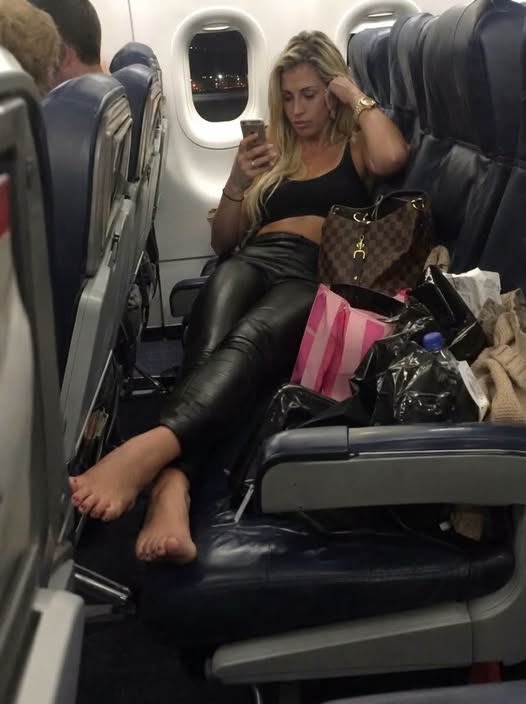
A Woman Refused to Give Up My Daughter’s Paid Seat—Then My 10-Year-Old Asked One Question That Silenced the Plane
My son, Noah, was only five weeks old, and I was about to face one of the most stressful experiences of my life: flying alone with a newborn and my ten-year-old daughter, Lily.
I had planned everything carefully.
I packed extra diapers, bottles, a change of clothes for both children, and enough supplies to get us through unexpected delays. Knowing how difficult traveling with two young children could be, I had also paid extra for two seats together with additional legroom—one for Lily by the window and one for me, where I could comfortably hold Noah.
I thought the extra expense would make the journey easier.
I never imagined that simply trying to sit in our assigned seats would become a confrontation that everyone on the plane would remember.
When we reached row 12, a woman was already occupying the window seat I had reserved for Lily.
Her coat and handbag were spread across the neighboring seat, leaving little room for anyone else. She had settled in as though the entire row belonged to her, with her headphones covering her ears and her attention fixed firmly on her phone.
I adjusted Noah against my chest and checked our boarding passes again.
We were in the right place.
“Excuse me,” I said politely. “I believe you’re sitting in our seats.”
The woman glanced at me, briefly looked at the sleeping baby in my arms, and then returned her attention to her phone.
“I’m already settled,” she replied.
For a moment, I thought she hadn’t understood what I was saying.
I showed her our boarding passes.
“I’m sorry, but these are the seats we paid for. My daughter is supposed to sit by the window.”
The woman sighed dramatically and removed one side of her headphones.
“Mothers with babies always expect everyone else to rearrange their lives,” she said. “You chose to travel with two children. That isn’t my problem.”
I stood there, trying to remain calm.
I hadn’t asked her to give up her own seat or move to another row. I was simply asking her to move from the seats assigned to us.
“I understand that flying can be uncomfortable,” I replied, “but these are our reserved seats.”
She rolled her eyes.
Meanwhile, passengers were continuing down the aisle behind us. Some were trying to lift their bags into the overhead compartments, while others waited for us to clear the way.
I could feel the pressure building.
Noah began moving in my arms, and I gently rocked him while trying to keep my voice steady.
Then a flight attendant arrived.
She checked our boarding passes, looked at the seat numbers, and examined the airline’s seating information on her device. Her expression changed as she reviewed the details.
It appeared that Lily’s seat had been assigned twice.
The flight attendant explained that there was another available seat several rows farther back. She lowered her voice and asked whether we might be willing to move so the boarding process could continue.
I hesitated.
I had paid extra to sit beside my daughter, particularly because I was traveling with a newborn. Keeping Lily close would make it easier to care for both children without constantly turning around or trying to communicate across the cabin.
But the aisle was crowded, Noah was becoming restless, and everyone seemed to be waiting for me to make a decision.
Before I could answer, the woman leaned back with a satisfied smile.
“Why should I move?” she asked. “She’s the one traveling with all that.”
She gestured toward Noah as though my baby were nothing more than an inconvenient piece of luggage.
I felt my cheeks grow warm.
I wanted to tell her exactly what I thought about her behavior, but I knew that arguing in the aisle wouldn’t help my children. I also didn’t want Lily to feel responsible for a scene she hadn’t created.
The flight attendant continued trying to resolve the seating issue, but the woman remained unwilling to cooperate.
Finally, I looked toward Lily.
She stood beside me, holding the straps of her small backpack. She was watching everything quietly, with an expression I couldn’t quite understand.
“It’s okay, Mom,” she said softly. “I’ll be fine.”
Those words hurt more than the woman’s insults.
Lily was only ten. She shouldn’t have had to reassure me because another adult had decided that our reserved seats didn’t matter.
I kissed her forehead.
“I’ll be just a few rows away,” I promised. “If you need anything, tell a flight attendant.”
The crew helped us arrange the alternative seating, and I reluctantly moved to row 15 with Noah.
From my new seat, I could still see Lily over the tops of the headrests. She sat quietly, placed her backpack near her feet, and looked out the window.
I tried to settle Noah, reminding myself that we were finally on our way.
The aircraft doors closed. The safety demonstration began, and the plane pushed back from the gate.
As the engines grew louder, I thought the uncomfortable incident was finally behind us.
I was wrong.
About ten minutes after takeoff, the seat belt sign switched off.
Passengers began talking again. Someone opened a magazine, a child asked for a snack, and the familiar noise of an airplane cabin returned.
Then I heard Lily’s voice.
It was clear enough to carry across several rows.
“Ma’am, my mom taught me never to embarrass people in public. That’s why I tried to tell you quietly.”
I immediately looked up.
The woman in row 12 turned around sharply.
“Then be quiet,” she snapped.
Lily didn’t shout back. She didn’t insult the woman or try to start an argument.
Instead, she unfastened her seat belt after the sign had gone off, took her backpack, and stood in the aisle while remaining near her seat.
My heart began pounding.
“Lily?” I called from my row.
She looked toward me briefly, reassuring me with a small glance before turning back to the woman.
Then she asked one simple question.
“Ma’am, before you get angry, could you please check what you’re sitting on?”
The woman’s expression changed.
For the first time since we had boarded, she looked down at the seat beneath her.
She shifted slightly, then reached toward the area partly covered by her coat.
A nearby passenger stopped reading. Another lowered her headphones. The conversation happening across the aisle faded away.
Even the flight attendant who had been walking through the cabin paused to see what was happening.
I leaned forward, trying to understand what Lily had noticed.
The woman lifted her coat.
Underneath it was something that clearly hadn’t belonged there when she boarded.
Her confident expression disappeared.
“What is that?” she asked.
Lily held her backpack against her side and answered calmly.
“That’s what I was trying to tell you before. I didn’t want you to get embarrassed in front of everyone.”
The cabin grew unusually quiet.
The woman looked from the object to Lily, then toward me.
For a moment, nobody seemed to know what to say.
I wanted to stand up and reach my daughter, but I also knew that the aisle was narrow and the plane was in flight. I stayed where I was and caught the flight attendant’s attention, trusting the crew to handle the situation safely.
The attendant approached the row and asked everyone to remain seated while she examined the situation.
The woman who had refused to move only minutes earlier was no longer smiling.
And Lily, my quiet ten-year-old daughter, simply waited for the adult to finish speaking.
She hadn’t raised her voice.
She hadn’t called anyone names.
She had done something much more effective: she had given the woman an opportunity to recognize the problem for herself.
As the flight attendant spoke with her, I realized that the moment wasn’t really about winning an argument over a seat.
It was about the way we treat people when we believe we have the upper hand.
The woman had assumed that because I was traveling alone with two children, I would be too exhausted or embarrassed to insist on what we had paid for. She had mistaken my patience for weakness and my daughter’s politeness for an invitation to ignore her.
But Lily had been paying attention.
She had noticed something important and tried to explain it privately. When the woman dismissed her, Lily chose to speak again—not to humiliate her, but to make sure the issue was finally addressed.
I felt a mixture of pride and concern.
I was proud that my daughter had remained composed in an uncomfortable situation. At the same time, I wished she hadn’t felt she needed to manage a confrontation that should have been handled by the adults around her.
When the flight attendant finished checking the situation, she assured Lily that the crew would take care of it.
Lily returned to her seat.
I gave her a small thumbs-up from across the cabin, and she smiled back.
Noah had finally fallen asleep against my chest.
I leaned back, exhausted but grateful that the tension was easing.
I still didn’t know exactly what the woman would say next, or whether she would apologize. But I knew one thing: my daughter had reminded an entire cabin that standing up for yourself doesn’t require cruelty.
Sometimes, all it takes is a calm voice, a little courage, and one question asked at the right moment.
And as the plane continued toward our destination, I couldn’t help thinking that Lily had taught me something, too.
Being polite doesn’t mean accepting unfair treatment. Being patient doesn’t mean surrendering what is rightfully yours. And choosing not to embarrass someone doesn’t mean you must remain silent when something needs to be addressed.
My ten-year-old had understood that distinction better than many adults.
I’ll never forget the way she stood there with her little backpack, speaking calmly while an entire cabin listened.
She wasn’t trying to become the center of attention.
She was simply trying to make someone listen.
And, finally, someone did.