My name is Megan, and five years ago, I lost my husband, Paul, in a highway accident. He was only thirty-four years old.
We had been married for nine years, and although our life together had not been perfect, I had always believed we would have many more years to build our future. We talked about traveling, renovating our home, and perhaps moving somewhere quieter when we grew older.
Then, in a single afternoon, everything changed.
Since Paul’s death, I have learned how to live with the absence he left behind. I returned to work, reconnected with friends, and gradually discovered that it was possible to laugh again without feeling guilty. I even went on a few dates when I felt ready.
But moving forward never meant forgetting him.
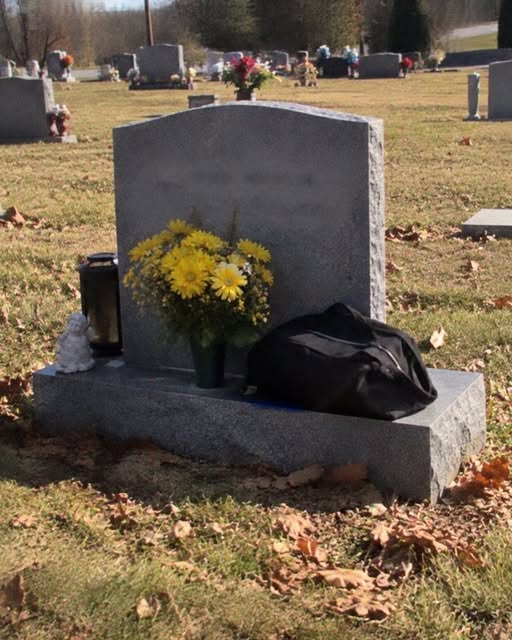
Every year, on the anniversary of his death, I take the morning off work and visit his grave. I bring yellow flowers because Paul used to buy them for our kitchen table. They were inexpensive, cheerful, and never arranged perfectly, but he always insisted they made our home feel brighter.
It was a small tradition, yet it had become one of the most meaningful parts of my year.
People sometimes tell me that five years is a long time and that I should finally let go. I understand what they mean, but grief does not follow a schedule. Some memories become less painful, while others remain as vivid as the day they happened.
This year, however, my annual visit turned into something I could never have anticipated.
It began with a black canvas bag resting beside my husband’s headstone.
And inside it was something that would make me question how much I truly knew about the final months of Paul’s life.
A Morning I Wanted to Spend Alone
On the morning of the anniversary, my sister offered to drive me to the cemetery.
“I can come with you,” she said while we spoke over breakfast. “You don’t have to do everything alone.”
I appreciated her concern, but I shook my head.
“Thank you. I know you’re trying to help, but I think I need some time by myself today.”
She understood. Before we ended the conversation, she reminded me to call her when I got home.
I promised I would.
On the way to the cemetery, I stopped at a small coffee shop near the flower store. I ordered my usual drink and sat by the window for a few minutes, watching people hurry past on their way to work.
It seemed strange that the world could continue at its usual pace on a day that felt so important to me.
At the flower shop, the woman behind the counter asked whether I wanted a card to accompany the yellow flowers.
“No, thank you,” I replied. “He knows who they’re from.”
The words came out naturally, and I smiled faintly at myself afterward. I knew Paul could not read a card, but the tradition still made sense to me.
Some habits survive because they provide comfort, even when the circumstances that created them have changed.
I placed the flowers on the passenger seat and drove toward the cemetery.
When I arrived, I noticed a few workers gathered near the main entrance. One of them directed me toward a smaller entrance on the opposite side of the grounds.
“There’s some maintenance happening near the front,” he explained. “You’ll find parking around the other side.”
I thanked him and followed the directions.
The cemetery was unusually quiet. The grass was damp from overnight rain, and the trees moved gently in the breeze. I could hear the distant sound of traffic, but otherwise, everything seemed still.
I parked and began walking along the familiar gravel path.
I had taken that path dozens of times over the years. I knew where the stones leaned slightly, where the trees cast shadows across the walkway, and where a small bench stood beneath an old oak tree.
Then I noticed something dark beside Paul’s headstone.
At first, I assumed someone had left a rubbish bag behind.
As I approached, however, I realized it was a black canvas bag with its zipper fully closed and its handles tucked underneath.
It looked deliberately placed.
There was no name tag, no note, and nothing to indicate who had brought it.
I stopped several feet away and looked around.
“Hello?” I called.
Nobody answered.
I glanced toward the nearest path, but no one was walking in my direction.
For a moment, I wondered whether another visitor had accidentally left the bag behind. Perhaps someone had brought gardening supplies or personal belongings and forgotten them.
Still, something about its position troubled me.
It was resting directly beside Paul’s headstone, as though whoever had left it there wanted me to notice it.
The Call That Made Me More Uneasy
I took out my phone and called the cemetery office.
A woman answered after a few rings. I explained what I had found and described the bag.
“Has anyone reported a lost item?” I asked.
She checked her records and told me that no report had been made.
“Please don’t remove it from the grounds,” she advised. “We’ll arrange for someone to come and inspect it.”
“How long will that take?”
“It may be a few minutes. If you can, leave it where it is.”
I agreed.
After ending the call, I placed the flowers on the ground near the headstone and stepped back.
I should have waited for a member of staff.
Instead, I found myself studying the bag more closely.
It was dry, even though the ground around it was still damp from the rain. The fabric had a few creases, but there were no obvious signs of damage. The zipper appeared intact, and the handles were folded neatly beneath the bag.
Someone had placed it there with care.
I felt a growing sense of unease.
What if it contained something personal belonging to another family? What if someone had made a mistake and left it at the wrong grave?
I didn’t want to disturb anything that might matter to someone else.
Yet the fact that it had been left beside Paul’s headstone made me wonder whether it had something to do with him.
I looked toward the entrance again.
No one was coming.
Then I crouched beside the bag and noticed a small piece of white paper tucked beneath one of its handles. I gently pulled it free.
My name was written on it.
Just my first name.
No address, no signature, and no explanation.
My hands began to tremble.
For several seconds, I considered putting the paper back and walking away. I could wait for the cemetery staff, call my sister, or ask someone else to help me understand what was happening.
But curiosity and fear had already taken hold.
I carefully opened the zipper just enough to look inside.
Then I saw what was beneath the folded fabric.
My knees weakened, and I lowered myself onto the gravel.
Inside the bag was a small wooden box, an envelope bearing Paul’s handwriting, and a photograph I had not seen in years.
I recognized his handwriting immediately.
I had kept birthday cards, letters, and little notes he had written during our marriage. Even after five years, I could identify the shape of his letters without needing to read a single word.
But why would someone leave a letter from Paul at his grave?
And why had it been addressed to me?
The Letter I Never Expected to Find
I removed the envelope from the bag and held it carefully in my hands.
My name was written across the front.
Beneath it, in smaller letters, were the words:
For Megan, when the time is right.
I read the sentence several times.
Paul had died five years earlier. How could he have known that someone would deliver a letter to me on this particular anniversary?
I reminded myself that there might be a simple explanation. Perhaps the letter had been written long before his death and discovered among his belongings. Perhaps someone who had known him had finally decided to pass it along.
I opened the envelope.
Inside was a handwritten letter folded into three sections.
The first few lines brought tears to my eyes.
Paul wrote about ordinary things: our kitchen table, the yellow flowers, the way I always left a light on in the hallway, and how I would complain when he forgot to put his shoes away.
He described these small details with such affection that, for a moment, it felt as though I were reading a message from an old friend.
Then the tone changed.
He explained that during the final months of his life, he had been keeping a personal journal. He had started writing because there were things he wanted to organize in his thoughts but did not know how to discuss.
He had not wanted to worry me unnecessarily, he wrote, and had hoped to explain everything when he felt ready.
The letter did not reveal a dramatic secret or accuse anyone of wrongdoing. Instead, it described a period when Paul had been struggling with decisions about his career, his family responsibilities, and the future we had imagined together.
He admitted that he had sometimes hidden his worries behind jokes and cheerful conversations.
Reading those words hurt because I recognized the behavior.
In the months before his accident, Paul had occasionally seemed distracted. When I asked whether something was bothering him, he would say he was tired or that work had been stressful.
I had believed him.
Now I wondered how many difficult days he had faced without telling me the full story.
The letter ended with a sentence I read again and again:
If you’re reading this, I hope you’ve given yourself permission to live a life that still has room for happiness.
I pressed the paper against my chest and cried.
For five years, I had carried the feeling that moving forward meant leaving part of Paul behind. His words reminded me that he had never wanted our memories to become a reason for me to stop living.
But the letter was only the beginning.
The Photograph in the Wooden Box
After composing myself, I examined the small wooden box.
It was simple, with a brass clasp and a faint scratch across the lid. Inside were several photographs, a folded piece of paper, and a key attached to a plain metal ring.
The first photograph showed Paul and me on our wedding day.
The second showed us standing in front of our first home.
The third was unfamiliar.
Paul was standing beside an older man outside a small community building. Both were smiling, and Paul was holding a folder under one arm.
On the back, someone had written a date from several months before his accident.
I turned the photograph over again.
I didn’t recognize the man.
The folded paper contained the name of a local community organization and a brief note explaining that Paul had volunteered there during his spare time.
I knew he had occasionally helped with neighborhood events, but I had never realized how involved he had become with that particular organization.
The note said that the box had been kept safely for several years by someone who had known Paul. The person had recently found the letter and photographs while sorting through stored belongings and wanted to make sure they reached me.
There was no explanation for why the delivery had taken so long.
I was still trying to make sense of everything when I heard footsteps approaching along the gravel path.
A cemetery employee had arrived.
He introduced himself, asked whether I was all right, and explained that the office had sent him to inspect the unattended bag.
I showed him the paper with my name and explained that I had found the letter and photographs inside.
He listened carefully and advised me to keep the items together while the office recorded the discovery.
He also asked whether I had noticed anyone leaving the bag.
I told him I hadn’t.
There was no reason to assume the person who had left it intended any harm, but the employee recommended that I contact the office if I had further concerns.
I thanked him and gathered my belongings.
Before leaving, I placed the yellow flowers beside Paul’s headstone.
For the first time in five years, I felt that I had learned something new about the person I had loved.
Not something that changed our marriage into a different story, but something that made the story larger.
Paul had been more complicated than I sometimes remembered. He had carried worries, hopes, and private ambitions that I had not fully understood.
That did not make our life together less meaningful.
It made it more human.
What I Learned From Paul’s Last Message
When I arrived home, I called my sister as promised.
She listened patiently while I explained what had happened at the cemetery. When I told her about the letter, she encouraged me to take my time reading it and to avoid making assumptions about the person who had left it.
She was right.
There were still questions I could not answer.
I did not know exactly when Paul had written the letter, why the box had remained with someone else for so long, or what had prompted its delivery on the fifth anniversary of his death.
I decided to contact the community organization mentioned in the note to see whether anyone could provide more context.
But I also realized that I did not need every question answered immediately.
The most important part of the letter was the message Paul had left for me.
He wanted me to remember our life with affection, not treat grief as a responsibility that required me to remain unhappy.
In the weeks that followed, I began making small changes.
I accepted an invitation to have dinner with friends. I returned to a hobby I had abandoned after his death. I even began planning a weekend trip that I had postponed several times because it felt strange to imagine enjoying something without Paul.
I still missed him.
I still visited his grave.
And I still bought yellow flowers.
But I no longer felt that every happy moment somehow diminished the love we had shared.
The black bag had arrived unexpectedly, and its contents had stirred memories I thought I had already explored. Yet the experience reminded me that the past can continue to teach us things long after we believe we understand it.
On the anniversary of Paul’s death, I had gone to the cemetery expecting another quiet morning filled with sadness.
Instead, I returned home with a letter that encouraged me to look forward.
I may never know every detail behind the bag’s arrival, but I know what I want to carry with me from that day.
Love does not disappear when a person dies. It changes shape, becoming part of our memories, our choices, and the way we treat ourselves and others.
And sometimes, the most meaningful reminder is not a dramatic revelation or a perfectly explained mystery.
Sometimes, it is a simple message from someone we loved, reminding us that we are still allowed to live.
I folded Paul’s letter carefully and placed it in a drawer beside our wedding photographs.
The next morning, I opened the curtains, made a cup of coffee, and set a small vase of yellow flowers on the kitchen table.
For the first time in a long while, I smiled without feeling guilty.
I thought of Paul, of the life we had shared, and of the future I still had an opportunity to build.
Then I turned toward the day ahead.
And I began again.