My daughter Emily was twenty-one years old and studying at a college four hours away from home. She had always been independent, determined, and reluctant to ask anyone for help. That was why I knew something was seriously troubling her when my phone rang late one afternoon and I heard her crying.
“Mom, please, I don’t know what to do,” she said between sobs. “Something is wrong with my heart. The doctors say I need surgery immediately. I’m really scared.”
For a moment, I couldn’t speak.
Emily had mentioned feeling unwell over the previous few weeks, but she had repeatedly assured me that it was probably exhaustion from studying. I had encouraged her to arrange a medical appointment, and she had promised she would.
Now she was telling me that she was at a private medical clinic near campus and that the doctors had recommended an operation costing approximately $24,000.
“Are you alone?” I asked.
“Yes, Mom.”
“Have you spoken to the doctor yourself? Do they know I’ve been called?”
“Please come,” she whispered. “I’ll explain everything when you get here.”
I grabbed my keys, packed my handbag, and left almost immediately.
During the drive, my mind raced through every possibility. I wondered how long Emily had been feeling ill, whether she had told the doctors about her medical history, and why nobody from the clinic had contacted me directly.
Most of all, I was frightened that my daughter might be facing a serious medical problem without anyone she trusted beside her.
I called her twice during the journey, but she didn’t answer. I sent messages asking whether she was comfortable and whether she needed me to bring anything.
Neither message received a reply.
By the time I reached the clinic, I was exhausted from worry.
I had no idea that the most confusing part of the day was still ahead of me.
The Strange Scene in the Recovery Room
A receptionist directed me to the recovery area and told me where to find Emily.
When I entered the room, I immediately hurried to her bedside.
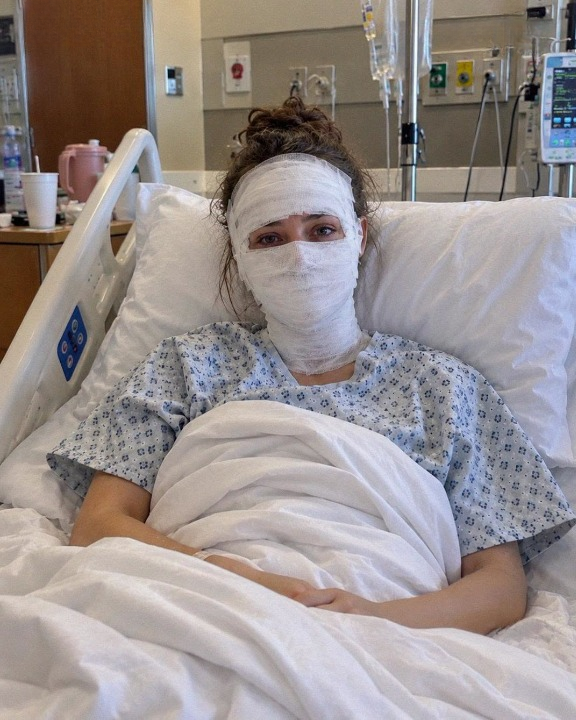
She was lying beneath a white blanket, looking tired and unusually quiet. A thick bandage covered much of her face, leaving me startled by her appearance.
“Emily! Oh, sweetheart, what happened?”
She turned toward me slowly.
“Mom, please don’t ask too many questions right now. I’m hurting, and I just want to rest.”
I sat beside her and took her hand.
“Of course. But I need to understand what’s happening. Why is your face bandaged? You told me you were having heart surgery.”
She looked away.
“The doctors said I had a bad reaction to something during the procedure. They needed to cover my face while it heals.”
I stared at her.
That explanation raised more questions than it answered. I couldn’t understand why an operation involving her heart would require such extensive facial bandaging.
“Did the surgeon explain what happened?” I asked.
Emily closed her eyes.
“Mom, I’m exhausted. They said the operation went well. Please, can we talk later?”
I wanted to insist that she explain everything, but she looked genuinely distressed. I didn’t want to make her feel that she had to answer a dozen questions while recovering.
Instead, I adjusted her blanket and asked whether she needed water.
She shook her head.
After a few moments, she spoke again.
“Could you go downstairs and settle the bill? They said the payment needs to be completed today.”
I hesitated.
“All right, but I want to speak with your surgeon first.”
Her fingers tightened around mine.
“Please don’t make things difficult, Mom.”
That sentence stayed with me as I left the room.
Emily had always been willing to discuss difficult situations with me, even when she was embarrassed or worried. Now she seemed desperate to prevent me from asking questions.
I told myself that fear and exhaustion could explain her behavior.
Still, I decided that I would not make a substantial payment until I understood what the clinic was charging for and what treatment she had received.
The Doctor’s Unexpected Comment
The billing office was located at the end of a quiet hallway.
A staff member checked Emily’s details and told me that I would need to speak with the surgeon before the final paperwork could be completed.
A few minutes later, a middle-aged doctor entered the consultation room.
“You’re Emily’s mother?” he asked warmly.
“Yes. I’m here to pay the bill, but I have several questions about her operation.”
He nodded and pulled out a chair.
“Of course. I understand this has been a difficult day for your family.”
I explained that Emily had called me in tears, saying she needed urgent heart surgery. I also mentioned the bandage covering her face and asked whether there had been a complication.
The doctor listened without interrupting.
Then he smiled faintly.
“Well, I must say, it was very brave of your family to agree to this.”
I frowned.
“Agree to what, Doctor?”
His expression changed.
For a moment, he seemed unsure how to respond.
He glanced at the paperwork in front of him, then looked back at me.
“Perhaps we should clarify what Emily has told you,” he said carefully.
My heart began pounding.
“What exactly are you saying?”
The doctor explained that before discussing any private medical information, he needed to confirm Emily’s consent and establish which treatment records could be shared with me.
I understood the need to protect my daughter’s privacy. But I was also the person she had asked to travel across the country and pay a substantial bill.
“I don’t want information I’m not entitled to,” I told him. “I simply need to understand what I’m being asked to pay for and whether my daughter is safe.”
He nodded.
“That’s a reasonable concern. Let’s review the documentation and make sure we’re discussing the same procedure.”
He asked me to wait while he checked the records and contacted the appropriate member of the medical team.
I remained seated, trying to make sense of his earlier words.
Why had he described my family as brave?
What had Emily agreed to?
And why did her explanation of the operation seem so different from the doctor’s reaction?
The Paperwork That Raised More Questions
When the doctor returned, he brought a member of the administrative team with him.
They explained that the clinic’s billing records needed to be reconciled with the treatment information before a final payment could be discussed.
I asked whether Emily had undergone the heart operation she had described over the phone.
The doctor didn’t immediately give me a detailed answer. Instead, he explained that the medical team would need to speak with Emily and confirm the information she had authorized them to share.
I found the situation frustrating, but I reminded myself that guessing would not help anyone.
I asked to see an itemized statement showing the proposed charges, along with the clinic’s official payment instructions.
The administrative employee agreed to prepare the relevant documents.
As I examined the paperwork, I noticed that the description of the proposed treatment did not clearly match the explanation Emily had given me. I couldn’t determine whether this was a misunderstanding, an incomplete record, or something that needed further investigation.
I pointed out the discrepancy.
“Could someone explain this line to me?” I asked.
The employee studied the document.
“We’ll need to confirm this with the treating team before we can give you an accurate answer.”
I appreciated that response more than a rushed explanation.
I had arrived prepared to pay whatever was necessary to protect my daughter’s health. But love and fear were not reasons to sign documents I didn’t understand.
I asked them to pause the payment process until the details could be confirmed.
Then I returned to Emily’s room.
The Question My Daughter Didn’t Want to Answer
Emily was awake when I entered.
She looked at me anxiously.
“Did you pay the bill?”
“Not yet,” I replied, sitting beside her. “I spoke with the doctor, and I need you to help me understand something.”
She turned her face toward the window.
“What did he say?”
“He said we need to clarify the treatment and the paperwork. Emily, you told me you needed urgent heart surgery. But the information I saw wasn’t clear, and I don’t understand why you have such extensive bandaging on your face.”
She remained silent.
I waited.
Finally, she began to cry again.
“I’m sorry, Mom.”
I took her hand.
“I’m not here to punish you. I’m here because I love you. But I need you to tell me the truth so we can work out what to do next.”
She wiped her eyes with the edge of the blanket.
“I was scared you wouldn’t come if I told you everything.”
Her answer hurt more than I expected.
“Why would you think that?”
She hesitated before speaking.
“I didn’t know how to explain what was happening. I thought if I told you I needed surgery, you’d come immediately.”
I felt a mixture of relief and concern. At least she was beginning to talk, but her words still left important questions unanswered.
I didn’t want to jump to conclusions or accuse her of something I hadn’t established.
Instead, I asked whether she was in immediate danger and whether her medical team had explained her current condition.
Emily said she needed help understanding the situation herself.
I told her that we would ask the medical staff to explain her care, the purpose of the treatment, and the next steps. If she was medically stable, we could then discuss the financial arrangements calmly.
For the first time since I had arrived, she nodded without arguing.
Choosing Facts Over Fear
The doctor returned later that afternoon after arranging an appropriate conversation with Emily.
With her permission, he explained the information relevant to her care and clarified which parts of the bill required further review.
I listened carefully, asked questions, and took notes.
Some details still needed to be confirmed, so I requested copies of the available records and a clear itemized statement. I also asked whom we should contact if we needed a second opinion or an independent review.
The clinic agreed to provide the appropriate documentation through its usual procedures.
I didn’t make the payment that day.
Instead, I focused on making sure Emily had access to the care she needed and understood the decisions being made about her health.
When we were alone again, she apologized for frightening me.
“I thought I was doing what I had to do,” she said.
I hugged her gently.
“I understand that you were frightened, but you cannot make a medical emergency seem different from what it is. If you need help, tell me what’s happening. We can face difficult situations together.”
She nodded, looking ashamed.
I explained that I would help her review the costs and explore appropriate payment arrangements once we understood the treatment and confirmed the charges.
But I also made it clear that any medical decisions had to be based on accurate information from qualified professionals.
She promised to be more honest with me.
I hoped she meant it.
What I Learned From That Terrifying Day
I had left home believing I was racing against time to save my daughter. By the time I reached the billing office, I was so frightened that I had almost allowed urgency to replace careful judgment.
The doctor’s unexpected comment forced me to stop and ask questions.
That moment taught me something important: when a loved one is unwell, we naturally want to act immediately. But helping someone does not mean abandoning our judgment or agreeing to every request without clarification.
Medical decisions deserve careful explanations. Significant bills deserve clear documentation. And families deserve honest conversations, especially when fear makes everything feel urgent.
Most importantly, I learned that I could support Emily without pretending to understand something I did not.
I could sit beside her, listen to her worries, and help her ask the right questions. I could request records, seek clarification, and make informed decisions about financial assistance.
I did not need to solve every problem in one afternoon.
As the evening approached, I sat beside my daughter while the noise of the clinic continued outside her room.
She rested quietly, and I held her hand.
I still had questions. We still had paperwork to review, and there were conversations we needed to have once she felt stronger.
But I was no longer making decisions based solely on panic.
I was her mother, and I would stand beside her through whatever came next.
This time, however, I would make sure we faced the situation with honesty, clear information, and a better understanding of the choices before us.