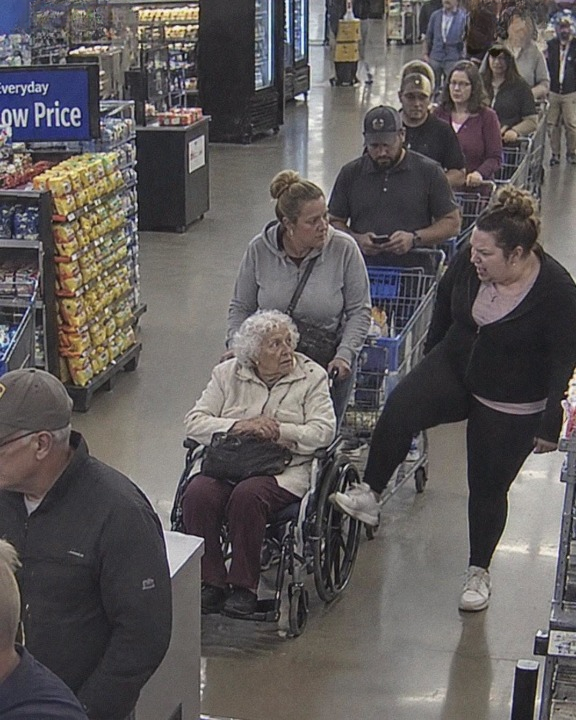
My mother is eighty years old, and for the past six years, she has relied on a wheelchair following a serious accident. Although her mobility has changed, her personality has not. She remains thoughtful, independent, and determined to enjoy life as much as possible.
Last Saturday, I took her to a crowded department store to buy a birthday present for my daughter. We had planned a quick shopping trip, but the weekend crowds had other ideas. Every checkout line seemed to stretch halfway across the store, and shoppers were growing impatient as the afternoon wore on.
When an employee noticed my mother’s wheelchair, she kindly directed us toward an accessible checkout register.
“That register should be easier for you,” she explained. “Please follow me.”
I thanked her and guided my mother toward the designated area. We were nearly at the front when a woman in her forties stepped directly in front of us.
“Excuse me!” she said sharply. “We’ve been waiting here for forty minutes. You can’t just push ahead of everyone.”
I calmly explained that a store employee had directed us to the accessible register.
The woman looked at me, then turned her attention to my mother. Her expression changed from irritation to disbelief.
“She looks perfectly fine to me,” she said.
I was taken aback.
My mother wore a comfortable cardigan, dark trousers, and a pair of sensible shoes. She was sitting quietly in her wheelchair, holding her handbag on her lap.
The woman gestured toward her legs.
“People pretend to have disabilities just to get special treatment. It’s unfair to everyone else who has been waiting.”
Several customers turned to look at us.
I felt embarrassed, angry, and protective of my mother all at once. But my mother lowered her eyes and gently touched my hand.
“Please, sweetheart,” she whispered. “I don’t want an argument.”
I tried to explain that disabilities are not always visible and that the employee had directed us to the register. The woman refused to listen.
Instead, she stepped behind my mother’s wheelchair and gave one of its wheels a forceful shove with her foot.
The chair jolted forward.
I immediately grabbed the handles to steady it.
“Don’t touch my mother or her wheelchair!” I said firmly.
My mother’s face had gone pale. She held tightly to the armrests, trying to regain her composure.
The woman folded her arms.
“Then she should stand in line like everybody else.”
At that moment, a security guard began approaching us from the other side of the checkout area.
I thought he would finally put an end to the confrontation.
But before he could speak, my mother raised one hand.
“Please, give me a moment,” she said quietly.
Her voice was remarkably calm.
Then she reached into the pocket of her cardigan and withdrew a small, worn leather case.
It looked old enough to have been carried for decades. The edges were faded, and the clasp had lost much of its shine.
The woman gave a dismissive laugh.
“What is that supposed to prove?”
My mother didn’t answer.
She simply held the case in both hands and looked toward the security guard.
“Sir, would you mind staying here while I show you something?”
The guard nodded cautiously.
The woman rolled her eyes, but her confidence seemed to weaken as she watched my mother open the case.
Then everything changed.
The woman stared at what my mother was holding. Her mouth opened, but no words came out.
Her shopping basket slipped from her hand and hit the floor.
“Oh my goodness,” she whispered.
A moment later, she swayed unsteadily and collapsed beside the checkout counter.
People gasped.
The security guard immediately called for medical assistance while another employee cleared the surrounding area. I stayed beside my mother, making sure she was safe and that nobody accidentally struck her wheelchair in the confusion.
For a few seconds, I forgot all about the argument.
The woman needed help, regardless of what she had said to us.
As staff members responded, my mother closed the leather case and held it against her chest.
Then the store’s public-address system crackled.
“Attention, all employees,” an urgent male voice announced. “Please follow the emergency procedures and keep the main entrance clear while the situation is assessed.”
Customers began whispering among themselves.
I turned toward my mother.
“What was in that case?” I asked softly.
She looked at me with an expression I had never seen before—part sadness, part determination.
“Something I have carried for a very long time,” she replied.
And that was when I realized the incident had uncovered a story much bigger than a disagreement over a shopping queue.
The Security Guard Asked One Important Question
Once the immediate confusion had settled, the security guard returned to speak with us.
He introduced himself as Daniel and apologized for the distress we had experienced.
“Are you both all right?” he asked.
I assured him that we were, although I explained that the woman had pushed my mother’s wheelchair and made insulting remarks about her disability.
Daniel listened carefully.
“Thank you for telling me. I’ll make sure the incident is documented, and we’ll review what happened.”
He then asked whether my mother needed medical attention.
She shook her head and thanked him for his concern.
Before he left, however, he glanced at the leather case.
“May I ask what you showed that woman? She seemed to recognize it.”
My mother hesitated.
“It’s an old identification case,” she explained. “It contains something connected to a chapter of my life that I rarely discuss.”
She opened it again, this time turning it toward me.
Inside was an old photograph, a folded document, and a small identification card. The photograph showed my mother as a much younger woman, standing beside a group of people in front of a community building.
I recognized her immediately, although she looked barely thirty.
“What is this place?” I asked.
“A rehabilitation center,” she answered. “I volunteered there for years after I recovered from my own earlier injuries.”
I looked at her in surprise.
I knew about the accident that had eventually led to her using a wheelchair, but I had never heard much about her earlier experiences helping people with disabilities.
She pointed to the document.
“This card belonged to a volunteer program that supported people with mobility challenges. The woman who collapsed may have recognized the emblem.”
The explanation made sense, but it didn’t fully explain the woman’s reaction.
My mother seemed to notice my confusion.
“There’s more to the story,” she admitted. “But I’d rather explain it somewhere quieter.”
I agreed.
Before leaving the checkout area, I asked a store employee whether the woman who had fainted was receiving medical care. The employee confirmed that emergency assistance had been requested and that staff were attending to her.
I was relieved.
Whatever had caused her to collapse, she deserved proper care.
The Story Behind the Old Leather Case
We moved to a quiet seating area near the store’s customer service desk.
My mother placed the leather case on the table and slowly began explaining its history.
Decades earlier, she had volunteered with a local organization that helped people adapt to life after serious injuries. The program arranged practical assistance, connected families with support services, and helped participants maintain their independence.
At the time, my mother was younger, energetic, and eager to help.
She had worked alongside volunteers, physical rehabilitation professionals, and families who were learning how to navigate unfamiliar challenges.
“It changed the way I looked at people,” she told me. “You learn very quickly that you cannot understand someone’s entire life by looking at them for a few seconds.”
She explained that the identification card had been issued during those volunteer years. She kept it because it reminded her of the people she had met and the lessons she had learned.
The photograph was especially meaningful to her. It showed a group of volunteers who had spent countless hours helping others rebuild their confidence after life-changing events.
I studied the faces in the picture.
“Was that woman in the photograph?” I asked.
Mom examined it carefully.
“I’m not certain. It’s been many years, and people change. I don’t want to make assumptions.”
She then explained why she had opened the case in the first place.
When the woman accused her of pretending to have a disability, my mother had wanted to respond without shouting or revealing personal medical details to a crowd of strangers.
The case was a reminder of her history and the work she had done. She hoped the identification card might help the security guard understand why the situation mattered so much to her.
She had not expected the woman to react so dramatically.
“I didn’t open it to frighten her,” Mom said. “I simply wanted someone in authority to understand that this was more than a disagreement about a queue.”
I took her hand.
“You shouldn’t have had to prove anything about yourself.”
She gave me a small smile.
“You’re right. But sometimes, people make assumptions before they take the time to listen.”
An Unexpected Apology
About twenty minutes later, a store employee approached us.
The woman who had fainted had received medical attention and was being assessed by the responding professionals. The employee could not share private medical details, but she told us the woman had regained consciousness.
Soon afterward, the security guard returned with an update.
He explained that the store would review the incident and that any further action would be handled according to its procedures.
I asked whether the woman had said anything about what had happened.
Daniel paused before answering.
“She asked whether she could apologize when she feels well enough. I told her we couldn’t promise when that would be possible, but we would pass along the request.”
I wasn’t sure how I felt.
Part of me was still angry. The woman had insulted my mother and behaved aggressively toward her wheelchair. No explanation could make that acceptable.
But I also knew that people sometimes act badly because of frustration, mistaken assumptions, or feelings they haven’t learned to manage.
That didn’t excuse her behavior.
It simply meant that I didn’t need to decide what kind of person she was based on one incident.
My mother seemed to share that view.
“If she apologizes sincerely, I’ll listen,” she said. “But I hope she understands why what she did was wrong.”
We eventually completed our shopping, although neither of us felt much like browsing afterward.
On the way home, I kept thinking about the scene at the checkout counter.
I had initially believed that the most important part of the day would be the moment the woman realized she had made a terrible mistake.
Instead, what stayed with me was my mother’s quiet composure.
She had been publicly insulted, physically startled, and placed in an uncomfortable situation. Yet she had refused to respond with cruelty.
She had stood up for herself without humiliating someone else.
That took more strength than I had appreciated.
What My Mother Taught Me That Day
Later that evening, I asked my mother whether the incident had upset her.
“Of course it did,” she admitted. “I’m human. It hurts when someone questions your dignity, especially when they haven’t bothered to understand your circumstances.”
She explained that using a wheelchair had changed many aspects of her daily life, but it had not changed who she was.
She still enjoyed shopping, visiting friends, celebrating birthdays, and choosing thoughtful gifts for her grandchildren.
She still had opinions, memories, ambitions, and a sense of humor.
Most importantly, she still deserved the same courtesy as anyone else.
“People don’t owe strangers their medical histories,” she told me. “If someone needs assistance, we should treat them with respect rather than demanding that they prove they deserve it.”
I thought about how quickly the other shoppers had turned to stare. Some looked uncomfortable. Others appeared uncertain about whether to intervene.
I understood that witnessing a confrontation can be difficult. People may worry about making matters worse or misunderstand what is happening.
But there are simple ways to help.
We can speak calmly, seek assistance from staff, avoid touching another person’s mobility equipment without permission, and refuse to join in when someone is being mocked.
We don’t have to know everything about another person to treat them with dignity.
The following week, my mother and I visited the department store again to finish a few errands.
This time, our shopping trip was uneventful.
An employee greeted us, directed us toward the appropriate checkout, and asked whether we needed any assistance.
My mother thanked her and continued with her day.
As we left, she slipped the old leather case back into her handbag.
I asked whether she intended to keep carrying it.
“Certainly,” she replied with a smile. “It reminds me of people who taught me something important.”
“What did they teach you?”
She looked toward the busy parking area.
“That you never know the whole story just by looking at someone.”
I have thought about those words many times since that Saturday.
A wheelchair doesn’t tell you everything about a person’s health. An impatient customer doesn’t know another shopper’s circumstances. And a brief encounter rarely reveals the complete story of someone’s life.
The leather case didn’t magically resolve the disagreement, nor did it make my mother’s disability something she needed to justify.
What mattered was that she remained calm, asked for appropriate help, and reminded everyone around her that respect should never depend on appearances.
That afternoon began with an accusation and ended with a lesson I won’t forget.
We may not always understand another person’s circumstances, but we can always choose to treat them with dignity.