Well, congratulations, Layla. You’ve officially found the most ridiculous way to waste your inheritance.”
Those were the first words my husband, Declan, said when I told him I had purchased my grandmother’s old house.
I had expected questions. Perhaps a little concern about the repairs or a discussion about how I planned to manage the expenses.
What I hadn’t expected was laughter.
Declan stood in our kitchen with his arms crossed, staring at me as though I had just announced that I intended to throw our savings into the ocean.
“You spent that much money on that place?” he asked. “Have you actually looked at it lately?”
Of course I had.
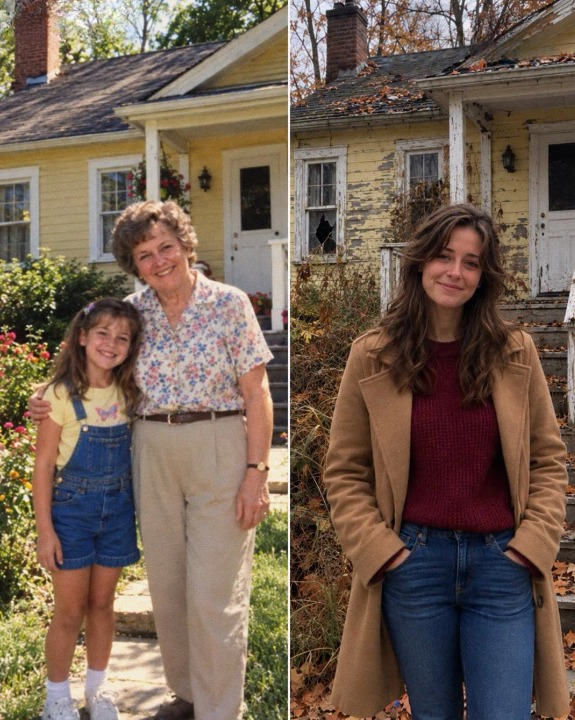
The house was in terrible condition. The paint was peeling, several windows were cracked, the front gate leaned to one side, and weeds had swallowed most of the garden. Even the porch steps looked as though they might collapse under the weight of an adult.
But to me, it was never just an old house.
It was the place where I had spent my happiest childhood summers. It was where my grandmother had taught me to bake, where she had comforted me after my first heartbreak, and where we had sat together on warm evenings talking about everything and nothing.
After she died, the house was sold.
Losing it had felt like losing another piece of her.
So when I discovered that the property had returned to the market years later, I couldn’t ignore the opportunity.
I used part of the inheritance she had left me to purchase it.
I knew the work would be expensive. I knew it would take time. But I had savings of my own, and I was prepared to restore the place gradually.
What I didn’t know was that the house held a secret that would change everything.
And my husband was about to discover it first.
The House Everyone Else Saw as a Ruin
When I was a little girl, my grandmother’s house seemed enormous.
It stood at the end of a quiet lane, surrounded by an untidy but beautiful garden. Roses climbed along the fence, a large oak tree shaded the backyard, and a narrow stone path led from the gate to the front porch.
Inside, the house always smelled of cinnamon, fresh bread, and the lavender sachets Grandma tucked into her drawers.
She had a tiny kitchen with old wooden cabinets and a window overlooking the garden.
That was where she taught me to bake.
I remember standing on a chair beside her, carefully measuring flour while she explained that recipes were useful, but patience was even more important.
“Never rush something that deserves to be done properly, sweetheart,” she used to say.
I didn’t understand how much that advice applied to life until I grew older.
In the afternoons, we would sit on the porch. She would drink tea, I would eat biscuits, and we would talk until the sunlight began to fade.
Sometimes she told me stories about her youth. Other times, she asked about school, my friends, and the dreams I was too embarrassed to share with anyone else.
She always listened as though my answers mattered.
After she passed away, I tried to accept that the house belonged to someone else.
I told myself that memories could survive without a building to contain them.
But when I saw the property listed again, something inside me changed.
I drove past it twice before I finally called the agent.
The moment I stepped through the front door, I knew I wanted to bring it back to life.
The walls were damaged, the floors needed attention, and the garden was nearly unrecognizable. Yet beneath all the neglect, I could still see the home I remembered.
I could almost hear Grandma calling me into the kitchen.
For the first time in years, I felt close to her again.
That was why I bought it.
Not because I thought it would make me rich, but because I wanted to preserve something that had shaped the person I became.
Eleven Years of Marriage and One Uncomfortable Argument
Declan and I had been married for eleven years.
We had built a comfortable life together, although we didn’t always agree about money.
He preferred practical decisions, carefully planned expenses, and investments that could be measured in numbers. I appreciated those things, too, but I also believed that not every valuable decision could be reduced to a financial calculation.
The old house represented something personal.
To Declan, it represented a long list of repair bills.
“Have you seen the roof?” he demanded that evening. “What about the plumbing? The electrical wiring? The foundation? You could spend years fixing that place and still have a property worth less than what you put into it.”
“I’ve considered the repairs,” I replied.
“Apparently not carefully enough.”
I took a deep breath.
“I used my inheritance, Declan. I haven’t taken money from our joint savings. I have a plan.”
He laughed again.
“Your plan is to spend every weekend doing work that professionals charge thousands of dollars to do.”
“I’ll hire professionals for the things I can’t handle.”
“And where do you think all that money is going to come from?”
“From the savings I’ve set aside.”
He shook his head.
“This is the worst decision you’ve ever made, Layla.”
His words hurt more than I wanted to admit.
I wasn’t asking him to love the house. I wasn’t even asking him to help me repair it.
I had simply hoped he would understand why it mattered to me.
Instead, he treated my decision as proof that I was incapable of thinking clearly.
For the next two days, the subject followed us everywhere.
If I mentioned replacing the windows, he reminded me that I had wasted my inheritance.
If I discussed cleaning the garden, he asked whether I planned to spend the rest of my life maintaining a property that nobody wanted.
Eventually, I stopped telling him about my plans.
I decided to begin cleaning the house that weekend, whether he supported me or not.
“Fine,” he said when I told him. “But don’t expect me to get involved.”
I nodded and walked away.
I was disappointed, but I wasn’t going to abandon the house simply because my husband couldn’t see what I saw in it.
At least, that was what I believed before the phone rang.
The Phone Call That Changed Everything
Three days after our argument, I was sorting through paint samples at the kitchen table when my phone began to ring.
Declan’s name appeared on the screen.
I answered.
“Hey. What’s up?”
For a moment, he said nothing.
Then I heard him take a breath.
“Layla, I’m at your grandmother’s house.”
I sat up straight.
“What? Why are you there?”
“I decided to take a look around.”
I couldn’t help sounding surprised.
“You told me you wanted nothing to do with the place.”
“I know.”
There was something strange in his voice.
It wasn’t irritation. It wasn’t the sarcastic tone I had heard over the past few days.
He sounded unsettled.
“Declan, what’s going on?”
“I found something.”
“What did you find?”
Another pause.
“I don’t know how to explain it over the phone.”
A chill ran through me.
“Is something wrong with the house? Did part of the roof fall in?”
“No. It’s not that.”
“Then what is it?”
He exhaled sharply.
“Just get in the car, Layla. You need to see this.”
Before I could ask another question, he ended the call.
I stared at my phone for several seconds.
My mind immediately filled with possibilities. Had he discovered structural damage? Had someone entered the property? Was there a problem with the ownership documents?
I grabbed my keys and drove straight there.
When I pulled into the driveway, Declan was standing on the porch.
He looked pale.
That frightened me more than anything he could have said.
“What happened?” I asked as I climbed out of the car.
He looked at me, then toward the front door.
“I think you need to come inside.”
I followed him through the entrance.
The familiar smell of old wood and dust surrounded us. A few boards had been removed from the hallway floor, and a small pile of plaster rested beside the wall.
Then I noticed something unusual.
One section of the living room wall had been opened.
Behind it was a narrow wooden compartment that I had never seen before.
I stopped so abruptly that I had to grab the doorframe.
Inside the compartment sat an old metal box, several folded documents, and a photograph of my grandmother standing beside a man I had never seen before.
My heart began to pound.
“What is all this?” I whispered.
Declan looked at me.
“I was checking the wall because the plaster sounded hollow. When I moved one of the loose boards, I noticed the space behind it.”
He pointed toward the box.
“Then I found those.”
I stepped closer.
The metal box was covered in dust, but its small brass clasp appeared remarkably well preserved.
My hands trembled as I reached for the photograph.
On the back, written in my grandmother’s unmistakable handwriting, were six words:
“For Layla, when she comes home.”
I felt my knees weaken.
My grandmother had known that one day I might return to this house.
But why had she hidden these things?
And who was the man standing beside her?
The Letter Hidden Behind the Wall
Declan carefully lifted the documents from the compartment and placed them on a nearby table.
There were several envelopes, a small notebook, and a thick folder tied with a faded ribbon.
I recognized my grandmother’s handwriting immediately.
The first envelope had my name on it.
I opened it slowly.
Inside was a letter dated several years before her death.
“My dearest Layla,” it began. “If you are reading this, then you have returned to the house I loved so much. I always hoped you would find your way back here one day, although I could never know whether that would happen.”
I stopped reading.
My eyes filled with tears.
Declan stood quietly beside me.
The letter continued.
“This house holds many memories, but I want you to understand that its greatest value was never the walls or the garden. It was the life we built inside it, the people who came through its doors, and the kindness that was shared here.”
I wiped my eyes and kept reading.
Grandma explained that the man in the photograph was her older brother, Thomas, whom she had rarely discussed with our family.
Years earlier, Thomas had helped her purchase the property and had contributed money toward its renovation. The two had dreamed of turning part of the house into a place where young people who needed support could receive practical help, learn useful skills, and find temporary accommodation while rebuilding their lives.
But their plans had never been completed.
Circumstances had changed, and the project was put aside.
The house eventually became my grandmother’s private home, but she had kept the original documents and the notes describing what they had once hoped to achieve.
I looked at the photograph again.
Grandma had never told me this story.
Why?
I turned to the next page.
Her letter explained that she had deliberately kept the documents together because she hoped someone in the family might one day decide to restore the property rather than simply demolish it or sell it again.
She had not hidden them because they were valuable in the ordinary sense.
She had hidden them because they represented an unfinished dream.
I glanced at Declan.
“There’s more,” he said softly.
He pointed toward the folder.
Inside were copies of old plans, correspondence, and legal paperwork relating to the property.
One document described a small adjoining parcel of land that my grandmother’s family had acquired decades earlier.
According to the records, the parcel had been included in an earlier property arrangement, but the boundaries and ownership details needed to be checked against current records.
I didn’t understand everything I was reading.
But I understood enough to realize that the house’s history was more complicated than I had ever imagined.
Declan pulled out a chair.
“Layla, we need someone to look at these documents properly.”
For the first time since I had bought the house, he wasn’t talking about wasted money.
He was asking how we could find out more.
The Man in the Photograph
The following week, I arranged for a qualified property solicitor to review the documents and verify the information against official records.
I was careful not to assume that old papers automatically established current ownership or created any financial benefit. If the documents were going to mean anything, their details had to be confirmed.
The solicitor explained that some of the papers related to historical plans for the property, while others could help clarify its boundaries and previous arrangements.
The adjoining parcel mentioned in the documents had a complicated history, and further checks were necessary.
It took time to establish what remained legally relevant.
Meanwhile, I began learning more about Thomas.
I contacted an older relative who remembered hearing his name when she was a child. She told me that Thomas had been a practical, generous man who often helped people without telling anyone about it.
He and my grandmother had been close, although family disagreements had eventually separated them for a period.
The photograph had been taken during a time when they were working together on their plans for the house.
I stared at it for a long time.
My grandmother had spent years telling me stories about baking, gardening, and her childhood. Yet there had been an entire chapter of her life I had never known.
The discovery made me realize how little we sometimes know about the people we love.
We see them through the roles they play in our lives: grandmother, mother, father, spouse, friend.
But they existed long before we knew them, with their own hopes, disappointments, secrets, and unfinished dreams.
The house was beginning to feel different.
It was no longer simply the place where I had spent my summers.
It was also a record of a life I had only partially understood.
The Real Value of the Old House
As the weeks passed, I began restoring the property one section at a time.
I hired professionals to inspect the roof, electrical systems, and plumbing. I arranged for damaged windows to be measured and replaced, and I started clearing the garden with the help of a local landscaping service.
The work was expensive, but I kept a careful budget.
I wasn’t going to pretend that my grandmother’s house would become perfect overnight.
Some days, progress meant repairing a single window. Other days, it meant removing a pile of broken materials from a room that had been neglected for years.
But each improvement brought back another small part of the home I remembered.
I cleaned the kitchen cabinets and found the faint outline where Grandma had marked my height when I was a child.
I uncovered the old stone path beneath the weeds.
I even found a chipped mixing bowl tucked away in a cupboard, the same kind she had used when teaching me to bake.
Every discovery felt like a conversation with the past.
Declan began visiting the house more often.
At first, he said he wanted to help organize the documents. Eventually, he began offering practical suggestions about repairs and asking whether I needed assistance.
One afternoon, while we were standing in the kitchen, he looked toward the doorway and shook his head.
“I owe you an apology.”
I turned to him.
“For what?”
“For the way I treated you when you bought this place.”
He looked uncomfortable.
“I saw the damage and the expenses. I assumed you had made an emotional decision without thinking about the consequences.”
“You weren’t entirely wrong about the repairs,” I said.
“No,” he admitted. “But I was wrong to treat the things that mattered to you as though they were foolish.”
I didn’t immediately respond.
He continued.
“I should have asked why you wanted the house so badly. I should have listened before deciding that I knew better.”
It was the apology I had wanted from the beginning.
I told him that I understood his concerns about money, but I needed him to respect that the decision was mine to make.
He nodded.
We didn’t solve every disagreement in that one conversation. But something changed between us.
For the first time, he seemed willing to understand the emotional value of the house instead of judging it solely by its condition.
The Letter’s Final Message
Several months after the discovery, I returned to my grandmother’s letter and noticed a final page folded behind the others.
I had overlooked it during the first reading.
The handwriting was slightly shakier than the rest, suggesting it had been written later.
“My dear Layla,” it began, “if you have found the courage to begin restoring this house, I hope you will remember that you do not have to preserve everything exactly as it was.”
I read the sentence twice.
She continued:
“Rooms can be repaired. Gardens can grow again. Old furniture can be replaced. What matters is that a home remains a place where people feel welcome, where they are listened to, and where they are allowed to begin again.”
I sat at the kitchen table for a long time.
Then I understood what she had been trying to leave me.
The documents mattered because they explained the history of the property. The photograph mattered because it revealed a family story I had never known. The plans mattered because they gave me a glimpse of the hopes my grandmother and her brother had once shared.
But none of those things was the real gift.
The real gift was the opportunity to decide what came next.
I could restore the house as a private home, preserving the memories that meant so much to me. Or, if it proved practical and financially sustainable, I could explore whether part of the original vision might be brought to life in a modest way.
I didn’t have to make that decision immediately.
For the first time, I felt no pressure to turn the house into something extraordinary just to justify buying it.
It was enough to begin.
The Home That Brought Us Back to What Matters
A year after I purchased the property, the house looked completely different.
The roof had been repaired, the windows were secure, the garden was cleared, and the front porch had been restored.
The kitchen still needed work, but I had deliberately kept some of its original features. I wanted it to feel like the place where my grandmother had taught me to bake.
One Saturday morning, I made her cinnamon biscuits using the recipe I had written down as a child.
Declan walked into the kitchen and smiled.
“I remember those.”
I placed a plate on the table.
“Of course you do. You ate half the batch the first time I made them.”
He laughed.
For a moment, the house felt as though it had opened its doors to us again.
We sat by the kitchen window and talked about the months that had passed. We discussed the repairs, the documents, and the possibility of supporting a small community initiative in the future.
We would need to plan carefully, establish a realistic budget, and make sure any project was legally and financially workable.
But the possibility was there.
And it had begun with a decision Declan had called the worst of my life.
I sometimes think about the phone call that brought me rushing back to the house.
I remember his pale face, the hidden compartment, and the photograph bearing my grandmother’s handwriting.
I remember the shock of discovering that someone I had loved so deeply had kept an important part of her story hidden away.
But most of all, I remember what the house taught me.
Not every worthwhile decision looks sensible to someone standing outside it.
Some things have value because of the memories they preserve, the relationships they strengthen, or the opportunities they create.
My grandmother’s old house was not a guaranteed financial investment. It required money, patience, careful planning, and a great deal of work.
But it gave me something I hadn’t expected.
It gave me a reason to reconnect with my family’s history, a chance to restore a place that had shaped my childhood, and an opportunity to discover what my grandmother had hoped to leave behind.
And it forced my husband and me to have a conversation we should have had years earlier: a conversation about listening before judging, respecting each other’s choices, and understanding that not every meaningful decision can be measured by its immediate financial return.
Sometimes, the most valuable thing we inherit is not money or property.
Sometimes, it is a story waiting to be discovered, a dream waiting to be reconsidered, or a place that reminds us who we were before life became complicated.
When I bought my grandmother’s house, I thought I was trying to save a building.
I eventually realized that I was also preserving a part of myself.
And three days after my husband laughed at my decision, he stood beside me in that dusty living room and saw something he had never understood before.
The house wasn’t simply falling apart.
It was waiting for someone to give it another chance.