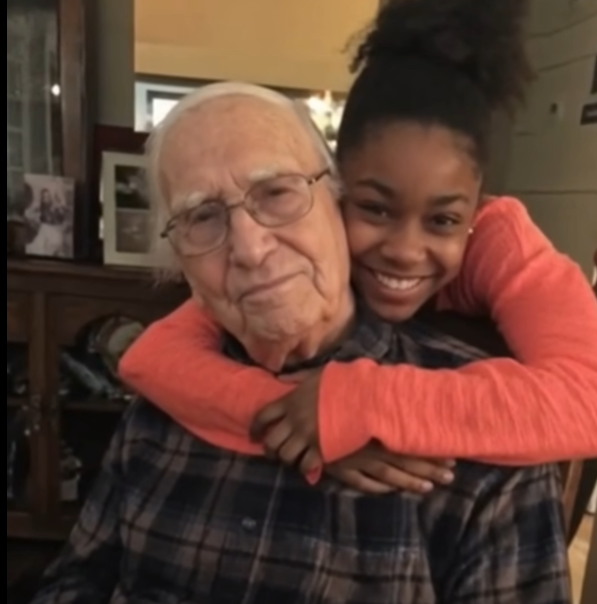
The fire began on an ordinary evening.
I had walked into my kitchen to get a glass of water when an orange glow suddenly appeared through the window. At first, I thought someone had turned on an unusually bright outdoor light. Then I saw the smoke rising above my neighbors’ roof.
Within moments, flames were spreading across the house.
I dropped my glass and rushed outside.
That was when I heard a frightened voice calling my name.
“Mr. Harlan! Please help!”
It was Charlotte, my neighbors’ sixteen-year-old daughter. She stood near the driveway, trembling and struggling to explain what had happened. Firefighters were already arriving, and several neighbors had gathered outside their homes.
Charlotte’s parents were still inside.
Despite the desperate efforts of the emergency crews, they did not survive.
Charlotte was the only member of her immediate family to make it out alive.
I stood there, unable to comprehend what I had witnessed. I had known the family for years. I had waved to them across the fence, exchanged holiday greetings, and watched Charlotte grow from a quiet little girl into a thoughtful teenager.
Now, in a single terrible evening, she had lost everything familiar.
I was seventy-six years old, and I knew something about loss. My wife had died five years earlier, leaving behind a home that often felt far too quiet. My adult children had their own lives in distant cities, and our conversations had gradually become limited to occasional phone calls and holiday visits.
I had grown accustomed to living alone.
I never expected that a tragedy next door would change the course of my life.
But the most unexpected decision I ever made was still ahead of me.
The Question That Changed My Quiet Life Forever
In the days following the fire, Charlotte stayed with temporary caregivers while social workers worked to determine what would happen next.
I visited whenever I could.
At first, she barely spoke. She would sit with her hands folded in her lap, looking down at the floor. Sometimes she answered my questions with a nod. Other times, she simply stared out the window.
I understood that there were no words capable of making her loss disappear.
One afternoon, a social worker contacted me to discuss Charlotte’s longer-term care. She explained that the process would involve careful assessments, legal arrangements, and consideration of what would be best for the teenager.
Then she asked whether I knew anyone who might be able to provide a stable home.
I looked around my empty living room.
For years, I had worried that my age made me less useful to the people around me. My children were independent, my career was long behind me, and most of my days followed the same quiet routine.
But when I thought of Charlotte facing an uncertain future without her parents, I found myself answering before I had time to overthink it.
“If it’s appropriate and everyone agrees that I can provide the care she needs, I’d like to take her in.”
The social worker explained that becoming her caregiver would require more than good intentions. We would need to discuss her needs, my health, the practical responsibilities involved, and the necessary legal arrangements.
I understood.
I was not offering to become her guardian because I believed I could replace her parents. I wanted to give her a safe home while she faced a future she had never imagined.
After the appropriate assessments and arrangements, Charlotte came to live with me.
And my quiet house began to feel different.
A Teenager Who Had Forgotten How to Feel at Home
During the first few weeks, Charlotte spent most of her time in her bedroom.
I left meals outside her door when she did not feel like joining me. I knocked before entering, respected her privacy, and reminded her that she could talk whenever she felt ready.
I did not expect her to recover quickly.
Grief does not follow a timetable, especially when someone has experienced such a sudden and devastating loss.
Some mornings, she came downstairs and ate breakfast without saying much. Other days, she barely touched her food. Occasionally, I heard her moving around at night, unable to sleep.
I tried to make the house feel predictable.
Breakfast was usually at eight. I watered the garden in the late afternoon. The television stayed off during dinner unless we both agreed to watch something.
These routines seemed small, but they gave our days a little structure.
One evening, I found Charlotte sitting on the back steps, looking toward the garden.
I sat beside her without asking questions.
After a while, I said, “You know, sweetheart, grief can feel too heavy for one person to carry. You don’t have to explain everything to me. We’ll take things one day at a time.”
She remained silent.
Then, very quietly, she asked, “What if I never feel normal again?”
I thought about my wife and the years it had taken me to learn how to live with her absence.
“I don’t think we have to become exactly who we were before something painful happened,” I told her. “Maybe we learn how to make room for the memories while still allowing ourselves to live.”
She leaned against my shoulder.
It was the first time since moving in that she had reached for comfort without being asked.
I knew then that our relationship was beginning to change.
The Little Things That Brought Us Together
The progress was gradual.
One morning, Charlotte came downstairs early and asked whether she could help prepare breakfast. A few days later, she accompanied me to the grocery store. Eventually, she began helping me water the tomatoes and pull weeds from the garden.
She discovered that I enjoyed old mystery novels, and sometimes she read aloud when my eyes became tired.
I learned that she loved baking.
Her first attempt at making bread produced a loaf so hard that I joked we could use it to repair the garden path. She laughed so suddenly that she surprised herself.
The sound filled the kitchen.
For a moment, I remembered how my house had felt when my wife was alive.
Not because Charlotte had replaced anyone, but because laughter had returned to a place where silence had settled for too long.
We began celebrating small occasions again. We made pancakes on Sunday mornings, watched films on rainy evenings, and planted flowers beside the garden fence.
Slowly, Charlotte started talking about school, her friends, and the things she hoped to do in the future.
She still had difficult days. Anniversaries and unexpected reminders could leave her quiet for hours. I never interpreted those moments as a failure to move forward.
Healing was not a straight line.
Our home simply became a place where she did not have to pretend that everything was fine.
By the time several months had passed, I no longer thought of Charlotte as the frightened teenager who had stood outside a burning house.
She was becoming herself again: thoughtful, funny, stubborn in the most ordinary teenage ways, and full of ideas about the future.
Without realizing it, I had begun thinking of her as family.
Why My Own Children Could Not Accept My Decision
Unfortunately, my decision created tension with my adult children.
My oldest daughter, Brooke, called regularly to ask how things were going. At first, I assumed she was worried about me.
Then her questions became increasingly uncomfortable.
“Are you sure you can handle all this, Dad?” she asked during one phone call.
“I’m managing,” I replied.
“You’re seventy-six. Raising a teenager is a huge responsibility.”
“I know it is.”
“And you barely knew her family outside of being neighbors.”
That comment bothered me.
I explained that I had known Charlotte for years and that I had not made the decision casually. Social workers were involved, and we were following the appropriate process.
Brooke was not convinced.
My son was even more direct.
“You’re taking on too much,” he told me. “What happens when you need help? What happens if you become ill?”
Those were reasonable questions in themselves. I had considered them carefully before agreeing to care for Charlotte.
But my children seemed to believe that concern about my age automatically meant that I should not be allowed to make a meaningful decision about my own life.
They also seemed uncomfortable with the attention Charlotte now received.
I tried to reassure them that I was not choosing one family over another. I still loved my children, and I wanted them to remain part of my life.
But I would not abandon a teenager who needed stability simply because the situation was complicated.
Over time, the phone calls became shorter.
Brooke stopped asking about Charlotte’s schoolwork or the things we did together. My son changed the subject whenever I mentioned her progress.
I hoped they would eventually understand.
I did not realize that Brooke had begun looking into the circumstances surrounding the fire.
My Seventy-Seventh Birthday
Nearly a year after the tragedy, my birthday arrived.
I had not planned a large celebration. I wanted a quiet afternoon with a few family members, some homemade food, and perhaps a little time in the garden.
Charlotte insisted on baking the cake.
She spent most of the morning in the kitchen, measuring ingredients and carefully decorating the top with fresh strawberries. When I tried to help, she handed me a bowl and told me that I was only allowed to wash dishes.
“You’ve earned the right to relax today,” she announced.
I laughed.
For the first time in a long while, I was looking forward to having my family gathered beneath one roof.
My son arrived first. A few relatives followed, bringing gifts and flowers. The house filled with conversation, and Charlotte seemed nervous but happy to be part of the celebration.
Then Brooke walked through the front door.
She greeted the other guests briefly but did not stop to admire the cake or ask Charlotte how she had made it.
Instead, she came straight toward me.
“Dad, we need to talk.”
Something in her expression made me uneasy.
“Can’t it wait until after the cake?”
“No,” she replied. “It can’t.”
I looked at her more closely.
She seemed upset, but beneath her anger was something else. Fear, perhaps. Or uncertainty.
“What is this about?”
Brooke glanced toward Charlotte, who was standing beside the kitchen doorway.
“Do you really know who she is?”
The room grew quiet.
Charlotte’s smile disappeared.
“Brooke,” I said firmly, “whatever you think you know, this is neither the time nor the place.”
But my daughter shook her head.
“I’ve been looking into the fire, Dad. There are things you were never told.”
My heart began to beat faster.
“What things?”
She took out her phone.
“I found a video,” she said. “And I think you need to see it.”
The Video That Made the Room Fall Silent
I stared at the phone in her hand.
For nearly a year, I had believed that I understood what had happened that terrible evening. The fire had taken Charlotte’s parents, leaving her alone and frightened. We had all struggled to accept the loss, but I had never questioned the basic facts as they had been explained to me.
Now Brooke was telling me that something did not add up.
“Where did you get this video?” I asked.
She explained that she had found it while reviewing publicly available information and old material connected to the incident. She had contacted someone who might be able to clarify what the footage showed, but she had not yet established the full context.
“I didn’t want to accuse anyone without evidence,” she said. “But I couldn’t ignore what I found.”
I looked at Charlotte.
Her face had gone pale.
For the first time since she had moved into my home, she seemed to be looking at the floor in the same way she had during those first difficult weeks after the fire.
“Charlotte?” I asked gently. “Do you know what she’s talking about?”
She opened her mouth, but no words came.
Brooke pressed play.
The video began with a view of the street outside the neighbors’ house. The footage was dark and grainy, apparently recorded from a security camera. Headlights passed across the screen, and a timestamp appeared in one corner.
Then a figure entered the frame.
I leaned closer.
The person approached the side of the house shortly before the first visible signs of smoke.
I could not identify the individual from the image alone.
Brooke paused the recording.
“This is the part that worries me,” she said. “The timing doesn’t match the account we were originally given.”
My hands began to tremble.
“Are you saying someone caused the fire?”
“I’m saying we don’t know enough yet.”
She looked at Charlotte.
“And I think she may know something she hasn’t told us.”
Every eye in the room turned toward the young woman standing beside the kitchen doorway.
Charlotte took a step backward.
“Please,” she whispered. “Not here.”
The words were so quiet that I almost missed them.
I stood up and moved toward her.
“Nobody is going to force you to explain anything in front of everyone,” I said. “If there’s something we need to understand, we can talk privately and get the facts straight.”
Brooke looked frustrated, but she lowered her phone.
I asked the guests to give us some space. My birthday celebration had disappeared from my mind. All I could think about was the possibility that the story I had believed for nearly a year was incomplete.
Charlotte Finally Tells Her Side of the Story
After the guests had moved into the living room, Charlotte and I sat together at the kitchen table.
Brooke remained nearby, her phone resting on the table.
For several minutes, nobody spoke.
Finally, Charlotte took a deep breath.
“I didn’t cause the fire,” she said.
“I didn’t say you did,” I replied.
She looked at me, tears gathering in her eyes.
“But I knew something was wrong that night.”
My stomach tightened.
She explained that, shortly before the fire began, she had noticed someone near the side entrance of the house. She had not been able to identify the person clearly, and she had been frightened by the sudden commotion.
When the smoke appeared, she ran outside and called for help.
In the confusion that followed, she struggled to explain everything she had seen. She was exhausted, frightened, and desperate to know whether her parents had survived.
Later, she became afraid that people would misunderstand her account or blame her for not doing more.
“So you kept quiet?” Brooke asked.
Charlotte nodded.
“I was scared. I didn’t know what I had actually seen, and I didn’t want to make things worse.”
I reached across the table and placed my hand over hers.
“Why didn’t you tell me?”
She lowered her eyes.
“Because you were the first person who made me feel safe after it happened. I thought if I told you something that made everyone suspicious, I might lose the only home I had left.”
My heart ached at those words.
I had believed that giving Charlotte a room, regular meals, and a place in my daily life was enough to help her feel secure. I had not realized how deeply she feared losing that security.
But I also knew that the footage could not simply be ignored.
If someone had information about the fire, the proper authorities needed to examine it. We could not determine what had happened through guesses, accusations, or a single unclear recording.
I told Charlotte that she deserved to be heard and that she would not have to face the situation alone.
Brooke agreed that the video should be shared with the appropriate investigators so that its authenticity, timing, and context could be checked.
For the first time that afternoon, the tension in the room began to ease.
We did not have all the answers.
But we had stopped pretending that the questions did not exist.
What the Fire Taught Our Family
In the weeks that followed, we sought clarification through the appropriate channels. We learned that video footage could provide useful information, but it could not establish the full circumstances of a fire without further examination.
The people responsible for investigating the incident would need to review the evidence, determine whether the recording was authentic, and compare it with other available information.
I refused to turn suspicion into certainty.
Charlotte had already experienced more loss than any teenager should have to face. She deserved compassion, but she also deserved the opportunity to explain what she remembered without being treated as guilty simply because she had been the sole survivor.
Brooke and I eventually had a difficult conversation of our own.
She admitted that her concerns about my age had become mixed with her fear that I was making a decision she could not control. She also acknowledged that confronting Charlotte at my birthday gathering had been unfair.
I told her that concern was welcome, but accusations needed evidence and difficult conversations needed to be handled with care.
Our relationship did not become perfect overnight.
However, we began speaking more honestly about our worries, our assumptions, and the ways grief had affected each of us.
Charlotte continued living with me under the arrangements we had established. We kept our routines, tended the tomatoes, and baked together when she felt ready.
Sometimes, she still became quiet when the fire was mentioned.
When that happened, I reminded her that she did not have to answer every question immediately. What mattered was that we approached the truth carefully and made sure the right people had the information they needed.
A Birthday I Would Never Forget
I had expected my seventy-seventh birthday to be a simple celebration.
Instead, it became the day my family learned that the story we had accepted might not have been complete.
I never received a magical explanation that erased the pain of losing my neighbors or answered every question about that terrible night. Some details required evidence, and some questions could only be answered through a proper investigation.
But the experience changed the way I understood trust.
Trust does not mean refusing to ask questions. Nor does it mean accepting every suspicion as fact.
It means being willing to listen, to examine what we know, and to admit when we do not yet have enough information.
I had welcomed Charlotte into my home because she needed someone willing to stand beside her during an unimaginably difficult time. I did not regret that decision.
She was not responsible for satisfying every curiosity surrounding the tragedy simply because she had survived it.
At the same time, our family needed to approach the unanswered questions with honesty and patience.
That evening, after everyone had left, Charlotte brought the birthday cake back to the kitchen.
“I’m sorry your birthday turned out this way,” she said.
I smiled gently.
“You don’t have to apologize for asking people to understand what happened.”
She placed two slices of cake on small plates and sat beside me.
For a while, we ate in silence.
Then she began telling me about a book she wanted to read and a project she hoped to complete at school. The conversation gradually returned to ordinary things, and I realized how important those ordinary moments had become.
Life had changed dramatically in the year since the fire.
I had become a caregiver again at an age when many people expect life to grow quieter. My children had been forced to reconsider their assumptions. Charlotte had begun rebuilding a future she once feared she would never have.
And we had all learned that the truth is not something to manufacture from fear.
It is something to seek with patience, compassion, and evidence.
At seventy-seven, I understood that family is not defined only by age, history, or blood.
Sometimes, it begins with a simple decision to open your door to someone who needs a safe place to begin again.
And sometimes, the greatest responsibility we can offer another person is not to promise that we have all the answers.
It is to promise that we will listen, ask the difficult questions carefully, and stand beside them while the truth is being uncovered.