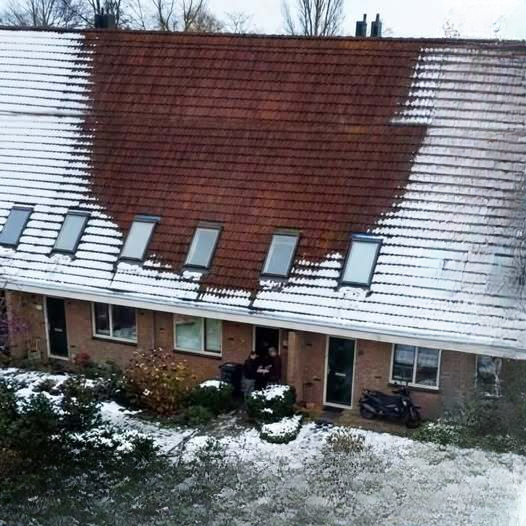
The House Where Snow Never Settled: A Winter Mystery and the Secret Beneath
A mysterious house remains untouched by snow while the surrounding neighborhood disappears beneath a winter blanket. What makes this ordinary-looking home so different, and what secrets might be hidden beneath its quiet exterior?
Editorial note: This is an original fictional mystery story inspired by an unusual winter scene. The events and characters are fictional and are intended for entertainment.
Introduction: The House That Winter Passed By
On February 23, 2026, a peaceful neighborhood awoke to a remarkable winter scene. During the night, heavy snowfall had transformed the streets into a quiet landscape of white rooftops, snow-covered trees, and frozen gardens. Parked cars stood beneath thick layers of snow, sidewalks had disappeared beneath soft drifts, and the familiar sounds of the neighborhood seemed to have faded beneath the cold morning air.
It was the kind of winter morning people remembered for years. Children hurried to their windows to admire the snow, neighbors stepped outside to clear their driveways, and early walkers left a trail of footprints across the otherwise untouched streets.
Yet one detail made the scene different from any ordinary snowfall.
At the end of a narrow residential street stood an old house that appeared almost completely untouched by the storm. While every surrounding roof carried a thick layer of snow, the roof of this particular house remained remarkably clear. Its front steps were dry, the small garden showed no obvious signs of fresh accumulation, and the path leading to its entrance looked strangely familiar against the white landscape.
At first, the difference seemed easy to explain. Perhaps the house had a heating system that warmed the roof. Maybe the wind had swept the snow away. Or perhaps the building’s unusual design prevented snow from collecting on its surfaces.
But as the morning progressed, more people began to notice the same thing.
The house was not simply less snowy than its neighbors. It looked as though winter had somehow passed over it entirely.
For the people living nearby, curiosity quickly replaced the ordinary concerns of a snowy morning. They began comparing observations, looking at the roof from different angles, and wondering whether there was a reasonable explanation for what they were seeing.
Some remembered that the house had stood empty for years. Others recalled occasional lights in its upstairs windows, even though no one seemed to visit the property. A few older residents mentioned stories about the building that had circulated long before the neighborhood became as busy as it was today.
None of these details proved anything unusual was happening.
Still, together, they created a question that was difficult to ignore.
Why had the snow settled everywhere except on that one house?
And what, if anything, lay beneath the building that made it so different?
Chapter 1: A Neighborhood Transformed by Snow
Winter had arrived gradually that year. The first cold mornings brought frost to the windows, and the trees along the street slowly lost their remaining leaves. By late February, residents had grown accustomed to low temperatures, gray skies, and the occasional light snowfall.
The storm that arrived during the night was different.
Weather forecasts had warned that several inches of snow might cover the region, but the amount that eventually fell surprised many residents. Snow continued through the evening and into the early hours of the morning, covering roads and gardens before most people had gone to sleep.
By sunrise, the neighborhood had become almost unrecognizable.
The branches of the old trees bent beneath the weight of the snow. Garden fences appeared shorter, and the roofs of nearby houses formed a continuous white line against the pale morning sky. The usual traffic noise was noticeably reduced, while the occasional sound of a shovel scraping against a driveway echoed between the buildings.
For many people, the snowfall was an inconvenience. Others welcomed the opportunity to enjoy a quiet morning indoors.
But the house at the end of the street attracted a different kind of attention.
It was an older two-story building with faded exterior walls, tall windows, and a sloping roof. A narrow walkway led from the front gate to a wooden entrance door. The garden was modest, containing a few shrubs, a weathered bench, and a tree that had grown close to the side of the house.
Nothing about its appearance suggested that it should respond differently to the weather.
The neighboring buildings had similar roof angles and were exposed to the same falling snow. Yet their rooftops were covered in white, while the mysterious house remained dark and clear.
A resident named Daniel, who lived two doors away, first noticed the difference while looking through his kitchen window.
He had been preparing coffee when the contrast caught his eye. At first, he assumed that the roof was simply darker than the others, making the snow difficult to see. He put down his cup and moved closer to the glass.
The roof was clearly visible.
There was no thick layer of snow, no obvious accumulation along the edges, and no large patches of white covering the tiles.
Daniel stepped outside to get a better look.
The air was cold enough to sting his face, and fresh snow crunched beneath his shoes. He looked from his own roof to the house across the street, then back again.
The difference remained unmistakable.
He took a few photographs and sent them to a neighborhood messaging group, asking whether anyone else had noticed the strange sight.
Within minutes, several people replied.
Some thought the photographs were misleading. Others suggested that a hidden heating system might be responsible. One resident joked that the house must have found a way to avoid winter altogether.
The conversation was lighthearted at first.
But as more people looked at the building, they began remembering details that made the mystery feel more intriguing.
Chapter 2: The Building With a Forgotten History
The house had not always been empty.
According to the older residents of the neighborhood, it had once belonged to a family who moved into the area several decades earlier. The family maintained a small garden, repaired the wooden fence regularly, and kept the exterior of the building in reasonable condition.
Children sometimes saw movement behind the curtains, and neighbors occasionally noticed someone opening the front door to collect deliveries or inspect the property.
Over time, however, the house became quieter.
The garden grew less organized, the paint faded, and the wooden gate began to lean. Eventually, the property appeared to be abandoned.
No one seemed certain when the last occupants had left.
Some residents remembered hearing that the family had moved to another town. Others believed that the building had been inherited by relatives who lived elsewhere. A few people thought the house had been purchased by someone who intended to renovate it but never completed the work.
Without reliable information, these stories remained neighborhood speculation.
The unusual snowfall brought them back into conversation.
One elderly resident, Margaret, remembered the building from her childhood. She said that its original owner had been a practical man who enjoyed repairing household equipment and experimenting with small mechanical projects.
He had reportedly worked with tools, old heating components, and electrical devices in a workshop at the back of the property.
Margaret could not remember the exact nature of his work. She also admitted that much of what she knew had come from conversations she overheard as a child.
Nevertheless, her recollection gave the neighbors a possible direction for their investigation.
Could the house contain an unusual heating system?
Was there an underground room beneath the building?
Or was the entire mystery simply the result of an architectural feature that nobody had noticed before?
These questions were reasonable, but none could be answered by looking at the roof alone.
A building can behave differently from its surroundings for many ordinary reasons. Heat escaping through a roof may melt snow, although that can also indicate poor insulation. Roof materials, sunlight, wind exposure, and the angle of a structure can all influence how snow accumulates.
The house might have had a perfectly ordinary explanation.
Yet the lack of clear information about its history made that explanation difficult to establish.
For Daniel and several other residents, the most interesting part of the mystery was no longer the snow itself.
It was the possibility that the building had a history they had never fully understood.
Chapter 3: Looking for an Ordinary Explanation
By late morning, the snowfall had slowed, and the neighborhood began returning to its usual routine.
Residents cleared their entrances, checked their cars, and helped one another move snow away from shared walkways. The mysterious house remained a topic of conversation.
Daniel decided to examine the situation more carefully.
He did not believe that anything supernatural was happening. He had spent enough winters in the area to understand that weather could produce surprising visual effects. Before accepting an unusual explanation, he wanted to consider the practical possibilities.
His first thought was heat.
If warm air escaped through the roof, it could melt falling snow before a thick layer had time to form. A poorly insulated attic might create a similar effect, particularly during a storm that lasted several hours.
However, this explanation raised another question.
If the house was empty, what was producing the heat?
A building can retain warmth for some time after its heating system has been switched off, but an apparently snow-free roof after a prolonged winter storm would require a closer examination of the actual conditions.
Daniel also considered the wind.
Wind can remove loose snow from exposed surfaces, especially along roof ridges and edges. Certain roof shapes create areas where snow accumulates unevenly, while other sections remain comparatively clear.
Perhaps the house stood in a small pocket of moving air that prevented the snow from settling.
To investigate this possibility, he compared the roof with nearby buildings from different viewpoints.
The neighboring houses faced similar directions, and the wind appeared to be affecting them in much the same way. Their roofs carried snow across broad sections, while the unusual house remained clear.
That did not completely rule out wind as an explanation, but it made the situation more interesting.
Daniel then looked at the building’s exterior.
The walls showed signs of age, and the gutters appeared worn. There was no obvious modern equipment mounted on the roof. No large ventilation units or visible heating devices could explain the difference from the street.
He could not determine whether the house had an active utility connection, and he had no reason to enter the property without permission.
Instead, he decided that the most sensible next step would be to look for public records or contact the property owner.
The mystery had become more compelling, but Daniel understood that curiosity did not justify trespassing.
For now, the house remained closed, quiet, and unexplained.
Chapter 4: A Detail Near the Garden
In the early afternoon, the sunlight briefly broke through the clouds.
The surrounding snow reflected the pale light, making the neighborhood appear brighter than it had that morning. The house at the end of the street remained easy to distinguish because its roof had none of the white covering visible elsewhere.
Daniel walked along the public sidewalk, keeping a respectful distance from the property.
From that angle, he noticed something he had not paid attention to before.
Near the side of the house, partly hidden behind an overgrown shrub, stood a small metal cover set into the ground.
It looked like an ordinary utility access point. The metal was weathered, and the surrounding area was covered with leaves and a thin layer of snow.
There was nothing remarkable about the cover by itself.
Residential properties often have access points for drainage systems, utility lines, inspection chambers, or other underground infrastructure.
Still, the detail reminded Daniel of Margaret’s story about the former owner’s workshop.
Could there have been an underground space beneath the garden?
He had no evidence that such a space existed. The metal cover might have served a completely unrelated purpose. Even if an underground room were present, that would not automatically explain the snow-free roof.
Nevertheless, the possibility added another layer to the story.
Daniel took a photograph of the exterior from the public walkway and shared it with the neighborhood group. He asked whether anyone remembered construction work, unusual deliveries, or repairs being carried out at the house years earlier.
The responses were mixed.
One neighbor remembered a contractor visiting the property during the early 2000s. Another recalled hearing tools or machinery from the rear garden on a few occasions. Neither person could provide a date or describe the work in detail.
The memories were too vague to establish anything.
Daniel realized how easily ordinary details could become exaggerated when people began comparing incomplete recollections.
A metal cover became a possible entrance. A workshop became a hidden laboratory. An unusual roof became evidence of a secret heating system.
The imagination could connect these details into a compelling story, but a convincing story was not the same as proof.
He decided to keep the possibilities separate from the facts.
The house had an unusual roof. It had a neglected garden. There was a metal cover near one side of the property, and older residents remembered a former owner who enjoyed mechanical projects.
Everything else remained unknown.
That distinction would become important as the investigation continued.
Chapter 5: Searching Through Old Records
Later that afternoon, Daniel began searching for information about the property’s history.
He looked through publicly accessible property records and local historical material, hoping to discover when the house had been built and whether its ownership had changed over the years.
The search was slower than he expected.
Older records were incomplete, and some documents referred to the property by descriptions that were no longer commonly used. Several neighboring buildings had been renovated or divided into separate lots, making it difficult to compare their histories.
Daniel found no immediate evidence of a hidden underground room or an unusual heating system.
He did, however, learn that the house was older than some of the surrounding buildings. Its original structure had likely been designed according to building practices that were common several generations earlier.
That discovery offered another possible explanation for its unusual appearance.
Older homes can contain additions, repairs, and structural changes made at different times. A roof that looks simple from the street may conceal several layers of materials, while modifications to the attic can affect ventilation and temperature.
None of this established why the snow had failed to accumulate.
It simply showed that the house might not be as straightforward as it appeared.
Daniel also considered whether the property had undergone recent maintenance. A roof that had been repaired or replaced with different materials might respond differently to snow, depending on its surface, slope, and exposure.
Without an inspection, however, he could not determine whether that had happened.
The records provided a useful lesson: a mystery often becomes more complicated when examined carefully.
At first, the house seemed to present a single impossible question. After a few hours of research, Daniel had several ordinary possibilities but no definitive answer.
The absence of evidence for a secret did not prove that the building contained nothing unusual. At the same time, it did not justify assuming that a secret existed.
He closed the documents and looked out at the street.
The snow was already beginning to settle into a familiar winter landscape. People continued clearing their paths, and the children who had been outside earlier were returning home.
Only the house remained visually different.
For Daniel, the mystery was no longer an invitation to invent an explanation. It was a reason to look more carefully at the details that other people might overlook.
Chapter 6: The Night Changes Everything
As evening approached, temperatures dropped again.
The sky darkened, streetlights reflected against the snow, and the neighborhood grew quieter. Most residents had finished their outdoor chores and returned to their homes.
Daniel checked the weather forecast. Another period of snowfall was expected overnight.
He wondered whether the house would remain unchanged after a second storm.
If the snow-free roof resulted from wind, temperature differences, or an ordinary feature of the building, the next snowfall might reveal a recognizable pattern. If the appearance had been caused by a temporary condition, the roof might look completely different by morning.
Daniel decided to observe the house from his own window rather than spend the night outside.
During the evening, he occasionally looked toward the building.
The street remained still. No obvious movement appeared behind the windows, and the front entrance stayed closed.
At around midnight, the snowfall began again.
Fresh flakes drifted through the light from the streetlamps, collecting on fences and garden walls. The neighboring roofs gradually regained their white covering.
The house looked darker against the snow.
Daniel could not determine whether anything unusual was happening to the roof in the darkness. The view from his window was limited, and he did not want to mistake shadows for evidence.
Eventually, he went to bed.
The next morning, he returned to the window before making breakfast.
The street was covered in a new layer of snow.
The trees looked heavier, the cars were almost entirely white, and the footprints from the previous day had disappeared beneath the fresh accumulation.
The house stood at the end of the street.
Its roof appeared clearer than the neighboring rooftops once again.
Daniel felt a renewed sense of curiosity, but he also recognized the limitations of what he could see. The appearance was unusual, yet a photograph taken from a distance could not explain the physical conditions responsible for it.
He decided that the next step should be a proper inquiry rather than another round of speculation.
If the property owner could be contacted, perhaps the building’s maintenance history would provide a straightforward answer.
If not, the house would remain an interesting neighborhood mystery until more reliable information became available.
Chapter 7: What Might Be Beneath the House?
The title of the mystery suggested something hidden beneath the building, but the phrase could mean several different things.
It might refer to a literal underground room. It could describe old foundations, a drainage network, or a forgotten utility space. It might also refer to the less visible history of the property: the memories, decisions, and unanswered questions that had accumulated over many years.
In a fictional story, any of these possibilities could lead to an unexpected discovery.
An underground workshop might contain old tools, handwritten plans, or equipment left behind by a former owner. A sealed cellar could preserve family photographs and documents that explain why the house was abandoned. An old maintenance tunnel might connect different parts of the property, revealing how the building had been modified over time.
But none of these possibilities should be treated as an established fact about the house.
There is also a more practical explanation for why the idea of something beneath a building feels so compelling.
People naturally become curious when visible evidence does not match their expectations. When a house appears different from every other building on the street, they look for an underlying cause.
The mind searches for a connection between the unusual roof, the property’s history, and the details near the garden.
A hidden structure offers a satisfying narrative because it appears to connect the separate observations into one explanation.
Real investigations, however, often produce less dramatic answers.
The roof may have a particular design. The surrounding wind patterns may be unusual. Heat may escape through parts of the structure. A recent repair may have altered how snow behaves on the surface.
The true explanation could involve several factors rather than one extraordinary discovery.
That is what makes the fictional mystery interesting: the house encourages questions without immediately providing answers.
Its appearance becomes a starting point for examining architecture, weather, memory, and the ways people interpret incomplete information.
Whether the secret lies beneath the ground or within the history of the building, the most important question remains the same.
What evidence would help distinguish a reasonable explanation from an attractive guess?
Chapter 8: A Possible Discovery in the Cellar
For the purposes of this fictional story, imagine that Daniel eventually receives permission from the property owner to examine the building’s exterior with a qualified building inspector.
The owner, who lives in another city, has recently inherited the house and knows little about its unusual appearance during the snowfall. Interested in the questions raised by the neighbors, the owner agrees to arrange an inspection.
The inspector begins with the roof.
From the ground and accessible exterior areas, the professional examines its shape, visible materials, drainage, and ventilation. The roof appears to have undergone several repairs over the years, but the initial observations are not enough to explain the lack of snow.
The inspector then checks the attic and heating arrangements using appropriate procedures.
In this fictional version, the examination reveals an old, partially modified ventilation system. Some of its components date from a previous renovation, and the airflow differs from what might be expected in a newer building.
The discovery is interesting, but it does not immediately solve the mystery.
The inspector explains that airflow, heat transfer, roof geometry, and weather conditions can influence snow accumulation. More detailed measurements would be needed to determine which factors mattered most during the storms.
While documenting the building, the inspector also notices a door leading to a small cellar.
The space is ordinary in appearance, containing shelves, old household items, and a collection of dusty tools. There is no evidence of a mysterious machine or an elaborate hidden chamber.
However, one shelf contains a box of handwritten notes belonging to the house’s former owner.
The notes describe repairs to the building, experiments with ventilation, and attempts to reduce winter maintenance. They include rough drawings of roof sections and observations about how snow behaved during earlier storms.
The discovery provides a new direction for the investigation.
The former owner had apparently been interested in how buildings respond to cold weather. He had documented changes to the house over several years, although the notes are incomplete and do not establish exactly why the roof remained clear.
Daniel realizes that the most interesting secret is not necessarily a hidden invention.
It is the record of someone who paid close attention to a familiar building and tried to understand its behavior.
The cellar contains no supernatural explanation, but it preserves a small part of the property’s forgotten history.
That discovery gives the house a different kind of significance.
The mystery began with an unusual roof. It has now become a story about observation, experimentation, and the traces people leave behind.
Chapter 9: The Importance of Looking Closely
After the fictional inspection, Daniel begins to understand why the house attracted so much attention.
The building had presented a visual puzzle, but the puzzle was not necessarily evidence of anything extraordinary.
It was an example of how an unexpected observation can encourage people to investigate their surroundings.
The first step is noticing the difference.
The second is describing it accurately.
The third is considering possible explanations without deciding too quickly which one must be correct.
This approach applies to many everyday situations.
A roof that appears snow-free might indicate unusual airflow, heat loss, or differences in construction. A patch of ice that forms in an unexpected location might be connected to drainage or a small change in temperature. A garden that remains dry while nearby areas are wet might have different soil conditions or better drainage.
Each observation raises a question.
The answer comes from gathering information, comparing possibilities, and using appropriate expertise when necessary.
Stories about mysterious houses often skip this process. They move directly from an unusual sight to a dramatic conclusion, leaving the reader with the impression that the first explanation is automatically the correct one.
A more satisfying mystery allows uncertainty to remain part of the story.
It gives readers enough detail to imagine several possibilities while making clear which events are established within the fictional narrative and which are simply theories.
In the case of the snow-free house, the most useful lesson is that unusual appearances do not require supernatural explanations.
The world contains countless small differences that become noticeable only when conditions are right. A heavy snowfall can make variations in roof design, exposure, and temperature more visible than they would be on an ordinary day.
What looks impossible at first may become understandable after careful observation.
That does not make the discovery less interesting.
In many cases, the process of finding an explanation is more rewarding than the mystery that inspired it.
Chapter 10: What the Snow Revealed
By the end of the week, the fictional investigation has changed how Daniel thinks about the house.
He no longer sees it simply as an empty building with a strange roof. He sees an older structure that has passed through several periods of ownership, repair, and change.
The house has a physical history recorded in its materials, its foundations, and the modifications made by people who lived there.
It also has a social history preserved in the memories of neighbors.
Some recollections are accurate. Others are incomplete. A few have probably changed over time as different people repeated them.
Together, these fragments create an imperfect picture of the past.
The snowfall brought that picture into focus because it gave everyone a common observation to discuss.
Before the storm, the house was merely another old building at the end of the street. Afterward, it became the center of a neighborhood conversation.
People began asking questions they had never thought to ask before.
Who built the house? Why had it been left empty? What repairs had been made? What did the former owner do in the cellar? Why did the roof appear so different from its neighbors?
Some questions could be investigated through records and professional inspection. Others might never receive complete answers.
That uncertainty is a natural part of historical research.
Not every old building has a dramatic secret, and not every forgotten detail can be recovered. Sometimes, the available evidence is enough to establish a likely explanation without providing every missing fact.
In the fictional story, the notes in the cellar give Daniel a glimpse of the former owner’s interests, while the inspection provides possible explanations for the roof’s unusual appearance.
Neither discovery transforms the house into something magical.
Instead, they make it more human.
Someone once lived there, worked there, made changes, and left behind objects that continued to exist after the house became quiet.
The snow did not create the history of the building.
It simply made people notice it.
Chapter 11: Why Ordinary Mysteries Capture Our Imagination
The story of a house untouched by snow offers a useful example of how small mysteries can capture attention.
A familiar setting makes the unusual detail more noticeable. A neighborhood full of snow-covered buildings creates a clear expectation: the roofs should look similar.
When one building breaks that pattern, the difference becomes the center of attention.
Readers are naturally drawn to this contrast because it creates an unanswered question. The setting is recognizable, the observation is easy to understand, and several explanations seem possible.
The mystery also develops through layers.
First, there is the visible difference between the roofs. Then comes the house’s forgotten history. After that, small details near the garden encourage further questions. Finally, the possibility of old records or a cellar gives the story a path toward resolution.
This structure allows the reader to participate in the investigation.
Rather than presenting a complete explanation immediately, the story reveals information gradually.
The important thing is to avoid confusing suspense with unsupported factual claims.
A fictional mystery can contain strange events, unexpected discoveries, and imaginative explanations. A factual article, on the other hand, should distinguish verified information from speculation and should not invent evidence about a real property.
That distinction helps readers understand what kind of content they are reading.
It also makes the story more trustworthy.
When a writer clearly establishes a fictional setting, the reader can enjoy the unusual events without being misled into believing that a real investigation has taken place.
The result can be both entertaining and informative.
A story about a snow-free house can encourage curiosity about architecture, weather, historical records, and the way people respond to unfamiliar observations.
It can also remind readers that the first explanation that comes to mind is not always the best one.
Sometimes, a mystery is an opportunity to ask better questions.
Chapter 12: The House After Winter
As the days passed, temperatures gradually rose.
The snow began melting from the sidewalks and garden walls. Small streams of water appeared along the edges of the roads, and the branches of the trees slowly lifted as the weight disappeared.
The neighborhood returned to its ordinary appearance.
The house at the end of the street looked less unusual without the white landscape surrounding it. Its faded walls, narrow entrance, and weathered garden became visible again.
People continued with their routines.
Some residents forgot about the mystery almost immediately. Others occasionally mentioned the photographs taken during the storm. A few remained interested in the house’s history, especially after hearing about the fictional cellar and the former owner’s notes.
Daniel kept the photographs because they reminded him of an unexpected morning.
He also remembered how quickly a simple observation had grown into a neighborhood discussion.
At first, everyone wanted to know why the snow had avoided the roof. As the conversation developed, the question became connected to the house’s past, the people who had lived there, and the possibilities hidden by years of neglect.
The building itself had not changed dramatically.
What changed was the attention people paid to it.
Before the snowfall, the house had been overlooked. Afterward, it became a reason to explore the history of a place everyone thought they already knew.
That is the quiet power of an ordinary mystery.
It interrupts routine, invites curiosity, and encourages people to examine something familiar from a new perspective.
Even after the snow disappeared, the questions remained.
Perhaps that was the most interesting part of the story: not the possibility of a hidden machine or an impossible event, but the reminder that every old building has a history, and that some of its details may remain unnoticed until the right moment brings them into view.
What Can Explain a Roof That Remains Free of Snow?
Although the house in this story is fictional, the central observation has several plausible real-world explanations. A roof that appears unusually clear after snowfall does not necessarily indicate a hidden structure or unusual technology.
1. Heat escaping through the roof
Warm air from an occupied building can rise into the attic and transfer heat through the roof. If enough heat reaches the outer surface, snow may melt or fail to accumulate in certain areas.
This can sometimes indicate poor insulation or ventilation problems. It is not automatically evidence of an efficient heating system.
2. Roof shape and surface materials
Steep roofs allow snow to slide off more easily than shallow roofs under some conditions. Roofing materials also differ in their surface properties, which can affect how snow adheres and melts.
A roof that looks clear from the street may still have small patches of snow on less visible sections.
3. Wind exposure
Wind can remove loose snow from exposed surfaces and redistribute it elsewhere. Buildings located near open spaces, corners, or other structures may experience different wind patterns.
These differences can make one roof look noticeably different from the roofs nearby.
4. Sunlight and temperature
Even during cold weather, sunlight can warm certain surfaces enough to influence snow accumulation. Differences in shade, roof orientation, and local exposure can produce uneven melting.
Cloud cover and changes in temperature throughout the day may also affect what an observer sees.
5. Building modifications
An older property may have undergone several renovations. Changes to the roof, attic, ventilation, or heating system can influence its thermal behavior.
A professional inspection is the appropriate way to investigate these possibilities when a building displays a persistent and unexplained difference.
No single explanation should be assumed without sufficient evidence. Several factors may work together, and the conditions during a particular storm can matter considerably.
Frequently Asked Questions
Why would one house remain free of snow when neighboring roofs are covered?
Possible explanations include heat escaping through the roof, wind removing snow, differences in roof materials, a steep roof angle, or greater exposure to sunlight. The actual cause depends on the building and weather conditions.
Does a snow-free roof mean that a house has an unusual heating system?
No. A clear roof does not establish that a special heating system is present. Ordinary differences in construction, temperature, ventilation, and wind can affect snow accumulation.
Could there be a hidden room beneath an old house?
Some buildings contain cellars, crawl spaces, utility areas, or other underground structures. However, the appearance of a roof alone provides no reliable evidence that a hidden room exists.
Is the house in this story a real property?
This article is an original fictional mystery inspired by the premise of a house that appears untouched by snow. The characters, investigation, and imagined discoveries are storytelling elements, not verified claims about a specific real-world property.
What should someone do if they notice an unusual feature on a neighboring property?
They can document what is visible from a lawful public location and seek reliable information when appropriate. They should respect the owner’s privacy and avoid entering private property without permission.
Why is it important to distinguish fiction from fact?
Readers should be able to tell whether a story describes verified events or an imagined scenario. Clear labeling helps prevent confusion and supports responsible publishing.
Conclusion: Some Secrets Begin With a Simple Question
The house without snow began as an ordinary winter observation: one building looked different from every other building on the street.
That difference raised questions about the roof, the property’s history, and the possibility of something hidden beneath the ground. In the fictional investigation, those questions led to old records, a forgotten cellar, and notes left behind by a former owner.
The story’s lasting lesson is not that every unusual sight conceals a dramatic secret.
It is that curiosity can encourage us to look more closely at the world around us.
A roof that behaves differently from its neighbors may have a practical explanation. An old house may preserve traces of people whose stories have been forgotten. A detail that seems insignificant today may become meaningful when examined alongside other evidence.
The most responsible way to approach a mystery is to observe carefully, consider reasonable explanations, and remain open to what the evidence can actually establish.
Sometimes the answer is simple. Sometimes the available information leaves questions unresolved. And sometimes the process of investigating an ordinary observation reveals a fascinating piece of history.
When winter eventually leaves the neighborhood, the house returns to its quiet place at the end of the street.
The snow melts. The rooftops become dark again. The garden emerges from beneath the white covering, and daily life resumes.
Yet the memory of that unusual morning remains.
For a brief moment, a familiar building encouraged an entire neighborhood to stop, look, and ask a question.
And perhaps that is where every good mystery begins: with something ordinary that suddenly appears a little less ordinary than before.
Suggested SEO title: The House Where Snow Never Settled: A Winter Mystery
Suggested meta description: Discover an original fictional winter mystery about a house that remains free of snow while its neighborhood turns white, and explore the possible explanations behind the unusual sight.
Suggested URL slug: house-where-snow-never-settled
Suggested category: Fiction / Mystery Stories
Suggested tags: winter mystery, mysterious house, snow-covered neighborhood, fictional mystery, hidden history, winter storytelling
Publishing recommendation: Use an original or properly licensed featured image, label the article clearly as fiction, and review the final page for originality, readability, navigation, and overall site quality. These steps can support a more trustworthy publishing experience, but no article can guarantee Google AdSense approval on its own.