After my divorce from Nigel, I made myself one promise: whatever happened between us, I would never allow our ten-year-old son, Dustin, to feel as though he had to choose between his parents.
The end of a marriage is difficult enough for adults. Children shouldn’t have to carry the burden of their parents’ disagreements or feel responsible for keeping everyone happy.
That was why I tried so hard to maintain a peaceful relationship with Nigel.
I encouraged Dustin to spend weekends with his father. I made sure he had everything he needed when he visited, and I never spoke negatively about Nigel in front of him.
Even when I felt hurt or frustrated, I reminded myself that Dustin deserved to have a relationship with both of his parents.
For a while, I believed we were managing reasonably well.
Then Nigel began dating a woman named Annabelle.
At first, I didn’t think much of it. Nigel was entitled to move on with his life, just as I was entitled to build a new future for myself. I hoped his new relationship would bring him happiness, and I expected Annabelle to treat Dustin kindly.
Unfortunately, things began to change.
Almost every weekend, Dustin returned from his father’s house a little quieter than before. Sometimes he went straight to his bedroom. Other times, he sat beside me on the sofa without saying much.
Whenever I asked whether he had enjoyed his visit, he would simply shrug.
“Everything okay, sweetheart?” I asked him one Sunday evening.
“Yeah, Mom.”
He gave me a small smile, but I could tell something was bothering him.
I didn’t want to pressure him, so I let him know that he could talk to me whenever he felt ready.
A few days later, while we were putting away his school clothes, he finally opened up.
“Mom, can I tell you something without you getting upset?”
I stopped folding a shirt and looked at him.
“Of course you can.”
He hesitated.
“Annabelle says things about you when I’m at Dad’s house.”
I felt a knot form in my stomach.
“What kind of things?”
Dustin looked down at the floor.
“She says your clothes look bad. Sometimes she makes comments about how you look, and she laughs about it with Dad.”
For a moment, I didn’t know what to say.
I was hurt, but what upset me most was the thought of my son sitting in a room while adults made unkind remarks about his mother.
“What does your dad say?” I asked carefully.
Dustin shrugged.
“Sometimes he laughs. Sometimes he doesn’t say anything.”
I took a deep breath and sat beside him.
“I’m sorry you’ve had to listen to that, sweetheart. You shouldn’t have to feel uncomfortable because of anything happening between adults.”
“Are you angry with Dad?”
It was the question I had hoped he wouldn’t ask.
I could have told him exactly how I felt. I could have explained every disappointment I had experienced since the divorce.
But that wouldn’t have helped him.
Instead, I gently took his hand.
“I’m upset about what’s happening, but you don’t have to fix it. You don’t have to choose sides, either. You are allowed to love your dad and love me. Those things can both be true.”
He leaned against my shoulder.
“Okay, Mom.”
I hugged him and hoped that was enough to reassure him.
Still, I couldn’t stop thinking about what he had told me.
I didn’t want to turn every weekend visit into an interrogation. I didn’t want Dustin to feel that he had to report every conversation at his father’s house.
But I also knew that he deserved to feel safe, respected, and free from adult criticism.
I hoped Nigel would recognize that.
Unfortunately, the situation remained uncomfortable.
Then our son’s school announced its annual fall fair.
Dustin was thrilled.
The event was one of his favorite days of the year. There would be games, music, food stalls, a costume parade, and a small awards ceremony for students who participated in the activities.
His class had decided to run a pumpkin-themed booth, and he immediately volunteered to help.
“Mom, can we make something special?” he asked one afternoon.
“Of course. What did you have in mind?”
“Pumpkin cupcakes!”
I laughed.
“That sounds delicious.”
We spent Saturday afternoon baking in the kitchen.
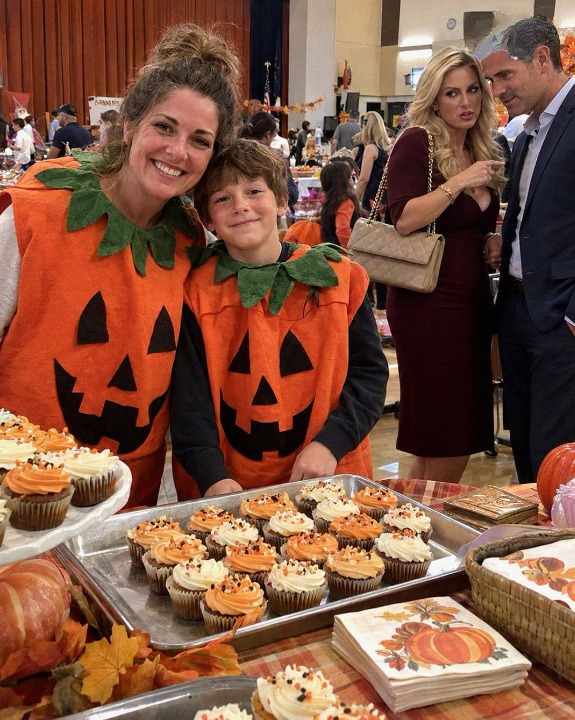
Dustin measured the ingredients while I helped him mix the batter. We decorated the cupcakes with orange frosting, little chocolate stems, and tiny green leaves.
Some turned out beautifully.
Others looked as though the pumpkins had spent the entire afternoon rolling down a hill.
We laughed at our mistakes and decided that the imperfect ones were our favorites.
Then Dustin had another idea.
“What if we wear pumpkin costumes to the fair?”
I raised an eyebrow.
“Matching costumes?”
“Yes! It would be funny.”
I pretended to consider the proposal seriously.
“Well, I suppose I could make a fool of myself for a good cause.”
He burst out laughing.
We spent the rest of the afternoon making simple pumpkin costumes from orange fabric, green felt, and a few household supplies.
They weren’t particularly elegant.
In fact, they looked ridiculous.
But Dustin loved them, and that was all that mattered.
On the morning of the fair, he hurried around the house, making sure we had packed the cupcakes, decorations, and everything else his class needed.
“Don’t forget your costume, Mom!”
“I wouldn’t dare.”
He grinned.
For the first time in weeks, he seemed completely carefree.
When we arrived at the school, the grounds were already filled with families. Colorful banners hung between the trees, children ran between the activity stations, and the smell of cinnamon, baked apples, and popcorn drifted through the air.
Music played near the main stage.
Parents chatted beside tables covered with homemade treats, while teachers helped students prepare for the afternoon activities.
Dustin immediately found some classmates and proudly showed them our cupcakes.
I watched him laughing with his friends and felt grateful for the ordinary happiness of the moment.
Then I noticed Nigel arriving.
He wasn’t alone.
Annabelle was walking beside him, dressed elegantly and looking around the school grounds as though she were inspecting the event.
I felt my stomach tighten, but I reminded myself that this was Dustin’s day.
I wasn’t going to let an uncomfortable encounter ruin it.
Nigel spotted us and walked over.
“Hey, Dustin!” he called.
Dustin turned and smiled.
“Hi, Dad!”
Nigel gave him a quick hug before glancing at my costume.
Annabelle followed his gaze.
For a moment, she said nothing.
Then she smiled in a way that made me uncomfortable.
“Well,” she said, “that pumpkin costume certainly makes a statement.”
I chose to take it as an ordinary observation.
“We had fun making them,” I replied.
She looked me up and down.
“With your figure, I suppose a pumpkin costume is a natural choice.”
Her comment landed like a slap.
I felt my face grow warm.
Before I could respond, Nigel laughed.
He actually laughed.
Then he put his arm around Annabelle and kissed her cheek as though the entire exchange were an amusing private joke.
I stood there, trying to maintain my composure.
Around us, several parents had heard the comment. One woman glanced away awkwardly, while another looked at me with sympathy.
I wanted to say something sharp.
I wanted to tell Annabelle that my appearance was none of her business and that Nigel’s laughter said far more about him than it did about me.
But before I could speak, I noticed Dustin.
He wasn’t laughing.
His smile had disappeared, and he was staring at his father with an expression I had rarely seen on his face.
“Dustin?” I asked softly.
He looked at me.
“I’m okay, Mom.”
But he wasn’t.
I could see it in the way he pressed his lips together and held his hands tightly at his sides.
I knelt slightly so I could speak to him without drawing attention.
“You don’t have to worry about this, sweetheart. Let’s enjoy the fair.”
He nodded, but his expression remained serious.
For the next hour, we helped at the class booth. Dustin handed out cupcakes, played a ring-toss game, and posed for photographs with his classmates.
He smiled when other children approached him, but every so often, I caught him looking toward Nigel and Annabelle.
It was clear that he was thinking about what had happened.
I wished I could make the situation disappear.
But I couldn’t control what other people said or did. All I could do was show my son that one unkind comment didn’t define us.
Eventually, the principal stepped onto the stage to announce the winners of the fair’s various activities.
Families gathered in front of the stage, and the teachers began arranging the students who had participated in the competitions.
Dustin stood beside me, holding the small paper bag that contained the last few cupcakes.
Then he looked up at me.
“Mom, I need to do something.”
“What is it, sweetheart?”
He didn’t explain.
Instead, he handed me the bag and walked toward the stage.
At first, I thought he was going to join his classmates.
But when the principal paused to check her notes, Dustin stepped forward and approached the microphone.
“Excuse me,” he said.
The principal looked surprised.
“Hello, Dustin. Do you need something?”
He nodded.
“Before the awards, could I show everyone something? It won’t take long.”
A few parents turned toward the stage.
I felt a sudden wave of uncertainty.
Dustin wasn’t usually the kind of child who volunteered to speak in front of a crowd. He could be confident with his friends, but standing before dozens of adults was something he rarely did.
The principal looked toward his teacher, who gave a small nod.
“All right,” she said. “What would you like to share?”
Dustin turned toward the computer table beside the stage.
“I brought something I think people should see.”
He handed a small flash drive to his teacher.
I stared at him, confused.
I had no idea what was on it.
His teacher connected it to the computer and opened a file.
A moment later, the screen behind the stage lit up.
The first image appeared.
It showed a series of messages that Dustin had saved after receiving permission to use the family computer. They were comments that had been made in a conversation about the fall fair and my costume.
I couldn’t read every line from where I stood, but I recognized the tone immediately.
The messages contained remarks about my appearance and jokes about the pumpkin costume. One included a comment suggesting that Nigel should be embarrassed to have been married to me.
The crowd became quiet.
I turned toward Nigel.
His smile had vanished.
Annabelle stared at the screen, her face suddenly pale.
Dustin stood at the microphone, holding himself remarkably still.
“I know grown-ups don’t always get along,” he began. “And I know my mom and dad don’t live together anymore. But my mom has always tried to make sure I can love both of them.”
He paused and glanced at me.
“She never tells me I have to choose between them. She helps me get ready when I visit Dad, and she always says it’s okay for me to love my family.”
My eyes filled with tears.
Dustin continued.
“But when people make fun of my mom, it hurts. She’s not just someone’s ex-wife. She’s my mom. She’s the person who helps me with homework, makes breakfast when I’m late, and stays with me when I’m sick.”
He looked toward the crowd.
“I don’t think anyone should have to be embarrassed about someone they love just because another person doesn’t like how they look.”
For several seconds, nobody spoke.
Then a few parents began applauding.
The applause spread through the audience, not as a celebration of anyone being exposed, but as support for a child who had found the courage to explain how adult behavior affected him.
I covered my mouth with one hand.
I was proud of him, but I also wished he hadn’t felt the need to carry this burden.
He should have been worrying about cupcakes, school games, and whether his class would win an award—not about defending his mother’s dignity.
At the side of the stage, Annabelle grabbed Nigel’s arm.
“Please,” she whispered urgently. “Make him stop.”
Nigel looked at her, then at Dustin.
For the first time that afternoon, he seemed to understand that this was not simply an awkward moment between adults.
Their behavior had reached their son.
He stepped forward, but Dustin had already finished speaking.
“I don’t want anyone to get in trouble,” my son said. “I just want people to be kind to each other, especially when children are listening.”
Then he handed the microphone back to the principal.
She thanked him for speaking honestly and reminded the audience that the fall fair was meant to celebrate the school community.
Dustin walked down from the stage.
I hurried toward him and wrapped my arms around him.
“Oh, sweetheart,” I whispered. “You didn’t have to do that for me.”
He hugged me tightly.
“I know. But I wanted you to know that I heard what she said, and I didn’t think it was right.”
I closed my eyes.
“You never have to defend my appearance or prove that I’m worth respecting. I’m your mom, and I love you. That’s enough.”
He nodded against my shoulder.
Across the courtyard, Nigel was speaking quietly with Annabelle. Their expressions were serious, and neither of them looked toward the audience.
After a few minutes, Nigel approached us alone.
He looked uncomfortable.
“Dustin,” he said, “can I talk to you for a moment?”
My son glanced at me.
I nodded, letting him decide whether he wanted to listen.
Nigel crouched slightly so he was at Dustin’s eye level.
“I owe you an apology,” he said. “I shouldn’t have laughed at those comments. I should have made it clear that speaking about your mother that way was wrong.”
Dustin didn’t answer immediately.
Nigel continued.
“You should never have felt that you needed to stand up in front of everyone to tell me that. I should have understood it myself.”
It wasn’t a perfect conversation, and it didn’t undo what had happened.
But it was a beginning.
Later, when the awards were announced, Dustin’s class received recognition for its creative booth. He returned to his friends, and before long, he was laughing again.
I watched him from beside the cupcake table.
That day had started with an insult that could easily have ruined the event. It ended with a difficult but necessary conversation about respect, responsibility, and the effect adult behavior can have on children.
On the drive home, Dustin sat quietly for a few minutes before speaking.
“Mom?”
“Yes, sweetheart?”
“Are you upset with me for showing everyone those messages?”
I thought carefully before answering.
“I’m not upset with you. I understand why you felt hurt, and I’m proud that you care about how people treat others. But next time something like this happens, please talk to me or another trusted adult first. You shouldn’t have to handle an adult problem all by yourself.”
He nodded.
“Okay.”
I reached over and squeezed his hand.
“You can always tell me how you feel. You don’t have to protect me from everything, either.”
He smiled faintly.
That evening, I placed our matching pumpkin costumes in the laundry basket and put the remaining cupcakes in the refrigerator.
They were ordinary things, but they reminded me of what the day had really been about.
Not my ex-husband’s new relationship. Not the comments about my appearance. Not even the unexpected moment on the stage.
It was about a little boy who loved both of his parents and wanted the adults in his life to remember that love should never be used as a reason to hurt someone else.
I had promised myself after the divorce that Dustin would never be forced to choose between us.
I still believed that promise mattered.
But I also learned that protecting a child doesn’t mean pretending hurtful behavior isn’t happening. It means listening when they speak, setting boundaries when necessary, and showing them that respect is not something anyone has to earn by looking a certain way.
As I tucked Dustin into bed that night, he wrapped his arms around me.
“Your pumpkin costume was still the best one,” he whispered.
I laughed and kissed his forehead.
“Thank you, sweetheart.”
And for the first time that day, the only thing I felt was gratitude.
My son had reminded me that dignity doesn’t come from appearance, relationships, or other people’s opinions.
It comes from how we treat one another—and from having the courage to choose kindness, even when doing so is difficult.