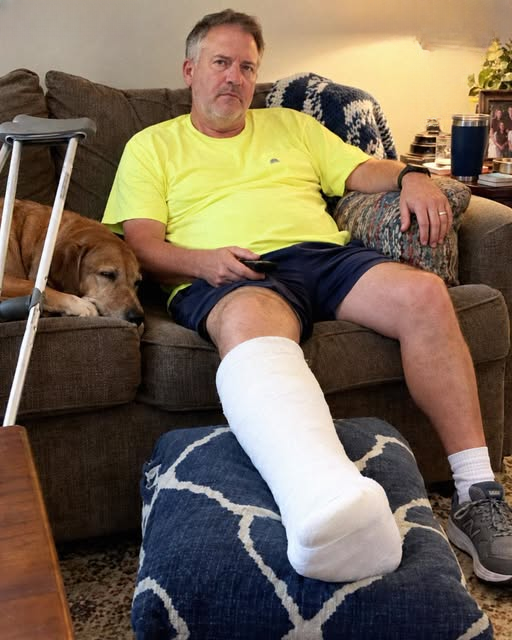
After thirty-two years of marriage, I thought I knew almost everything about my husband, Conor.
I knew how he took his coffee, which television programs he watched when he couldn’t sleep, and exactly how he behaved whenever he caught a cold. I knew that he complained about the weather even when the sun was shining, and I knew that a minor headache could convince him the entire day needed to be rearranged around his recovery.
Conor had always been a little dramatic whenever he was sick or injured.
A simple cold meant hot soup, herbal tea, extra blankets, and regular updates about how terrible he felt. If he had a headache, he wanted the curtains closed and the television turned down. If he developed a cough, he would ask me whether I thought it sounded serious.
I usually laughed at him, but I never minded taking care of him.
After more than three decades together, those little routines had become part of our life.
That was why I wasn’t particularly surprised when one afternoon, a coworker brought him home with his right leg wrapped in a cast.
I was in the kitchen preparing dinner when I heard the front door open.
“Can you come here for a minute?” Conor called.
There was something unusual about his voice, so I hurried into the hallway.
He was standing near the door, leaning heavily on a pair of crutches. His face was pale, and his right leg was held slightly forward.
“What happened to you?” I asked.
“Slipped at work,” he replied. “The floor was wet, and I went down before I could catch myself.”
His coworker explained that Conor had been taken for medical evaluation. The doctors had examined his ankle, applied a cast, and instructed him to keep weight off the injured leg while it healed.
“Six weeks,” Conor announced with a long sigh after his coworker left. “Six whole weeks of this. I can’t imagine anything worse.”
I gave him a sympathetic smile.
“You’ve survived thirty-two years of marriage to me. I’m sure you can survive six weeks with a cast.”
He laughed.
For the first few hours, everything seemed perfectly normal.
I helped him settle into his favorite chair, brought him something to eat, and placed a glass of water on the table beside him. I arranged a few pillows beneath his leg and made sure his phone and television remote were within reach.
He thanked me repeatedly.
Then I noticed that the edge of the cast appeared to be rubbing against his skin.
“Let me check that padding,” I said, reaching toward his leg.
Conor immediately pulled away.
“I’ve got it.”
I stopped and looked at him.
“Since when?”
He gave a quick, uncomfortable laugh.
“I just don’t want you bumping it. The ankle is already sore enough.”
I shrugged.
“All right. Just tell me if you need anything.”
At the time, his reaction seemed reasonable. He was in pain, and perhaps he was simply worried that I might accidentally make the injury worse.
The following morning, I offered to help him prepare for his shower.
“No, thanks,” he said. “I’ll manage.”
I reminded him that I could help cover the cast so it wouldn’t get wet, but he insisted that he had everything under control.
A few days later, I noticed the padding near the top of the cast had shifted slightly.
I reached toward it while he was sitting on the sofa.
Conor jerked his leg away so quickly that I nearly dropped the folded towel I was holding.
“Please don’t touch it,” he said sharply.
I stared at him.
For a moment, neither of us spoke.
Then I forced a small smile.
“Conor, I’m only trying to help.”
“I know. I just want to handle this myself.”
His voice softened, but something about the exchange bothered me.
This was the same man who had once asked me to check his temperature four times in one evening because he was convinced his cold was getting worse.
Now he wouldn’t even allow me to straighten a loose piece of padding.
I told myself that people sometimes behaved differently when they were in pain. Perhaps he felt embarrassed about needing assistance. Perhaps he wanted to preserve a little independence while recovering.
I decided not to push the issue.
But over the next two weeks, his behavior became increasingly unusual.
He began locking the bathroom door whenever he showered, even though he needed extra time to move safely on his crutches.
He refused my offers to help protect the cast from water.
At night, he carefully positioned his injured leg on his side of the bed and became irritated whenever I moved too close.
If I asked about his next medical appointment, he answered vaguely.
“The clinic will call.”
“Did they give you another appointment card?”
“I’ll sort it out.”
Whenever I asked whether his pain was improving, he changed the subject.
I began to feel as though I were living with a stranger who happened to share my home.
It wasn’t simply the cast that concerned me. It was the secrecy surrounding it.
After thirty-two years, I could usually tell when Conor was worried about something. He had a particular habit of rubbing the back of his neck when he was uncomfortable, and he often became unusually quiet when he was trying to avoid a difficult conversation.
I had seen those signs before.
But I had never seen him guard an injury so carefully.
One evening, while we were eating dinner, I finally asked him whether something else was bothering him.
He put down his fork.
“What do you mean?”
“You’ve been acting strangely since you came home. You won’t let me near your cast, you keep avoiding questions about your appointments, and you seem worried whenever I offer to help.”
He looked down at his plate.
“I’m just frustrated. I hate depending on people.”
“I understand that,” I replied. “But I’m your wife. You don’t have to pretend everything is fine with me.”
For a moment, I thought he might tell me what was really going on.
Instead, he sighed and said he was tired.
The conversation ended there.
I went to bed that night with a heavy feeling in my chest.
I didn’t want to suspect my husband of hiding something serious. We had built a life together, raised our family, and supported one another through financial worries, family disagreements, and the ordinary challenges that come with growing older.
I had always believed that honesty was one of the strongest parts of our marriage.
Now I wasn’t sure what to believe.
Still, I reminded myself that I shouldn’t jump to conclusions without understanding the facts.
Perhaps there was a simple explanation.
Perhaps he was embarrassed about something that had happened at work.
Perhaps he was afraid of how I would react to information he wasn’t ready to share.
Whatever the reason, I hoped he would eventually trust me enough to talk.
Then came the night everything changed.
It was late, and I was getting ready for bed when I heard a sudden crash from the bathroom.
The sound was followed by a sharp gasp.
“Conor?”
There was no answer.
I hurried down the hallway and knocked on the bathroom door.
“Are you all right?”
“I’m fine,” he called back.
His voice sounded strained.
A moment later, I heard another noise, followed by a frustrated groan.
I tried the handle.
The door wasn’t locked.
When I opened it, I found Conor sitting on the floor beside the bathtub. One crutch lay on its side, and a towel had fallen near the sink.
He looked startled when he saw me.
“What happened?” I asked, moving toward him.
“I slipped while turning around,” he said. “I’m all right.”
I immediately checked whether he had struck his head or hurt himself elsewhere. He insisted that he hadn’t, but his face showed how uncomfortable he was.
Then I noticed that part of his cast had cracked.
A section near the side had broken away, exposing some of the material underneath.
“Oh, Conor,” I said. “We need to get that checked.”
He reached for a towel and tried to cover the damaged area.
“Don’t touch it.”
I stopped.
His reaction was so sudden and intense that I stared at him in disbelief.
“Your cast is damaged,” I said. “You could hurt yourself if we leave it like this.”
“I said I’ll handle it.”
He tried to pull the towel over the opening, but his position made it difficult.
I knelt beside him, concerned that he might fall again if he tried to move without assistance.
“Please, just let me help you get somewhere comfortable. Then we can contact the clinic and ask what to do.”
For a brief moment, he looked as though he wanted to argue.
Then his hand slipped, and the towel fell away.
The damaged section of the cast became visible.
I leaned forward, expecting to see the padding or the ordinary medical dressing beneath it.
Instead, I noticed something that made me stop breathing for a moment.
There was a small, carefully wrapped object tucked beneath the loose edge of the cast. A narrow strip of fabric surrounded it, and part of a paper label was visible beside it.
I stared, confused.
“Conor, what is that?”
His face changed immediately.
He reached for the object, but I had already seen enough to realize that it wasn’t part of the medical equipment.
“What have you been hiding under there?” I asked.
He looked away.
For several seconds, neither of us spoke.
Then he whispered, “I was going to tell you.”
My heart began to race.
“Tell me what?”
He closed his eyes briefly, as though he had been carrying the weight of the secret for far too long.
“I didn’t know how to explain it.”
I felt a sudden wave of hurt.
“Conor, we’ve been married for thirty-two years. You don’t have to protect me from every difficult conversation. But you can’t expect me to understand what’s happening when you won’t tell me anything.”
He looked at me, and for the first time in weeks, I saw the familiar uncertainty in his expression.
The secret was no longer something he could hide behind a locked door or a carefully positioned leg.
It was right there between us.
I wanted answers, but I also knew that we needed to deal with the damaged cast safely. I helped him settle into a stable position without disturbing the injury, then contacted the appropriate medical service for advice about the broken cast and his fall.
Only after we had arranged for him to receive the necessary assessment did I return to the question that had been troubling me.
“Now,” I said quietly, “please tell me the truth.”
Conor looked down at the small wrapped object.
Then he took a long breath.
“What I’m about to tell you,” he said, “has nothing to do with the accident at work.”
I felt my stomach tighten.
“What do you mean?”
He finally met my eyes.
“The cast gave me an excuse to keep something hidden until I was ready.”
I stared at him, struggling to understand.
After thirty-two years of marriage, I had thought I knew every important part of his life. Yet here I was, sitting on the bathroom floor, looking at a man who seemed frightened of revealing something to his own wife.
I didn’t know whether I was about to hear an explanation that would reassure me or a confession that would change our relationship forever.
But I knew one thing.
I wasn’t going to let the conversation end with another vague answer.
“Conor,” I said, keeping my voice steady, “whatever this is, we need to talk about it honestly.”
He nodded slowly.
Then he began to unwrap the small object.
And as I watched his hands tremble, I realized that the most difficult part of that night might not be discovering what he had hidden beneath his cast.
It might be discovering why he had believed he couldn’t trust me with the truth.