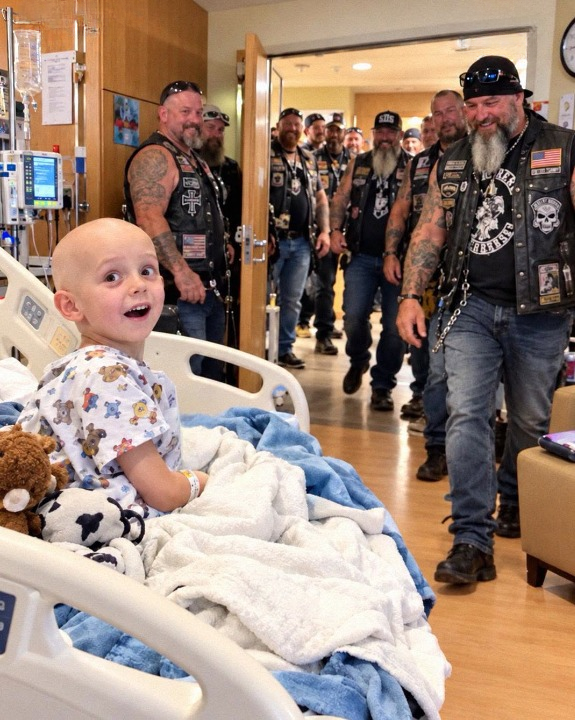
The doctor told me my son might have only three months left.
I remember sitting beside his hospital bed, listening as the medical team explained his condition and the uncertainty surrounding the months ahead. I nodded when they spoke, even though I could barely understand their words through the noise of my own thoughts.
Three months.
My little boy was still so young. He still had places he wanted to visit, games he wanted to play, and plans he talked about as though he had all the time in the world.
He wanted to see the ocean from a mountain road. He wanted to travel across the country. Most of all, he wanted to become a biker.
Not necessarily a professional racer or someone famous. He simply loved motorcycles. He loved the deep rumble of their engines, the shiny chrome, the leather jackets, and the stories about people who traveled long distances together.
Whenever a motorcycle passed our house, he would hurry to the window.
“Mom, imagine riding one of those someday!”
I would smile and tell him that we could talk about it when he was older.
I never imagined that someday might become such a painful word.
I had been raising him on my own for almost his entire life. His father had never been a consistent presence, and I had spent twelve years trying to fill every role my son needed.
I worked, paid the bills, attended school meetings, cooked meals, and stayed awake through nights when he was sick. I tried to be strong even when I felt exhausted.
I told myself that love would be enough.
Then his illness changed everything.
Our days became organized around hospital appointments, medical conversations, treatment schedules, and the constant effort to make him comfortable. I learned how to smile when he needed reassurance and how to step into the hallway when I needed a moment to cry.
I would have given anything to exchange places with him.
But I couldn’t.
All I could do was remain beside him and make sure he knew he wasn’t facing this alone.
A few weeks earlier, a new doctor had joined his care team.
I’ll admit that I didn’t immediately feel comfortable around him.
He was a large man with tattoos covering both arms, some extending above the collar of his shirt. His voice was deep, and his appearance was quite different from the doctors I had grown accustomed to seeing in the hospital.
When I first met him, I found myself studying his face, wondering what kind of person he was.
My mother noticed him, too.
One afternoon, she leaned toward me and whispered, “Is he really one of the doctors here?”
I gave her a questioning look.
“Why wouldn’t he be?”
She glanced toward the corridor.
“His tattoos. I just wasn’t expecting someone who looks like that.”
I understood her surprise because I had experienced something similar. I had formed an impression before I knew anything about him.
Still, I reminded myself that appearances didn’t tell the whole story.
I decided to pay attention to how he treated my son.
That was what mattered.
And little by little, I began noticing things that changed my opinion.
Unlike some people who spoke to me while my son sat quietly beside us, this doctor always addressed my boy directly.
He asked how he was feeling. He remembered the names of his favorite games and listened when he talked about school. He never made him feel invisible simply because he was young or ill.
If my son had a question, the doctor answered it in language he could understand.
If he didn’t feel like talking, the doctor didn’t force him.
And when my boy made a joke, the doctor laughed as though it were the funniest thing he had heard all day.
Those moments meant more to me than I could explain.
There were days when I struggled to find something cheerful to say. I had become so focused on medical updates and practical decisions that I sometimes forgot how desperately my son needed ordinary conversations.
The doctor seemed to understand that a hospital room was still a place where a child should be allowed to laugh, dream, and be himself.
One afternoon, I returned from the cafeteria and found the two of them sitting close together.
They were whispering.
My son was trying very hard not to laugh.
The doctor noticed me first and straightened up, wearing an innocent expression that immediately made me suspicious.
“What are you two talking about?” I asked.
My son pressed his lips together.
“Nothing, Mom.”
I raised an eyebrow.
“Nothing?”
He glanced at the doctor.
The doctor shrugged.
“I’m afraid I’m not allowed to reveal confidential information,” he said solemnly.
My son burst out laughing.
I shook my head, pretending to be offended.
“Well, that’s very interesting. Apparently, everyone in this room has secrets except me.”
My son reached for my hand.
“It’s a surprise, Mom.”
I wanted to ask more questions, but seeing him smile so brightly made me stop.
For the first time in days, he looked less like a patient and more like the boy I remembered from before the hospital became the center of our lives.
I decided to let him enjoy whatever little secret they had planned.
Over the following days, I noticed that the doctor often brought up motorcycles.
Sometimes he asked my son about his favorite models. Other times, he listened to stories about the imaginary road trips my boy wanted to take when he grew up.
My son could talk about motorcycles for hours.
He knew the difference between several types, recognized certain brands, and had memorized facts about famous long-distance rides. He had even drawn pictures of himself wearing a leather jacket and helmet, standing beside a motorcycle beneath a wide blue sky.
I kept those drawings in a folder beside my bed.
They were reminders that my son was more than his diagnosis.
He was a child with hopes, interests, and a vivid imagination.
Then, one afternoon, something unusual happened.
I was sitting beside his bed when I heard a growing rumble in the distance.
At first, I assumed it was traffic outside the hospital.
But the sound grew louder.
I looked toward the window.
Several motorcycles were pulling into the parking area.
Then more appeared behind them.
I counted as best I could, unable to believe what I was seeing.
There were twelve.
Twelve motorcycles, lined up neatly near the hospital entrance.
Their riders wore leather jackets, sturdy boots, and helmets. Some had gray hair, while others looked much younger. They spoke to one another as they dismounted, and their faces showed a mixture of excitement and nervous anticipation.
I turned toward my son.
His eyes had widened.
“Mom,” he whispered. “Are those bikers?”
Before I could answer, someone knocked on the door.
The tattooed doctor entered, carrying a small paper bag. Behind him stood several of the motorcyclists.
For a moment, I could only stare.
The doctor smiled at my son.
“Well, champ,” he said, “I think we have some visitors for you.”
My boy looked from the doctor to the riders, barely able to contain his excitement.
“Are they really here to see me?”
“They certainly are,” the doctor replied.
One of the riders stepped forward. He was an older man with a silver beard and a weathered leather jacket. He removed his cap and gave my son a friendly wave.
“Hello there, young man. We heard you know quite a bit about motorcycles.”
My son nodded enthusiastically.
“I know lots of things about them!”
“Then I think you’re going to enjoy meeting our group.”
I remained near the bed, overwhelmed by the scene unfolding in front of me.
I didn’t understand how these people had learned about my son or why they had come all this way. I looked at the doctor, hoping he would explain.
He seemed to understand my expression.
“We’ve been planning this for a little while,” he said quietly. “Your son has told me a lot about his dream. I thought we might find a way to make a special memory for him.”
I swallowed hard.
“You arranged all this?”
He nodded.
“With the help of some wonderful people.”
My son was looking at the motorcycles through the window again.
“Can I ride one?” he asked.
The doctor’s expression became gentle.
“Given your medical condition, we need to be careful about what activities are safe for you. I don’t want you doing anything that could put your health at risk.”
My son’s smile faded slightly.
I knew that question had been coming. It was the dream he had talked about for years.
The doctor pulled a chair closer to the bed.
“But that doesn’t mean we can’t bring some of the excitement to you.”
My son looked up.
“What do you mean?”
The older biker stepped forward and placed a small package on the bedside table.
“We’ve got something special for you,” he said. “And we’d like you to be part of our group for the day.”
My son stared at him.
“Me?”
“Absolutely,” another rider replied. “Every group needs someone who knows the important facts about motorcycles.”
A few of the riders chuckled.
The doctor opened the paper bag and took out a black leather vest. It was small enough for my son, and a carefully embroidered patch had been sewn onto the back.
My boy gasped.
The patch displayed the name of the riding group, along with a smaller emblem they had created especially for him.
The doctor held up the vest.
“What do you think, champ?”
My son reached for it with trembling hands.
“Is this really mine?”
“It’s yours,” the doctor said. “They wanted you to have something that would remind you that you’re part of their community.”
My son ran his fingers over the patch.
For several seconds, he couldn’t speak.
Then he looked at me.
“Mom, can I try it on?”
I nodded, tears already gathering in my eyes.
We helped him put the vest on carefully, making sure it didn’t interfere with his medical equipment or cause him any discomfort.
When he looked down at himself, his entire face transformed.
He wasn’t thinking about hospital walls or appointments. He wasn’t asking about the future or worrying about what the doctors might say next.
He was simply a boy wearing the vest he had always dreamed of owning.
The bikers gathered around him, introducing themselves one by one. They told him about their favorite rides, showed him photographs of their motorcycles, and answered his questions with remarkable patience.
One rider had traveled through several mountain regions. Another had restored an old motorcycle with his father. A third carried photographs of a bike he had owned for more than twenty years.
My son listened to every story.
He asked questions, laughed at their jokes, and showed them his drawings.
Soon, the hospital room was filled with conversation.
Even the nurses who passed by stopped to smile.
I stood near the window, watching my boy enjoy a moment that had nothing to do with his illness.
The doctor came to stand beside me.
“Thank you,” I whispered.
He looked toward my son.
“You don’t have to thank me. I just thought he deserved something wonderful to look forward to.”
I wiped my cheeks.
“I was worried when you first joined his team,” I admitted. “I didn’t know what to make of you.”
He smiled gently.
“That’s understandable. But I hope you can see that I’m here to help him, just like everyone else on his team.”
I nodded.
I had judged him before I knew him, just as my mother had. His tattoos and imposing appearance had distracted me from the qualities that mattered most: his patience, his compassion, and the respect he showed my child.
That day taught me something I wish I had understood earlier.
Kindness doesn’t always arrive in the form we expect. Sometimes it comes from someone we might have misunderstood at first glance.
Before the bikers left, they promised to stay in touch and send my son photographs from their future rides. They also gave him a small album filled with pictures of their motorcycles and the places they had traveled.
My son held the album close to his chest.
“Do you think I can be a biker too?” he asked the doctor.
The doctor sat beside him.
“I think you already have the most important part,” he replied. “You have the curiosity, the enthusiasm, and the courage to keep dreaming. And you have a whole group of people cheering you on.”
My son smiled.
I looked around the room at the people who had taken time out of their lives to bring happiness to a child they barely knew.
I knew that none of this could change the medical uncertainty we were facing. No gift could erase the difficult conversations ahead, and no kind gesture could promise us more time than we had been given.
But it could give my son something precious.
It could give him a memory filled with laughter, friendship, and the feeling that he belonged to something bigger than himself.
That evening, after everyone had left, I helped him settle back into bed.
He placed the leather vest carefully beside his pillow and opened the photograph album again.
“Mom,” he said sleepily, “today was one of the best days ever.”
I brushed his hair away from his forehead.
“I’m so glad, sweetheart.”
He closed his eyes, still holding the album.
For the first time in a long while, I sat beside his bed without immediately thinking about the next appointment or the next difficult decision.
Instead, I thought about the twelve riders who had walked into our lives, the doctor who had taken my son’s dream seriously, and the little boy who had reminded me that happiness could still find us in the middle of uncertainty.
I had entered that hospital believing my job was to keep my son strong.
That day, I learned that strength could also mean letting other people help us carry the weight.
And sometimes, the most meaningful gift we can give a child isn’t a promise about tomorrow.
It’s a beautiful memory today—one that reminds them they are loved, valued, and never alone.