I was sixty-one years old, barely five feet two inches tall, and traveling alone to meet my first granddaughter for the very first time.
I had spent weeks looking forward to that trip. I had packed a small gift for the baby, carefully chosen my travel clothes, and checked my flight details more times than I cared to admit. After years of waiting for this moment, I was finally going to hold the newest member of our family in my arms.
All I wanted was a peaceful flight.
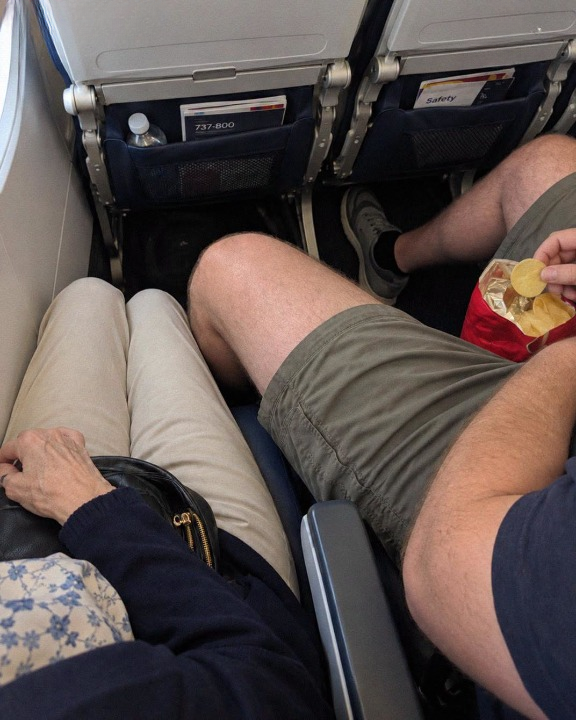
Unfortunately, the man assigned to the seat beside me had a very different idea of personal space.
He appeared to be around fifty, with broad shoulders, an expensive quarter-zip sweater, and polished loafers. He looked like someone who was accustomed to getting his way, and his behavior began before the plane had even left the ground.
As soon as he settled into his seat, he spread his legs so widely that one knee extended well into my side of the seating area.
At first, I assumed he would adjust once everyone was settled.
I moved slightly toward the window to give him room.
Instead, he stretched out even farther.
I glanced at the narrow space between us and tried to find a comfortable position. My shoulder was nearly against the window, and my handbag was tucked tightly beneath the seat in front of me.
I waited a moment before speaking.
“Excuse me,” I said politely. “Would you mind moving your leg over a little? I’m having trouble sitting comfortably.”
He looked down at me, then glanced at the space between our seats.
A small smile crossed his face.
“You’re tiny,” he replied. “You don’t need that much room.”
For a second, I thought he was joking.
I gave him a polite smile, hoping he would realize how unreasonable his comment sounded.
But he simply leaned back and returned his attention to his phone.
His knee remained exactly where it was.
I didn’t want to start an argument before takeoff, so I tried to make the best of the situation. I adjusted my posture, moved my arm closer to my body, and concentrated on the excitement of the journey ahead.
I reminded myself that I was going to meet my granddaughter.
That was what mattered.
But as the hours passed, the situation became increasingly uncomfortable.
The man’s leg continued pressing into my side. He occupied the shared armrest, draped his jacket over the divider between us, and repeatedly extended his foot into the space in front of my legs.
Whenever I shifted to find a more comfortable position, I ended up twisting toward the window.
My hip began to ache.
I tried to be patient. Perhaps he was simply unaware of how much room he was taking up. Perhaps a gentle reminder would finally resolve the problem.
“Could you please give me a little more space?” I asked again.
He removed one side of his headphones and sighed as though I had interrupted something important.
“I’m six feet three,” he explained. “Where exactly do you expect me to put my legs?”
I looked at him calmly.
“I understand that you’re tall,” I replied. “I’m only asking you to stay within your own seating area as much as possible.”
He gave a dismissive shrug.
“If you’re not using all that space, what’s the problem?”
Then he put his headphones back on.
I stared ahead, trying to keep my frustration under control.
His words stayed with me.
If you’re not using the space, what’s the problem?
It was such a simple sentence, yet it revealed exactly how he viewed the situation. In his mind, my smaller frame somehow meant that the space assigned to me mattered less.
I had paid for my ticket just as he had. I had the same right to sit comfortably, use my tray table, and enjoy the journey without constantly having to negotiate for room that was supposed to be mine.
Still, I remained quiet.
I had spent much of my life avoiding unnecessary disagreements. My late husband used to joke that I was the sort of person who would apologize to a chair if I accidentally bumped into it.
He wasn’t entirely wrong.
I preferred peaceful conversations to confrontations, and I often gave people the benefit of the doubt even when they didn’t seem to deserve it.
But there is a difference between being considerate and allowing someone else to disregard your needs.
That afternoon, I was beginning to understand the difference.
A little later, I decided to lower my tray table so I could take out the small snack I had packed for the journey.
Before I could open it fully, I realized that the man’s elbow was partly resting across the edge of my tray area.
“Excuse me,” I said again. “I’d like to use my tray table.”
He glanced at it without moving his arm.
“Seriously?” he muttered.
I waited.
He finally shifted his elbow a few inches, but his expression suggested that I was the one behaving unreasonably.
Then he shook his head.
“Some people really do make everything difficult.”
I felt my cheeks grow warm.
For a moment, I considered asking the flight attendant for assistance. I had already tried speaking to him politely more than once, and nothing seemed to change.
But I also knew that I was tired, uncomfortable, and emotionally invested in reaching my destination without any further stress.
I took a slow breath and focused on my snack.
I was not going to let a stranger ruin the excitement of meeting my granddaughter.
I pictured her tiny hands and the little gift waiting in my carry-on. I imagined my family gathering around the baby, smiling as we took photographs together.
Those thoughts helped me regain my composure.
The man beside me, meanwhile, continued behaving as though the entire row belonged to him.
He stretched his legs, adjusted his jacket, and occasionally shifted his weight without considering how his movements affected the person beside him.
Whenever our arms brushed, he looked annoyed.
Whenever I adjusted my position, I had to remind myself not to apologize for simply occupying my assigned seat.
Eventually, several hours into the flight, he removed his headphones and unfastened his seat belt.
“Going to the restroom,” he muttered.
He stood, squeezed past the passenger on his other side, and made his way into the aisle.
I watched him disappear toward the back of the aircraft.
For the first time since boarding, the seat beside me was empty.
I slowly straightened my aching leg.
Then I adjusted my shoulders, which had been pressed toward the window for most of the journey.
The difference was remarkable.
There was no knee pressing against my side. No elbow intruding on my tray table. No jacket hanging over the divider.
I could finally sit naturally.
I took a deep breath and looked at the space around me.
It was almost funny.
For hours, I had been made to feel as though I was asking for something unreasonable simply by wanting to sit comfortably in the seat I had paid for.
Now, with the man temporarily gone, I had enough room to move without making any special effort.
And then I remembered his question.
“If you’re not using the space, what’s the problem?”
I looked at his seat and thought about how the next few minutes might unfold.
I wasn’t interested in damaging anyone’s belongings or creating a safety issue. I didn’t want to interfere with another passenger’s property or give the flight crew an unnecessary problem to manage.
But I did want the situation to change.
I decided to take a different approach.
I gathered my own belongings, made sure everything was secure, and checked the area around my feet. Then I asked a passing flight attendant whether there was a reasonable way to address the ongoing seating problem.
She listened while I explained what had happened.
I described how I had repeatedly asked the man to give me more room and how his behavior had made it difficult to sit comfortably.
The flight attendant looked at the row and nodded thoughtfully.
“Thank you for letting me know,” she said. “I’ll see what I can do to help.”
I appreciated that she had listened without making the situation more uncomfortable.
After she moved on, I settled back into my seat and waited.
I didn’t know exactly what would happen next, but I felt better knowing that I had finally spoken up instead of silently accepting the situation.
A few minutes passed.
I heard footsteps approaching from the aisle.
The man was returning.
He came around the row, adjusting his sweater as he prepared to sit down. He appeared to be in the same impatient mood as before, and I suspected he expected the rest of the flight to continue exactly as it had.
Then he looked toward his seat.
He stopped.
His expression changed from mild annoyance to complete surprise.
He stared at the space in front of him, then glanced at me as though he expected me to explain something immediately.
“What happened here?” he demanded.
Several passengers nearby looked up.
I remained calm.
He pointed toward his seating area, his face growing increasingly red.
“What did you do?”
I looked at him, then toward the flight attendant, who was approaching our row.
For the first time during the flight, he seemed uncertain about what to say next.
The flight attendant stopped beside us and asked him to explain his concern.
He began speaking quickly, gesturing toward his seat and looking from me to the attendant.
I waited until he had finished.
Then I spoke in the same measured tone I had used from the beginning.
“I asked for enough room to sit comfortably,” I said. “I tried explaining that several times, but we weren’t able to resolve it between ourselves.”
The flight attendant listened carefully.
She asked both of us a few questions, checked the seating arrangement, and explained that passengers were expected to treat one another respectfully and follow the crew’s instructions.
The man looked as though he wanted to argue, but the attendant remained professional.
I felt a wave of relief.
I hadn’t needed to raise my voice or trade insults with a stranger. I had simply explained the problem and asked a member of the crew for assistance.
The man eventually stepped back, still visibly frustrated.
I turned toward the window and took another slow breath.
I thought about how easily the situation could have been avoided if he had listened the first time I asked for a little more room.
There had been no need for the dismissive comments or the repeated attempts to make me feel unreasonable.
We were two strangers sharing a row of airplane seats, each entitled to basic courtesy.
That was all.
As the flight continued, I found myself thinking about my late husband.
He had always encouraged me to be kind, but he also believed that kindness should never require a person to ignore their own needs.
I could almost hear him telling me that I had every right to speak up.
I smiled to myself.
The journey had certainly not gone the way I had imagined, but it had reminded me of something important.
Being polite doesn’t mean remaining silent when someone treats you unfairly. And standing up for yourself doesn’t require cruelty, revenge, or a public argument.
Sometimes, it simply means explaining the problem clearly and asking the right person to help resolve it.
When the plane finally began its descent, I looked out at the approaching city and felt my excitement returning.
I was about to meet my first granddaughter.
That was the memory I wanted to carry away from the trip—not the uncomfortable hours, not the disagreement, and certainly not the behavior of a stranger who had forgotten that courtesy works both ways.
I gathered my belongings, checked that I had the gift for the baby, and prepared to leave the aircraft.
Whatever the man beside me thought about the experience, I knew that I had learned something valuable.
My size did not determine how much respect I deserved.
And no matter how small someone might appear, their comfort, dignity, and personal space matter just as much as anyone else’s.