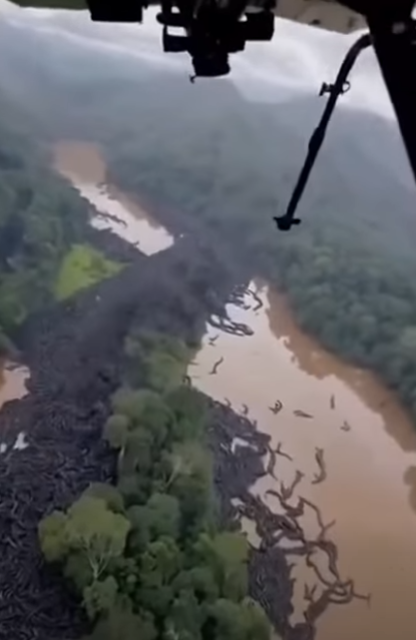
Unusual Jungle Footage Sparks Curiosity: What Could Be Behind the Mysterious Sighting?
Videos showing unusual shapes or enormous figures in remote forests can quickly attract attention online. A short clip, especially one recorded in a dense jungle or mist-covered landscape, may leave viewers wondering whether they have witnessed something extraordinary. When the footage is unclear and the location is unfamiliar, even an ordinary object can appear mysterious.
But before drawing conclusions, it is important to examine what the video actually shows, whether its source can be verified, and whether there are reasonable explanations for what appears on screen.
Why Mysterious Footage Captures People’s Attention
People are naturally curious about unusual images and unexplained events. A video that appears to show a towering figure moving between trees can inspire questions about its size, identity, and origin.
Online headlines often intensify this curiosity with dramatic wording, encouraging viewers to watch before the full context becomes clear. Sometimes the footage is presented without a precise location, a recording date, or information about the person who captured it.
These missing details make independent verification difficult. Without knowing where the video was recorded or having access to the original file, it is not possible to determine confidently what the camera captured.
A compelling presentation can make a clip feel convincing, but the strength of a claim depends on the evidence behind it rather than the emotions it creates.
How Forest Environments Can Distort Perception
Dense forests and jungles create challenging conditions for photography and video recording. Trees, vines, uneven terrain, fog, and changing light can obscure objects and make their dimensions difficult to judge.
An animal standing behind vegetation may appear much larger or stranger than it would in a clear view. A tree trunk viewed from an unusual angle might resemble a moving figure, while a distant piece of equipment could be mistaken for something unfamiliar.
Camera movement can add to the confusion. When a person zooms in on a distant object, the image may lose detail, making it harder to identify recognizable features. Motion blur can also change the apparent outline of an object.
These effects do not mean every unusual clip has an ordinary explanation. They do mean that a video should be examined carefully before its subject is identified.
Could the Footage Show a Real Animal?
One possibility worth considering is that the recording shows a known animal that is difficult to identify because of the viewing conditions.
Large animals moving through thick vegetation may be visible only in fragments. A viewer might see a back, a head, or a limb without enough information to recognize the species. If the animal is partly hidden or moving quickly, its shape may appear unfamiliar.
Identifying an animal usually requires more than estimating its apparent height. Useful details include its body proportions, movement, gait, visible features, habitat, and the surrounding environment.
Experts may also consider whether the animal’s behavior matches what is known about species living in the region. Clear images from different angles can be particularly helpful.
Without the original footage or reliable information about its location, however, it would be premature to identify the subject as any particular animal.
The Influence of Folklore and Local Legends
Stories about mysterious beings in remote landscapes have existed in many cultures for generations. Some describe unusually large creatures, while others feature forest spirits or legendary guardians associated with particular places.
Familiar examples include Bigfoot in North American folklore and the Yeti in Himalayan traditions. These stories have inspired books, documentaries, expeditions, and countless online discussions.
When an unclear video circulates, viewers may compare its subject with figures from these traditions. Such comparisons can make a clip more interesting, but similarities in appearance do not establish that a legendary creature was recorded.
Folklore remains culturally significant because it reflects the stories, beliefs, and traditions communities pass between generations. Examining these stories can be valuable in its own right, while keeping cultural history separate from scientific evidence.
Could Digital Editing Be Involved?
Modern editing tools make it possible to change the appearance of video footage in many ways. Computer-generated imagery, compositing, visual effects, and AI-assisted tools can create convincing scenes that would be difficult or impossible to record in real life.
A fabricated creature might be added to an existing forest video. An ordinary object could be altered to look unusually large, or several recordings might be combined to create the impression of an event that never occurred.
However, it is important not to assume that every unusual video is digitally manipulated. A clip may be authentic but unclear, staged for entertainment, or recorded under conditions that make its subject difficult to identify.
Determining whether editing was involved requires examining the actual recording. Potential clues include inconsistent lighting, unnatural movement, mismatched shadows, unusual edges, and differences in image quality. None of these signs proves manipulation on its own, since ordinary camera limitations can produce similar effects.
The original, highest-quality recording is generally more useful than a heavily compressed version shared across social media.
What Scientists Look for When Evaluating Unusual Claims
When a video appears to show something previously undocumented, researchers need evidence that can be independently examined.
The first question is provenance: who recorded the footage, when was it captured, and where did the event occur? Reliable answers help establish whether the recording can be investigated further.
Researchers may then examine the image quality, compare the subject with known animals or objects, and look for additional recordings of the same event. Independent witnesses can provide useful information, particularly when their accounts were recorded before they had an opportunity to influence one another.
Physical evidence may also be relevant. Depending on the claim, this could include tracks, biological material, environmental measurements, or other observations that can be studied using established methods.
A single unclear clip rarely provides enough information to establish the existence of an unknown species. Strong conclusions require evidence that can be checked and evaluated by people who are not relying solely on the original claim.
Why Viral Videos Can Be Difficult to Verify
Once a video begins spreading online, copies may appear on multiple accounts. Each version can have a different caption, headline, or explanation, and the original source may become difficult to locate.
Some posts provide little information beyond a brief claim that something extraordinary has been recorded. Others use dramatic descriptions without identifying the location or explaining how the footage was obtained.
As a result, viewers may encounter numerous versions of the same recording without receiving any additional evidence.
A practical way to evaluate such content is to search for the earliest available upload, examine whether the creator provides context, and look for independent reporting or expert analysis. Reverse image searches and individual video frames can sometimes help identify earlier appearances of the same material.
It is also useful to distinguish between a claim being widely shared and a claim being independently confirmed. Popularity can make a video visible, but it cannot establish the accuracy of its interpretation.
How Perspective Can Make Objects Look Enormous
Judging size from a two-dimensional image is difficult because the viewer usually lacks reliable information about distance.
A relatively small object close to the camera can appear larger than a much bigger object farther away. Without a known reference point, such as a person standing beside the subject or an object with established dimensions, estimating scale can be unreliable.
Dense vegetation makes this problem even more complicated. Trees in the foreground may hide the lower portion of an object, while overlapping branches can create the impression of an unusual silhouette.
Camera lenses can also affect how a scene appears. Wide-angle lenses may exaggerate the apparent distance between foreground and background objects, while zooming can flatten depth and make separate objects appear closer together.
For these reasons, claims about the extraordinary size of a figure should be treated cautiously unless the footage includes clear reference points.
A Responsible Way to Examine the Clip
Anyone interested in understanding an unusual jungle video can begin with a few straightforward steps.
First, locate the original recording rather than relying exclusively on reposts. The original may include a longer sequence, a description of the location, or details that were removed from shorter versions.
Second, watch the entire clip at normal speed before slowing it down or zooming in. Viewing individual frames can be helpful, but excessive enlargement may introduce artifacts that make the subject harder to recognize.
Third, examine the surroundings. Look for trees, buildings, people, vehicles, or other objects that might help establish scale. Consider whether movement in the background matches the apparent movement of the subject.
Fourth, compare the footage with reliable information about animals and equipment that could be present in the region. A familiar object seen under unusual conditions may initially appear unfamiliar.
Finally, look for independent confirmation. Multiple recordings from different viewpoints, a documented location, and a credible account from the person who captured the footage can provide a stronger basis for evaluation.
These steps cannot guarantee a definitive answer, but they help separate useful evidence from speculation.
What Can Be Concluded About the Mysterious Sighting?
Without access to the actual video and verifiable information about its origin, it is not possible to determine exactly what the recording depicts.
Possible explanations include a misidentified animal, an object seen from an unusual perspective, a staged scene, or digitally altered footage. The available information may not be sufficient to distinguish between these possibilities.
There is also no reliable basis for concluding that a mysterious figure represents an undiscovered giant creature simply because it looks unusual in a short clip.
A careful assessment should remain open to evidence while avoiding claims that go beyond what the recording supports. If clearer footage, independent observations, or physical evidence becomes available, the interpretation may change.
Conclusion: Curiosity Is the Beginning, Not the Final Answer
Unusual jungle footage can be fascinating because it combines an unfamiliar environment with the possibility of discovering something unexpected. Such recordings encourage people to ask questions about nature, perception, technology, and the limits of what a camera can capture.
Yet a dramatic image is only the beginning of an investigation. Lighting, perspective, vegetation, camera limitations, and digital editing can all influence how a scene appears.
The most reliable approach is to examine the original recording, establish its source, consider ordinary explanations, and seek independent evidence before accepting extraordinary claims.
A mysterious video may eventually reveal a recognizable animal, a clever visual effect, or something that remains unresolved. Until the evidence supports a more specific conclusion, the most accurate description is simply that the footage has not been verified.
Have you seen the original jungle clip? The full recording, its source, and any available location details would help make a more informed assessment of what appears on screen.