I always believed I knew my daughter Emily well.
At fourteen, she was beginning to value her independence. Some days she was cheerful and talkative; on others, she preferred to stay in her room with her headphones on. Like many teenagers, she occasionally complained about homework, rolled her eyes when I reminded her about chores, and insisted that I didn’t understand her problems.
Despite those ordinary teenage moments, I had never considered her a child who would deliberately skip school.
Every weekday morning, Emily followed the same routine. She ate breakfast, collected her backpack, checked her phone, and headed out the front door. I would usually watch from the kitchen window until she reached the end of the driveway.
It was a routine I had come to trust.
That was why the telephone call on Thursday afternoon left me so confused.
I was preparing dinner when my phone rang. The school’s number appeared on the screen, and I answered without hesitation.
“Hello?”
“Good afternoon,” a woman said. “This is Mrs. Carter, Emily’s homeroom teacher. I’m calling because we’ve noticed something concerning about her attendance.”
I put down the spoon I was holding.
“Is everything all right?”
Mrs. Carter paused briefly.
“Emily hasn’t attended her classes this week. We wanted to contact you to make sure everything is okay at home.”
For a moment, I thought I had misunderstood her.
“That can’t be right,” I replied. “She leaves for school every morning. I’ve watched her walk out of the house.”
“I understand,” Mrs. Carter said gently. “But according to our attendance records, she has been absent since Monday.”
My stomach tightened.
I asked whether there could have been a mistake in the school’s records. Mrs. Carter promised to double-check, but her voice remained calm and certain.
By the time the call ended, I was struggling to understand what I had just heard.
If Emily hadn’t been attending school, where had she been going every morning?
And why hadn’t she told me?
The Evening Everything Looked Normal
When Emily returned home that afternoon, I was waiting in the kitchen.
She walked through the door, placed her backpack beside the stairs, and asked what we were having for dinner.
Her behavior seemed completely ordinary.
She complained about an assignment, mentioned a friend from school, and asked whether she could use the family car over the weekend once she was old enough to begin practicing.
I watched her carefully, searching for some sign that she knew I had spoken with her teacher.
There was nothing obvious.
Finally, I asked, “How was school today?”
“Fine,” she answered.
“What did you do in class?”
She shrugged.
“The usual stuff. Why?”
I hesitated.
I wanted to ask where she had really been, but I worried that confronting her immediately might cause her to shut down before I understood what was happening.
So I asked a few ordinary questions instead.
She answered briefly, then changed the subject.
Later that evening, I checked the family calendar and reviewed the messages I had received from school. There were no obvious explanations for her absences. I thought about whether she might be having trouble with classmates, struggling academically, or dealing with something she was afraid to discuss.
I also wondered whether she had been feeling unwell or experiencing anxiety about attending school.
Whatever the reason, the situation was serious enough that I couldn’t simply ignore it.
Emily was still a child, and I was responsible for making sure she was safe and receiving an education.
I decided that the following morning, I would find out where she was going.
The Morning I Decided to Follow
Friday arrived with a clear sky and a cool breeze.
Emily came downstairs at the usual time, ate a little breakfast, and checked that she had everything in her backpack.
“Have a good day,” I told her.
“You too,” she replied automatically.
She walked out the door.
I waited a few minutes before collecting my keys and leaving the house. I didn’t want to start an argument before I understood what was happening.
My plan was simple: observe her usual route, find out whether she boarded the school bus, and determine whether she actually reached the school.
I kept a respectful distance and avoided doing anything that might put either of us in danger.
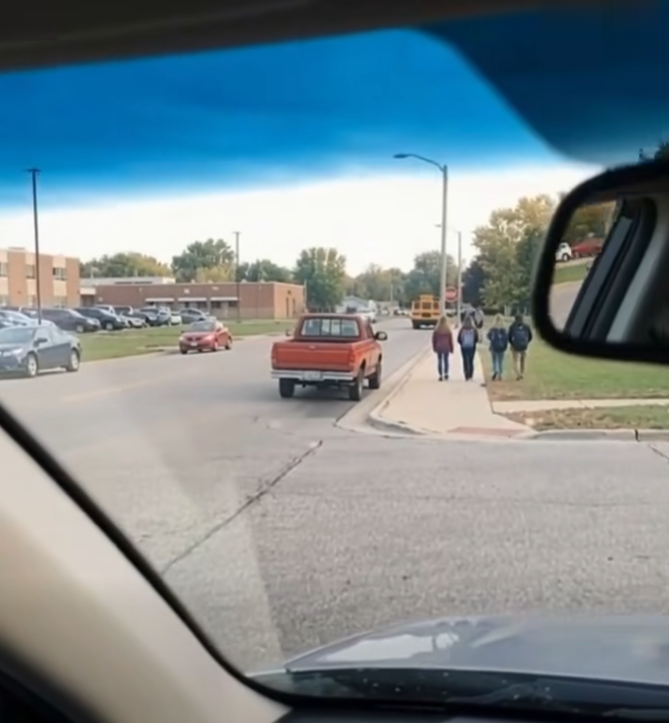
From a nearby parking area, I watched as Emily approached the bus stop with several other students.
She looked no different from any other teenager heading to school. Her backpack hung from one shoulder, and she appeared to be checking something on her phone.
When the bus arrived, she climbed aboard.
I felt a brief wave of relief.
Perhaps the teacher’s records really were incorrect.
Perhaps I had misunderstood something.
But I decided to continue watching until I knew where she went after the bus reached its destination.
I drove toward the school separately, taking care not to follow so closely that I would distract the driver or create a traffic hazard.
The bus eventually arrived.
Students began stepping down onto the pavement, talking among themselves as they headed toward the school entrance.
I searched the crowd for Emily.
There she was.
She stepped off the bus with the others.
Then, instead of walking toward the building, she stopped near the bus stop.
I watched, puzzled.
She looked down the street, checked her phone, and waited.
A few minutes later, an older pickup truck pulled up near the curb.
Emily walked toward it.
Then she opened the passenger door and climbed inside.
My heart began beating faster.
Who was driving?
Why was she getting into that vehicle instead of going to school?
Had she arranged to meet someone?
I couldn’t answer any of those questions from where I was parked.
I reminded myself that seeing her enter a vehicle did not automatically mean something dangerous was happening. There could be an explanation I didn’t yet understand.
But she had been absent from school all week, and I now had a clear reason to be concerned.
I decided to keep the situation in view while considering the safest way to proceed.
The Questions That Wouldn’t Leave My Mind
As the pickup moved away from the curb, I remained several vehicles behind.
My thoughts raced.
I remembered the evenings when Emily had come home unusually quiet. I recalled how she sometimes took her dinner upstairs without telling me much about her day.
At the time, I had assumed she was simply growing more private.
Now those moments seemed connected, although I knew I could not draw conclusions without learning more.
Was she having problems at school?
Was someone pressuring her to stay away?
Had she become involved in something she didn’t know how to explain?
Or was there a completely different reason for her behavior?
I considered calling the police immediately, but I didn’t want to make unsupported accusations about the driver. At the same time, I knew I shouldn’t dismiss the possibility that my daughter might need help.
My priority was to establish that she was safe.
I thought about calling the school again and asking whether anyone had contacted Emily about her attendance. I also considered contacting another trusted adult who knew her well.
The pickup continued through several streets.
I kept my distance and paid attention to the route rather than trying to get close enough to identify the driver through the windows.
I knew that if I saw signs of immediate danger, I would need to contact emergency services rather than attempt a risky confrontation.
Then the truck turned into a small parking area near a row of buildings.
It slowed and came to a stop.
I pulled over at a safe distance.
For several seconds, I simply watched.
The driver opened the door.
And then I finally got a clear look at the person behind the wheel.
I felt a sudden jolt of recognition.
I knew that face.
I had seen it before, although I couldn’t immediately understand why this person would be meeting Emily on a school morning.
My mind filled with questions.
Why hadn’t Emily told me about this arrangement?
Why had she pretended to attend school?
And what had happened during the previous four days?
I took a breath and reminded myself not to jump to conclusions.
Whatever the explanation, it was time to stop guessing and find out the truth.
A Parent’s Fear and a Teenager’s Silence
As I sat in my car, I realized how easily worry could turn into suspicion.
I had spent years trying to provide Emily with a safe, stable home. I wanted her to feel that she could tell me anything, even when she had made a mistake or was afraid of disappointing me.
Yet something had happened that made her feel unable or unwilling to tell me the truth.
That realization hurt.
Parents often imagine that they will recognize every important change in their children’s lives. We notice their routines, their favorite foods, the friends they mention, and the moods they bring home from school.
But teenagers also experience worries they may not know how to explain.
They can fear embarrassment, punishment, rejection, or the possibility that adults will misunderstand them.
Sometimes they hide a problem because they believe they can solve it alone. Other times, they may not fully understand the consequences of the decisions they are making.
None of those possibilities excuses a week of unexplained school absences.
However, understanding the reason behind the behavior is an important step toward resolving it.
I didn’t want to begin a conversation with accusations. I wanted Emily to understand that I was concerned about her safety and that she could speak honestly without being immediately dismissed.
I also needed to establish the facts.
The person driving the pickup might be connected to the situation in a way I hadn’t anticipated. Until I spoke with Emily and learned more, I couldn’t know whether the meeting was harmless, misguided, or genuinely concerning.
I took out my phone and prepared to contact the appropriate person if the circumstances suggested that Emily was at risk.
What I Planned to Do Next
I decided that the next conversation with my daughter would have to be different from our usual exchanges.
Instead of asking only whether she had completed her homework or why she hadn’t answered a message, I would ask what had been happening in her life.
I would give her a chance to explain where she had been going, why she had missed school, and who she had been meeting.
I would listen carefully to her answers, while making it clear that her safety and education could not be ignored.
If she revealed that someone had threatened, manipulated, or pressured her, I would seek appropriate professional assistance. If the situation involved a misunderstanding or a poor decision, we would address it together and work with the school to make a plan for returning to class.
I also intended to speak with Mrs. Carter again.
The school needed accurate information about Emily’s attendance, and its staff might be able to help identify academic, social, or emotional difficulties that had contributed to the situation.
Most importantly, I wanted Emily to know that she didn’t have to manage a difficult situation alone.
Trust between a parent and a teenager does not mean ignoring problems. It means creating an environment in which difficult truths can be discussed honestly, with appropriate boundaries and support.
The Lesson Hidden Behind the Mystery
Looking back, the most troubling part of that morning wasn’t simply that Emily had missed school.
It was how easily an entire week had passed without me understanding what was happening in her life.
Her routine had looked normal from the outside. She had left home at the usual time, carried her backpack, and acted as though everything was fine.
I had trusted the routine because it was familiar.
But routines cannot replace communication.
Parents and caregivers need to pay attention when something changes, ask questions when the information doesn’t add up, and work with schools when attendance becomes a concern.
Teenagers, meanwhile, need to understand that hiding a problem can sometimes make it more difficult to resolve.
That doesn’t mean every private conversation or unexpected friendship should be treated as a threat. Young people deserve growing independence and reasonable privacy.
The challenge is balancing that independence with appropriate supervision, honest communication, and clear expectations.
As I watched the pickup truck, I knew I didn’t yet have all the answers.
I had discovered that Emily’s school routine wasn’t what I believed it to be. I had seen her enter a vehicle with someone I recognized, and I knew I needed to understand why.
The next step wasn’t to invent the worst possible explanation.
It was to find out the truth, make sure my daughter was safe, and help her face whatever had led to that morning.