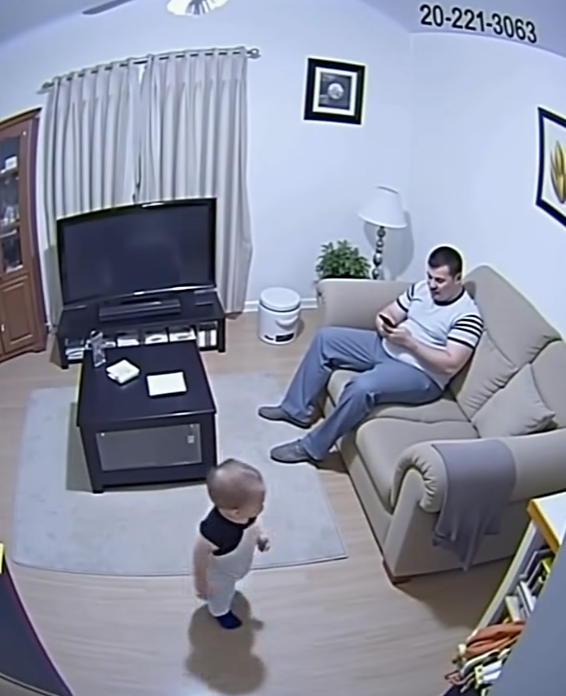
For several weeks, I had felt that something was wrong in our home.
My husband, Daniel, had become distant and unusually quiet. The man who once greeted me with a smile when he came through the door now seemed irritated by even the simplest questions. He often returned home later than expected, offered brief explanations, and avoided conversations that might have lasted more than a few minutes.
At first, I thought he was exhausted.
Work can be stressful, and I knew that even strong relationships go through difficult periods. I tried to give him space, hoping that whatever was troubling him would eventually pass.
But then I began noticing something that worried me far more than his changing mood.
He had also started acting differently around our two-year-old daughter, Sophie.
Daniel had once been an affectionate father. He would sit on the living-room floor with her, help her arrange her toys, and laugh when she tried to copy his expressions. When she toddled toward him with her arms raised, he would pick her up and carry her around the house.
Those ordinary moments had always made me happy.
Recently, however, they had become rare.
Sometimes Sophie would approach him with a toy, only for him to glance at his phone and walk away. On other occasions, he seemed uncomfortable when she wanted his attention.
I could not understand the change.
What made the situation more confusing was that Daniel continued insisting on looking after Sophie whenever I worked on weekends.
“Don’t worry about anything,” he would tell me while I prepared to leave. “I’ll stay home with her. There’s no need to ask your mother to come over.”
He repeated this so often that I began wondering why he was so determined to handle those days himself when he appeared so distant from our daughter during the week.
I wanted to believe there was a reasonable explanation.
But the longer the situation continued, the harder it became to ignore my concerns.
The Changes I Began to Notice in Sophie
At first, I thought Sophie was simply going through a difficult stage.
Children around her age can experience sudden changes in their moods, sleeping habits, eating patterns, and attachment to their parents. They are still learning how to communicate their feelings, and sometimes their behavior changes before they have the words to explain why.
I reminded myself of that whenever I noticed something unusual.
But after several weekends, I began to see a pattern.
Whenever I returned home from work, Sophie seemed different.
She was often unusually quiet. Sometimes she cried over things that had never bothered her before. At other times, she pushed away food she normally enjoyed or showed little interest in her favorite toys.
I tried to comfort her, thinking she might simply have missed me during the day.
I would sit beside her, offer her a snack, and ask whether she wanted to read one of her favorite picture books.
Occasionally, she would gradually relax and return to her usual self.
Then there were the moments involving Daniel.
When he entered the room, Sophie sometimes moved closer to me. If he reached toward her, she might turn away or hide behind my legs.
I had never seen her behave that way so consistently before.
One evening, Daniel walked into the living room while Sophie was playing with her blocks. She looked up, noticed him, and immediately moved toward me.
I picked her up.
“What’s wrong, sweetheart?” I whispered.
She buried her face against my shoulder.
Daniel glanced at us and said he was tired. A moment later, he left the room.
I watched him go, struggling to understand what I had just witnessed.
I did not want to jump to conclusions about my husband. I knew that a toddler’s behavior could have many explanations, and I understood that stress might affect the way adults interacted with their families.
Still, I could not ignore how uneasy the situation made me feel.
Something had changed, and I needed to understand what it was.
The Questions I Could No Longer Ignore
Over the following days, I tried to speak with Daniel about the situation.
I asked whether anything had happened while I was at work. I asked whether Sophie had been sleeping normally and whether she had eaten her meals.
His answers were usually brief.
“Everything was fine.”
“She’s just being difficult.”
“You’re worrying too much.”
Whenever I asked whether he had noticed her becoming upset around him, he changed the subject or said I was reading too much into ordinary toddler behavior.
I wanted those explanations to reassure me.
Instead, they left me with more questions.
I also began paying closer attention to Sophie’s daily routine. I made notes about when she seemed upset, whether she had eaten normally, and how she behaved around different people.
I did not want to confuse an isolated difficult day with a genuine pattern.
But the pattern continued.
Daniel remained unusually insistent about looking after her on weekends, while Sophie sometimes seemed unsettled after I returned home.
I knew I needed to approach the situation carefully.
My daughter’s well-being mattered more than my desire to avoid an uncomfortable conversation with my husband.
If there was a simple explanation, I wanted to find it. If something was wrong, I needed to know so I could take appropriate steps to protect her.
For the first time, I admitted to myself that hoping the situation would disappear was not enough.
The Weekend I Decided to Take Action
The following Friday evening, I prepared everything Sophie would need for the next day.
I packed her snacks, checked her clothes, and arranged her toys in the places where she usually played.
Daniel watched me from the doorway.
“You don’t need to prepare all that,” he said. “I’ll manage.”
“I know,” I replied. “I just want to make sure everything is ready.”
He shrugged and returned to his phone.
I looked at Sophie, who was sitting on the rug with a stuffed animal in her lap.
She looked up at me and smiled.
That small smile reminded me why I could not continue dismissing my concerns.
I loved my husband, and I wanted our family to be happy. But my responsibility as a mother was to make sure that Sophie was safe and that her needs were being met.
Those responsibilities could not depend on whether asking difficult questions made someone uncomfortable.
I considered several ways to understand what was happening.
I could arrange for a trusted relative to help with childcare. I could speak with a pediatrician about Sophie’s behavioral changes. I could also seek professional guidance on how to approach a sensitive family situation without making assumptions.
I knew that whatever I did needed to focus on my daughter’s welfare rather than on proving a suspicion.
At the same time, I wanted to understand what happened during the hours I was away.
I had been relying on Daniel’s assurances, but those assurances no longer gave me the peace of mind they once had.
By the time Saturday morning arrived, I had decided that I could not simply continue as before.
The Moment I Realized I Needed Answers
Before leaving for work, I checked on Sophie one last time.
She was sitting in her room, moving small toys across the floor and making quiet sounds to herself.
I crouched beside her.
“Be good, sweetheart,” I said softly. “I’ll see you later.”
She reached toward me, and I kissed her forehead.
Daniel appeared at the doorway.
“You’ll be late,” he said.
I stood up and collected my things.
As I walked toward the front door, I glanced back at them.
Daniel was looking at his phone. Sophie was still on the floor.
For a moment, I considered turning around and asking him directly whether something was wrong.
But I knew that another brief exchange might leave me with the same unanswered questions.
I needed a thoughtful plan, not another argument.
During my break at work, I called someone I trusted and explained that I was concerned about the changes I had noticed in my daughter.
I did not claim to know what was happening. I simply described the behavior that had worried me and asked for advice about the next steps.
The conversation helped me think more clearly.
I realized that I did not need to accuse anyone to take my concerns seriously. I could arrange safer childcare, seek professional advice, and make decisions based on what I observed rather than on speculation.
I also understood that a young child might not be able to describe a troubling experience clearly.
That made it especially important to listen patiently, avoid leading questions, and seek appropriate professional support if I remained concerned.
By the end of the day, I had decided that Sophie’s safety and emotional well-being would come first, regardless of how uncomfortable the situation became.
What I Saw When I Reviewed the Available Information
That evening, I returned home with a heavy feeling in my chest.
Daniel greeted me briefly and said that everything had gone well.
Sophie was in her room.
I went to check on her and sat beside her for a few minutes. She seemed quieter than usual, and I found myself watching her expressions, wondering what she might be trying to communicate.
I did not want to frighten her with repeated questions.
Instead, I spoke gently and allowed her to play while I stayed nearby.
Later, when I had a quiet moment, I reviewed the information available to me about the day.
I was hoping to find something that would explain the difference I had noticed in Sophie’s behavior.
At first, nothing seemed particularly unusual.
Then I came across something that made me stop.
I looked more carefully, trying to understand what I was seeing rather than immediately deciding what it meant.
My heart began to beat faster.
I had spent weeks wondering whether my concerns were justified. Now I was faced with information that I needed to consider carefully and responsibly.
I could not yet explain everything.
I could not be certain what had caused the changes in Sophie.
But I knew I could no longer ignore the situation or rely solely on vague reassurances.
I needed to establish the facts, ensure that my daughter was safe, and decide what support might be necessary.
The next step would require calm judgment, not panic.
Whatever the explanation turned out to be, Sophie deserved to be protected, listened to, and treated with care.
A Mother’s Responsibility Comes First
Being a parent means learning to recognize when something about a child’s behavior deserves attention.
It does not mean assuming the worst whenever a child becomes quiet, cries more often, or changes their routine. There can be many reasons for those behaviors, including ordinary developmental changes, tiredness, illness, anxiety, or disruptions at home.
However, it also means taking persistent concerns seriously.
Young children depend on adults to create safe environments, notice changes, and respond when something seems wrong.
When a child repeatedly appears frightened or distressed around a particular person, it is important to consider the circumstances carefully rather than dismissing the behavior automatically.
Parents can start by documenting specific observations, speaking with a pediatrician, and seeking guidance from an appropriate child-welfare professional when needed.
If there is a reasonable concern that a child may be in immediate danger, the priority should be to move the child to safety and contact the appropriate emergency or child-protection services.
It is also important to avoid confronting a potentially unsafe person in a way that could increase the risk to the child.
In my situation, I knew that I needed to focus on what I could establish and what would help Sophie feel secure.
My goal was not to create a dramatic confrontation.
It was to understand the situation and make sure my daughter was safe.
What This Experience Taught Me About Trust and Parenthood
I had always believed that trust was one of the foundations of a family.
Trust allows parents to share responsibilities, support one another, and believe that their children are being cared for when they are not present.
But trust should not require someone to ignore repeated warning signs.
It should exist alongside communication, accountability, and a willingness to address concerns honestly.
I learned that loving someone does not mean automatically accepting every explanation they provide. It also does not mean assuming that a worrying situation has only one possible cause.
It means being willing to ask difficult questions, gather reliable information, and take reasonable steps when a child’s well-being is involved.
Most importantly, I realized that I did not need to have every answer before taking my daughter’s distress seriously.
I could listen to her, seek professional guidance, and ensure that she was cared for in a safe environment while I worked to understand what had happened.
Sometimes, the most responsible decision a parent can make is to pause, acknowledge uncertainty, and seek help from people qualified to assess the situation.
That is not an admission of failure.
It is part of protecting a child.
Final Thoughts: When a Parent’s Concerns Cannot Be Ignored
For weeks, I had watched my husband become distant and my daughter grow increasingly unsettled.
I had tried to explain away the changes because I wanted to believe that everything was normal.
But eventually, I understood that my daughter’s well-being mattered more than maintaining the appearance that nothing was wrong.
A child’s behavior cannot tell an entire story on its own, and an unexplained change should not automatically be treated as proof of wrongdoing. Nevertheless, persistent distress deserves attention, careful observation, and an appropriate response.
Parents do not need to choose between being fair and being protective.
They can avoid making unsupported accusations while still taking sensible steps to ensure their children are safe.
For me, that meant listening closely, seeking reliable guidance, and refusing to dismiss concerns simply because the answers might be difficult.
Every child deserves to feel secure at home, to be treated with patience, and to have adults who take their needs seriously.
And every parent deserves the opportunity to ask questions when something does not seem right.