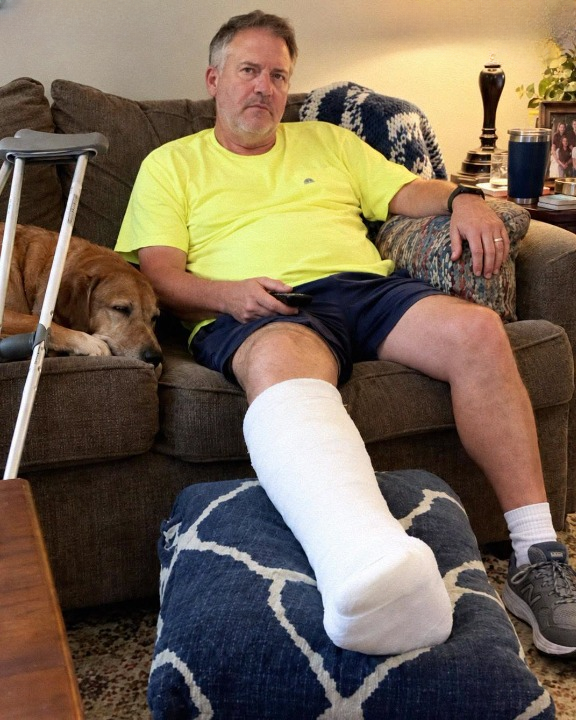
After thirty-two years of marriage, I thought I knew nearly everything about my husband, Conor.
I knew how he took his coffee, which side of the bed he preferred, and how dramatically he behaved whenever he caught a cold. A simple headache could convince him that he needed an entire afternoon of rest, while a sore throat meant hot tea, extra blankets, and regular reminders that he wasn’t feeling well.
I used to tease him about it.
“You know, Conor, if you ever get seriously injured, I’ll have to hire someone to look after you.”
He would grin and pull the blanket over his head.
“That’s what wives are for.”
It was a familiar joke between us, one of the many small traditions that had carried us through three decades of marriage.
So when one of his coworkers brought him home one Thursday afternoon with his right leg in a cast, I expected the usual performance.
Instead, I discovered a side of my husband I had never seen before.
And it began with something as simple as a request to help him get comfortable.
The Injury That Changed Everything
Conor had apparently slipped on a wet floor at work and injured his ankle.
His coworker helped him through the front door, carrying his bag while Conor carefully balanced himself on a pair of crutches.
“It’s a fracture,” he explained, lowering himself onto the sofa with a long sigh. “The doctor says I’ll need the cast for about six weeks.”
“Oh, sweetheart,” I said, hurrying to bring him a pillow. “That must hurt.”
“It does. You have no idea.”
I smiled and placed the pillow beneath his leg.
For the first hour, everything seemed normal. He asked for water, complained about the uncomfortable position of his foot, and requested a sandwich because he hadn’t eaten since lunchtime.
I brought him what he needed, made sure his phone was within reach, and helped arrange the cushions.
Then I noticed that the edge of his cast seemed to be pressing against his skin.
“Let me check that,” I said, reaching toward his leg.
Conor immediately pulled away.
“I’ve got it.”
I blinked.
“What?”
“I said I’ve got it. Don’t touch the cast.”
I stared at him, waiting for the familiar smile that would tell me he was joking.
It never came.
“I’m only trying to make sure you’re comfortable.”
“I know. But I’d rather handle it myself.”
I shrugged and returned to the kitchen, assuming he was embarrassed about needing help.
After all, Conor had always valued his independence. Perhaps the injury had made him feel vulnerable.
I decided not to make a big deal out of it.
By the next morning, however, his behavior had become even stranger.
The Rules I Couldn’t Understand
When Conor got up to shower, I offered to help him cover the cast so it wouldn’t get wet.
“No, thank you.”
“I have a waterproof cover. I bought one years ago when your nephew broke his arm.”
“I said I’ll do it.”
His voice was sharper than I expected.
I stopped in the doorway.
“Conor, what’s going on? You’re acting as though I’m trying to hurt you.”
He looked away.
“I’m not acting like anything. I just don’t need help with every little thing.”
The words stung more than they should have.
For thirty-two years, we’d looked after each other through illnesses, family emergencies, financial worries, and the ordinary disappointments of life. I had never thought of helping him as a burden.
Still, I backed away.
“Fine. Just be careful.”
Over the following days, the pattern continued.
He insisted on managing his own showers. He refused to let me adjust the padding around his cast. Whenever I asked whether the swelling had improved, he gave me a vague answer and changed the subject.
He also became unusually protective of his phone.
If I entered the room while he was reading a message, he would turn the screen away.
When his follow-up appointment came up in conversation, he claimed it had been postponed.
“Didn’t the doctor want to see you this week?” I asked one evening.
“They’re busy.”
“Shouldn’t we call and check?”
“There’s nothing to check.”
He picked up the television remote and turned the volume higher.
I sat beside him, feeling an unfamiliar distance grow between us.
I knew my husband could be stubborn. But this was different.
It wasn’t merely that he refused assistance. It was the way he seemed frightened whenever I came too close to his injured leg.
I began wondering whether he was hiding something from me.
I hated that thought.
After thirty-two years together, I wanted to believe there was a reasonable explanation.
But every day brought another reason to doubt that everything was as simple as a workplace accident.
The Night I Heard the Crash
Two weeks passed.
Conor continued moving around the house on his crutches, although he seemed more uncomfortable than before.
Sometimes, when he thought I wasn’t watching, he would sit very still and stare at the cast.
If I asked whether he was in pain, he always said he was fine.
One evening, I went upstairs to put away the laundry while he took his usual shower.
I was folding towels when I heard a sudden crash from the bathroom.
Then came a sharp, frustrated groan.
“Conor?”
There was no answer.
I dropped the towels and hurried toward the bathroom.
“Are you all right?”
“Stay there!”
His voice was so urgent that I froze.
A moment later, I heard him shifting against the bathtub.
“Conor, open the door.”
“I said I’m fine!”
But he didn’t sound fine.
I tried the handle. The door was unlocked, so I pushed it open.
Conor was sitting on the floor beside the bathtub, one crutch lying several feet away.
His face was pale, and he was breathing heavily.
“Don’t move,” I said, rushing toward him. “Let me help you.”
“Wait!”
He reached for a towel and pulled it over his right leg.
But I had already noticed something.
Part of the cast had cracked along the side.
A section had separated enough to reveal a glimpse of the skin underneath.
And there, near the edge of the broken plaster, I saw something that didn’t look like an ordinary injury.
There were dark, uneven marks on his skin, along with what appeared to be the corner of a folded piece of paper tucked beneath the cast’s outer padding.
I stopped moving.
“Conor, what is that?”
He closed his eyes.
For several seconds, neither of us spoke.
Then he whispered, “Please don’t be angry.”
I felt my heart sink.
“Angry about what?”
He looked at the cracked cast, then back at me.
“There’s something I should have told you before this happened.”
The Truth Beneath the Cast
I helped Conor remain still while we worked out what to do next.
The damaged cast needed professional attention, and I wasn’t going to let him risk making the injury worse simply to preserve a secret.
I called the medical service that had treated him and explained that his cast had cracked after a fall.
While we waited for instructions, I brought him a dry towel and sat beside him.
“I’m listening,” I said quietly. “Tell me the truth.”
Conor rubbed his face with both hands.
“The accident at work wasn’t the whole story.”
I felt a chill move through me.
“What does that mean?”
He took a long breath.
“About a month ago, before the accident, I went to see a doctor about a problem I’d been having. I hadn’t told you because I thought it would turn out to be nothing.”
I waited.
“They found something unusual during an examination. They wanted me to have more tests, but I kept putting them off.”
I stared at him.
“What kind of problem?”
He looked down at his hands.
“A lump near my ankle. I’d noticed it for a while. At first, I thought I’d strained something. Then it started bothering me more often.”
I glanced at his cast.
“Are you telling me that the lump was there before you broke your ankle?”
He nodded.
“And the doctor wanted to investigate it?”
“Yes.”
My thoughts raced.
“Then why didn’t you tell me?”
Conor’s eyes filled with tears.
“Because I was frightened.”
I had expected many possible explanations for his secrecy. I had wondered whether he was embarrassed, hiding a mistake, or dealing with something that would affect our marriage.
I hadn’t expected him to admit that he had been afraid of a medical diagnosis.
He explained that he had visited a clinic before the workplace accident. The doctor had recommended further examinations, but Conor had left without arranging them.
When he later injured his ankle, the hospital focused on the fracture. The existing lump was covered by the cast, and Conor hadn’t explained its history to the medical team.
The folded paper I had noticed was an appointment reminder and a note containing the clinic’s contact information.
He had kept it hidden because he couldn’t bring himself to tell me what was happening.
“I thought if I didn’t talk about it, I could keep pretending everything was normal,” he said. “I know how foolish that sounds.”
I felt tears gathering in my eyes.
“You’ve spent weeks letting me think you simply didn’t want help. All this time, you’ve been carrying this fear alone.”
He nodded.
“I didn’t want you to worry.”
“Conor, I’m your wife. Worrying about you is part of loving you. You don’t protect me by shutting me out.”
He began to cry.
“I know that now.”
The Appointment We Should Have Made Together
The medical team advised us on how to handle the damaged cast and arranged for Conor to be assessed.
I stayed beside him while we followed their instructions.
The cast was examined, and the clinicians checked his injury and the area he had been reluctant to discuss. They explained that the lump needed proper investigation and that its appearance alone could not establish what it was.
Conor listened carefully this time.
He answered the questions he had previously avoided and agreed to the recommended follow-up appointments.
I accompanied him whenever possible.
The waiting was difficult.
There were forms to complete, appointments to arrange, and questions neither of us could answer immediately. Some days Conor was optimistic; on others, he became quiet and withdrawn.
But we faced those days together.
Eventually, the additional examinations provided a clearer explanation for the lump. It was a noncancerous growth that required monitoring and treatment because of its location and the discomfort it caused.
The doctor explained the findings, discussed the available options, and helped Conor make an appropriate treatment plan.
I felt an enormous wave of relief.
But even after the immediate medical uncertainty had passed, something remained between us.
The growth had frightened Conor, but his decision to hide it had frightened me in a different way.
I had spent weeks wondering why the man I trusted most suddenly seemed unwilling to let me near him.
We needed to talk about that, too.
The Conversation That Changed Our Marriage
A few evenings later, we sat together at the kitchen table.
Conor’s leg was supported, and the room was quiet except for the ticking of the clock.
“I owe you an apology,” he said.
I folded my hands.
“Yes, you do.”
He nodded without arguing.
“I convinced myself that keeping this from you would make things easier. I thought I could get through the appointments, find out what was wrong, and tell you only if I had to.”
“Do you understand how that made me feel?”
“Yes.”
“I thought you didn’t trust me. I thought you were hiding something about our marriage. Every time you pulled away when I tried to help, I wondered what I had done wrong.”
He looked devastated.
“You didn’t do anything wrong.”
“Then remember that the next time you’re frightened.”
He reached across the table and took my hand.
“I will try. I can’t promise I’ll never be afraid, but I don’t want to shut you out again.”
I squeezed his hand.
“That’s all I ask. Tell me when you’re scared. Tell me when you don’t have the answers. We can deal with uncertainty together.”
For the first time in weeks, he looked directly into my eyes without trying to change the subject.
“I should have told you from the beginning.”
“Yes,” I said. “You should have.”
I wasn’t going to pretend that the secrecy hadn’t hurt me. But I also understood that fear can make people behave in ways they later regret.
The important thing was what we chose to do next.
We agreed to be more honest about health concerns, attend important appointments together when possible, and ask for help instead of allowing fear to grow in silence.
Thirty-Two Years, and Still Learning
As Conor recovered, our ordinary routines slowly returned.
He still complained about uncomfortable pillows. He still insisted that his tea tasted better when I made it. And he still managed to turn a minor inconvenience into a long story about how difficult his day had been.
Some things, apparently, would never change.
But I noticed a difference when he wasn’t feeling well.
Instead of immediately dismissing my questions, he began telling me how he was actually doing.
If he felt worried, he said so.
If he needed time to think, he explained that instead of shutting me out.
And when I offered to help, he was more willing to accept it.
One afternoon, as I adjusted the cushion beneath his recovering leg, he looked at me and smiled.
“You know, you were right about something.”
I raised an eyebrow.
“Only one thing?”
He laughed.
“You said you’d have to hire someone to look after me if I ever got seriously injured.”
“And?”
“I think you’re still the best person for the job.”
I shook my head, smiling despite myself.
“Don’t push your luck.”
We laughed together, and for the first time in a long while, the tension between us seemed to ease.
I had learned that even after decades of marriage, people can still surprise each other. Sometimes the hardest secrets aren’t signs that love has disappeared. Sometimes they are signs that fear has made it difficult to ask for support.
But understanding someone’s fear doesn’t mean ignoring the hurt their actions cause.
Trust depends on honesty, even when the truth is uncomfortable.
Conor’s broken cast had revealed more than an injury he had tried to conceal. It had revealed how easily silence could create distance between two people who had spent thirty-two years building a life together.
We couldn’t change those difficult weeks.
What we could do was learn from them.
And as I watched my husband slowly regain his confidence and independence, I realized that marriage isn’t about knowing every detail of another person’s life without ever being surprised.
It’s about choosing to be honest when the truth is frightening, listening when the other person is hurt, and remembering that neither partner has to face every difficult moment alone.
After thirty-two years, I thought I knew everything about Conor.
I was wrong.
But we were still learning how to know each other better.
And this time, we were doing it together.