When the doctors told me my son might have only three months left, I sat beside his hospital bed and nodded as though I understood every word.
I didn’t.
I heard the explanations, the careful pauses, and the gentle phrases doctors use when the truth is too painful to deliver all at once. But my mind kept returning to one thought.
My boy was only twelve.
He still had so much he wanted to do.
He wanted to see the ocean from the back of a motorcycle. He wanted to travel along winding country roads, visit places he had only seen in photographs, and grow old enough to make his own decisions.
He had a list of dreams, and becoming a biker was near the top.
Whenever he talked about motorcycles, his whole face changed. He would sit up straighter, his eyes bright with excitement, and describe the sound of an engine or the feeling of riding along an open road.
I used to smile and tell him that he had plenty of time to think about those things.
Now, sitting in a hospital room surrounded by machines, I couldn’t bear to hear him talk about the future.
I wanted to promise him everything.
Instead, I was afraid to promise anything at all.
The Doctor I Didn’t Know Whether to Trust
A new doctor had joined my son’s medical team a little while earlier.
I’ll admit that I judged him before I knew him.
He was a large man with tattoos covering both arms and extending toward his neck. He wore his hospital clothes comfortably, spoke in a deep voice, and had a serious expression that made him look intimidating when he wasn’t smiling.
If I had passed him on a quiet street late at night, I probably would have crossed to the other side.
My mother noticed him, too.
One afternoon, she leaned toward me and whispered, “Are you sure he’s one of the doctors? Look at all those tattoos.”
I didn’t answer, but I understood what she meant.
I was already frightened about my son’s condition. The last thing I wanted was to feel uncertain about the people responsible for his care.
So I watched the new doctor closely.
At first, I expected him to be like many of the other medical professionals who came into the room, checked a chart, asked a few questions, and moved on to the next patient.
But he surprised me.
He never spoke about my son as though he wasn’t there.
He spoke directly to him.
When he entered the room, he greeted my boy first, asked how he was feeling, and waited for an answer rather than directing every question toward me.
He remembered the small things, too.
He remembered the name of a video game my son had mentioned during an earlier visit. He remembered a funny story about one of his classmates. And he remembered that my son loved motorcycles.
Most importantly, he never treated him as though his illness had become his entire identity.
Some days, he managed to make my son laugh when I couldn’t even find the strength to smile.
I began to understand that the tattoos and intimidating appearance I had noticed first told me almost nothing about the person standing in front of me.
Still, I was cautious.
Trust is difficult when you’re a frightened parent, especially when your child’s future feels uncertain.
But I couldn’t deny that my son seemed happier whenever this doctor visited.
The Dream My Son Refused to Give Up
I had raised my son largely on my own.
His father had never been a consistent presence in our lives, and for twelve years, I had tried to fill every role I could.
I worked, cooked, cleaned, attended school meetings, and learned to fix little problems around the house. I became an expert at hiding my worries because I wanted my son to feel safe.
I told myself that if I loved him enough, I could make up for everything he lacked.
But watching him with the new doctor made me realize something.
My son didn’t need me to become someone else.
He needed people who cared about him in different ways, people who could share his interests, listen to his stories, and give him moments when he could simply be a child.
The doctor seemed to understand that instinctively.
One afternoon, I arrived at the hospital and found the two of them leaning toward each other, whispering.
My son was trying desperately not to laugh.
The doctor looked up when he noticed me.
“What are you two talking about?” I asked.
My son pressed his lips together, attempting to look serious.
“It’s a secret.”
I raised an eyebrow.
“A secret from your own mother?”
He nodded.
“Sorry, Mom.”
The doctor gave me an innocent expression that was so obviously exaggerated that I almost laughed.
“I’ve been sworn to secrecy,” he said.
“By a twelve-year-old?”
“Very serious business.”
My son burst out laughing.
It was such a wonderful sound that I forgot, for a moment, where we were.
I didn’t ask any more questions. I was simply grateful to see him enjoying himself.
But as I left the room later that afternoon, I couldn’t stop wondering what they were planning.
A Strange Sound in the Hospital Corridor
The following day, I was sitting beside my son’s bed when I heard a series of voices coming from farther down the corridor.
At first, I paid little attention.
Hospitals are rarely quiet. Nurses talk at their stations, visitors move between rooms, and carts roll across the floors.
Then the sound grew louder.
I heard footsteps, low voices, and what sounded like several people laughing together.
My son lifted his head.
“Mom, what’s happening?”
“I don’t know, sweetheart.”
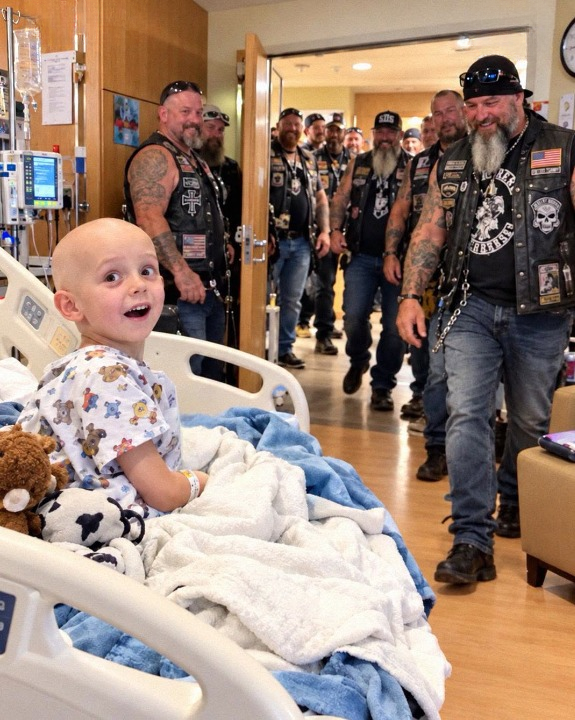
A moment later, the doorway filled with people.
Twelve men stood outside, each dressed in motorcycle gear or a leather vest. Some had gray beards, others had tattoos on their arms, and several wore patches representing their riding clubs.
They looked like the kind of people who might spend their weekends traveling hundreds of miles together on motorcycles.
I stared at them.
For a few seconds, I couldn’t understand why so many bikers were standing outside my son’s hospital room.
Had someone made a mistake?
Was there a charity event taking place?
Had the doctor arranged some kind of meeting?
Before I could ask, the tattooed doctor stepped forward.
He was smiling.
My son looked from the doctor to the men behind him, his eyes wide with astonishment.
Then he sat up as much as his condition allowed.
“Are those real bikers?” he whispered.
One of the men chuckled.
“As real as they come, young man.”
Another lifted a hand in greeting.
“We’ve heard a little about you.”
My son looked at the doctor.
“You told them about me?”
“I might have mentioned that I know a young man with a very big dream,” the doctor replied.
I felt a mixture of confusion and concern.
The doctor had not discussed this visit with me, and I wanted to understand what was happening. But before I could ask, he came to the side of the bed and spoke gently to my son.
“Now, champ, let’s get one thing straight. With your current medical condition, riding a motorcycle isn’t a safe option. Your care team and your parents need to make sure that anything we plan is appropriate for you.”
My son’s face fell slightly.
I knew that expression. He had heard enough difficult news recently to recognize when someone was telling him no.
Then the doctor smiled.
“But that doesn’t mean we can’t find another way to bring your dream a little closer.”
My son looked up again.
“What do you mean?”
The doctor stepped aside.
“Gentlemen, I think it’s time.”
The Surprise They Had Been Planning
One of the bikers carried a large gift bag. Another held a neatly wrapped box, while a third had a small package tucked beneath his arm.
They approached the bed one at a time, making sure not to crowd my son.
The first man introduced himself as Marcus.
He had a silver beard, a weathered leather vest, and the kind of warm smile that made him seem less intimidating the longer I looked at him.
“We heard you love motorcycles,” he said.
My son nodded enthusiastically.
“I love them. I’ve watched videos of long rides for years.”
Marcus grinned.
“Then we have something for you.”
He handed my son the gift bag.
Inside was a miniature motorcycle model, carefully painted with black and silver details. It was more elaborate than any toy I had seen him own, with tiny mirrors, realistic wheels, and a stand that allowed it to sit upright.
My son stared at it.
“Wow.”
The second biker handed him a book filled with photographs of motorcycles, famous riding routes, and stories from people who had traveled across different parts of the country.
The third gave him a black baseball cap with a small embroidered motorcycle emblem.
Then the doctor brought out the final gift.
It was a framed photograph of a group of motorcyclists standing beside their bikes on a scenic road, the mountains stretching into the distance behind them.
On the bottom of the frame was a handwritten message:
For a young dreamer with a brave heart. Keep imagining the roads ahead.
My son traced the words with one finger.
I watched his face change.
He was no longer looking at hospital equipment or listening to adults discuss his condition. He was looking at a world full of possibilities, captured in photographs and stories.
“Did you all come here just for me?” he asked.
Marcus nodded.
“We sure did.”
“Why?”
The room became quiet.
Marcus glanced at the doctor before answering.
“Because sometimes, people need a reminder that they’re more than what they’re going through. We heard that you have a big imagination and a love for motorcycles. We wanted you to know that there are people out here who are cheering for you.”
My son looked down at the model in his hands.
Then he looked up at the men standing around his bed.
“Thank you,” he said softly.
It was only two words, but I could hear how much they meant to him.
The Kindness I Hadn’t Expected
I had spent so much time worrying about my son’s medical condition that I had forgotten how important small moments of happiness could be.
The bikers didn’t arrive with promises of miracles or claims that they could change his diagnosis.
They came because they wanted to give him something to look forward to.
They talked about their favorite motorcycles, the places they had visited, and the friendships they had formed over the years.
One man described a trip along a coastal road where the ocean seemed to stretch endlessly beside the highway.
Another told my son about a mountain town famous for its annual motorcycle gathering.
My son listened to every story.
He asked questions, examined the photographs, and laughed when one of the bikers admitted that he had once taken a wrong turn and ended up hundreds of miles away from where he intended to go.
For nearly an hour, the room felt different.
It was still a hospital room. My son was still receiving care, and the difficult realities of his condition had not disappeared.
But there was laughter now.
There were stories, gifts, and twelve strangers who had taken time out of their lives to make a young boy feel seen.
At one point, I stepped into the corridor because I couldn’t hold back my tears.
The doctor followed a moment later.
“I’m sorry,” he said. “I should have spoken to you about the visit beforehand.”
I wiped my eyes.
“Yes, you should have.”
He nodded, accepting my response without trying to defend himself.
“I wanted to give him something to look forward to. The group was happy to help, but I also wanted to make sure the visit was appropriate for him.”
I looked through the doorway at my son.
He was showing Marcus the motorcycle model and explaining which bikes he liked best.
“Thank you,” I said quietly. “I was wrong to judge you before I knew you.”
The doctor smiled.
“You were worried about your child. I understand.”
His answer made me feel even more emotional.
He didn’t ask me to explain myself. He didn’t make me feel foolish for my first impression.
He simply returned his attention to my son.
And I realized that this was what had made me begin to trust him in the first place.
He cared about the person in the bed, not just the medical condition written on the chart.
A Memory That Belonged to My Son
Before the bikers left, they asked whether they could take a photograph with my son.
We checked with the hospital staff, and with everyone’s agreement, one of the nurses took a picture of the group beside his bed.
My son wore his new cap and held the miniature motorcycle carefully in both hands.
He was smiling.
Not the polite smile he sometimes gave visitors when he was tired, but a genuine, joyful smile that reached his eyes.
I took a photograph of my own.
I wanted to remember that moment.
Not because it erased our worries or changed what the doctors had told us, but because it showed that happiness could still find us in unexpected places.
When the bikers finally prepared to leave, Marcus bent down slightly so he could speak to my son at eye level.
“Keep that imagination working, young man,” he said. “There are a lot of wonderful stories in the world.”
My son nodded.
“I will.”
The men waved goodbye and disappeared down the corridor, their voices gradually fading into the ordinary sounds of the hospital.
After they had gone, my son placed the motorcycle model on the bedside table.
He looked at the framed photograph for a long time.
“Mom?”
“Yes, sweetheart?”
“Do you think I’ll get to see a road like that someday?”
I sat beside him and took his hand.
“I hope you get to see many beautiful places,” I said honestly. “We’ll keep talking with your doctors about what is possible, and we’ll take things one step at a time.”
He nodded, seeming satisfied with that answer.
Then he picked up the book and began turning the pages.
I watched him for a while without speaking.
I could not promise him an easy future. I could not make every difficult day disappear, and I couldn’t answer every question that frightened me in the middle of the night.
But I could sit beside him.
I could listen to his dreams.
And I could make sure he knew that his life was more than a medical prognosis.
What Those Twelve Men Taught Me
That evening, after my son had settled down, I looked again at the photograph from the visit.
Twelve men in leather stood around a twelve-year-old boy who loved motorcycles.
At first glance, we might have seemed like an unlikely group.
Yet they had come together because they wanted to offer kindness to someone they had never met.
I thought about the assumptions I had made when the tattooed doctor first entered the room.
I had seen his appearance before I had seen his patience. I had noticed his tattoos before I noticed the way he listened to my son.
I had allowed fear and unfamiliarity to shape my opinion before I had given him a chance to show me who he was.
The experience reminded me that compassion doesn’t always arrive in the form we expect.
Sometimes it comes from a doctor who remembers a child’s favorite game.
Sometimes it comes from twelve motorcyclists carrying gifts into a hospital room.
And sometimes it comes from people who cannot change the difficult circumstances of a family’s life but can still make a day brighter.
My son’s medical journey remained uncertain, and I knew we would continue to face challenging conversations and difficult decisions.
But that day had given us something valuable.
It had given my boy a memory filled with laughter, photographs, stories, and people who had gone out of their way to make him feel important.
It had reminded me that dreams don’t have to be dismissed simply because life takes an unexpected turn.
And it had taught me that a person’s appearance tells only a small part of their story.
I still don’t know what the coming months will bring for my son.
But I know what happened that afternoon.
Twelve strangers walked into his hospital room, not to offer impossible promises, but to show him that his dream mattered and that he was not alone.
And when I look at the photograph from that day, I no longer see a group of intimidating men in leather.
I see twelve people who chose kindness.
I see a doctor who understood that caring for a child means seeing the person beyond the diagnosis.
And I see my son, smiling with a miniature motorcycle in his hands, enjoying a moment that belongs entirely to him.
That is the memory I will hold on to.
Whatever the future brings, no one can take that afternoon away from us.