What Does the White Road Sign With a Black Diagonal Stripe Mean? A Guide for UK Drivers
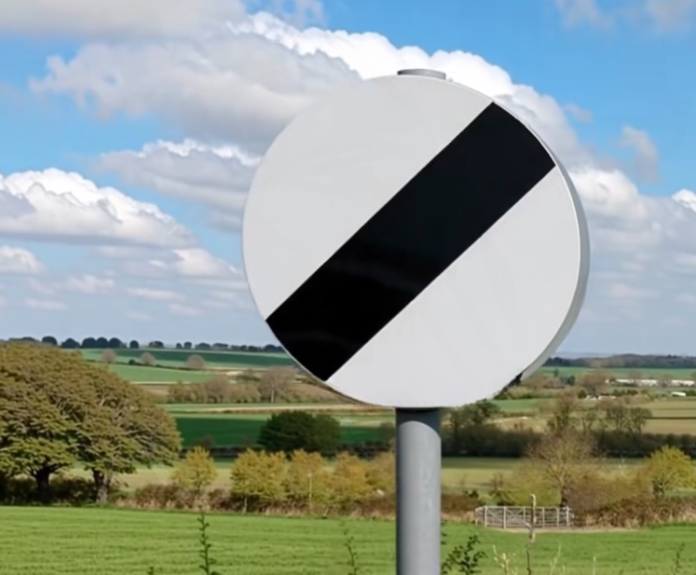
A simple road sign can carry an important message. In the United Kingdom, a white circular sign crossed by a thick black diagonal stripe tells drivers that the national speed limit applies. Although the sign has no numbers or written instructions, understanding its meaning is essential for safe and legal driving. The speed limit that follows depends on the type of road, the vehicle being driven, and any other applicable restrictions.
The Road Sign That Every UK Driver Should Recognize
Imagine driving along a familiar road when you notice a circular white sign with a thick black stripe running diagonally across it. There are no numbers to tell you whether the limit is 20, 30, 50, or 70 miles per hour. There are no words explaining what you should do next.
At first glance, the sign may seem unusually simple. Yet it communicates an important change in the speed-limit rules that apply to the road ahead.
The sign indicates that the national speed limit applies. Rather than establishing one fixed speed for every driver, it refers you to the national limits for the road type and class of vehicle you are using.
According to the UK government’s official guidance on traffic signs, the symbol is used to indicate the national speed limit for the relevant road and vehicle category. Official government guidance explains how these signs operate.
Understanding this sign is particularly important when moving between urban streets, rural roads, dual carriageways, and motorways. Each environment presents different hazards, and the applicable maximum speed can change accordingly.
The sign does not mean that drivers should automatically accelerate. It means they must follow the relevant national speed limit while continuing to drive at a speed appropriate for the conditions.
What Does the Black Diagonal Stripe Actually Mean?
The white circular sign with a black diagonal stripe is commonly known as the national speed limit sign.
Unlike a conventional speed-limit sign displaying a number inside a red circle, this sign does not specify one particular speed. Instead, it indicates that the default national limit for the road and vehicle type applies.
For a driver of an ordinary car, the relevant limit may be different on a single carriageway, a dual carriageway, or a motorway.
This is why it is important to understand the road you are travelling on rather than relying on the sign alone.
The sign can appear when a road enters a section where the national speed limit applies, including after a lower speed restriction ends. Drivers must still pay attention to other signs, road markings, temporary restrictions, and local conditions.
For example, a driver leaving a built-up area may encounter this sign when entering a rural road. The national limit may then apply, but the driver must still consider bends, junctions, visibility, weather, and the presence of other road users.
The main lesson is simple: the sign identifies the applicable speed-limit system, not a universal speed that is always safe to travel at.
What Speed Can You Drive After Seeing the Sign?
For cars and motorcycles, the national speed limit in Great Britain generally depends on whether the road is a single carriageway, a dual carriageway, or a motorway.
The following table provides a general guide for ordinary cars and motorcycles.
| Road type | National speed limit |
|---|---|
| Single carriageway | 60 mph |
| Dual carriageway | 70 mph |
| Motorway | 70 mph |
These limits are subject to the applicable rules, vehicle classification, and any separately signed restrictions. Other vehicle categories may have lower limits, including certain vans, vehicles towing trailers, buses, and heavy goods vehicles.
A dual carriageway is not simply a wide road. It is a road where the carriageways for traffic travelling in opposite directions are separated by a central reservation or other physical separation.
A single carriageway may have several lanes, but if opposing traffic is not separated by a central reservation, the national limit for a car is generally 60 mph unless another restriction applies.
The UK government provides a full breakdown of limits by road type and vehicle category in its official speed-limit guidance.
Drivers should always check the restrictions that apply to their particular vehicle rather than assuming the car limit applies to every vehicle on the road.
Why the National Speed Limit Is Not Always 70 mph
One common source of confusion is the belief that seeing the black diagonal stripe means the speed limit has become 70 mph.
That interpretation is incorrect.
The national speed limit for a car on a single carriageway is generally 60 mph, while the limit on a dual carriageway or motorway is generally 70 mph.
The distinction matters because road layouts can be misleading. A rural road may appear broad and open but still be a single carriageway. Likewise, a road with two lanes in each direction is not necessarily subject to the same restrictions as every other road with that layout.
Drivers must identify the type of road and remain aware of any signs that impose a lower limit.
There may also be temporary speed restrictions because of roadworks, incidents, adverse conditions, or traffic-management systems.
A posted limit takes precedence over the general national limit where it applies. Drivers should never assume that the black stripe permits them to ignore a lower speed limit displayed elsewhere.
The Difference Between Single and Dual Carriageways
Understanding the difference between single and dual carriageways is one of the most useful skills for interpreting the national speed limit sign.
A single carriageway generally has traffic travelling in both directions on the same carriageway, even if the road has more than one lane.
A dual carriageway separates opposing traffic with a central reservation or another physical dividing feature.
This distinction affects the national speed limit that applies to cars and motorcycles.
Consider two examples.
On a rural single-carriageway road, the national limit for an ordinary car is generally 60 mph. However, a narrow road with sharp bends, hidden entrances, or poor visibility may require a substantially lower speed.
On a dual carriageway, the national limit for an ordinary car is generally 70 mph. Even then, congestion, roadworks, weather conditions, and other restrictions may require drivers to travel more slowly.
The road’s appearance alone is not a reliable way to determine the limit. Look for the relevant signs and understand the legal definition of the road type.
Why You Must Not Treat the Limit as a Target
A legal speed limit is a maximum, not a recommended speed for every situation.
This distinction is central to safe driving.
A car travelling at 60 mph on a wet, winding country road may be moving too quickly for the conditions, even though 60 mph is the general national limit for that type of road.
Similarly, travelling at 70 mph on a motorway may be inappropriate when visibility is poor, traffic is slowing, or a hazard appears ahead.
Drivers should adjust their speed to account for:
- Weather: Rain, ice, fog, and strong winds can make driving more difficult.
- Road layout: Sharp bends, narrow lanes, steep gradients, and limited visibility may require a lower speed.
- Traffic: Congestion, slow-moving vehicles, and sudden braking can increase collision risks.
- Other road users: Pedestrians, cyclists, motorcyclists, and horse riders may be particularly vulnerable.
- Roadworks and temporary restrictions: Additional signs may require a lower speed than the national limit.
The safest speed is one that remains within the legal limit while allowing the driver to respond appropriately to hazards.
What Happens When You Leave a Lower Speed Limit?
The national speed limit sign may appear when a lower speed restriction ends and the national limit becomes applicable.
For example, a driver travelling through a village may encounter a lower speed limit before reaching a more open stretch of road. If the national speed limit sign appears, the applicable national limit may then take effect.
However, this does not mean that drivers should accelerate immediately to the maximum permitted speed.
The road may remain narrow, winding, or busy. A junction could be just ahead, or visibility may be restricted by hedges, buildings, or parked vehicles.
A responsible driver assesses the surroundings before adjusting speed.
It is also important to remember that signs can be followed by additional restrictions. If a new numerical speed-limit sign appears farther along the route, that sign must be observed.
When driving through unfamiliar areas, pay attention to the sequence of signs rather than assuming that one sign determines the limit for the entire journey.
Do These Rules Apply to Every Vehicle?
No. The national speed limit depends partly on the vehicle being driven.
Ordinary cars and motorcycles generally have a maximum national limit of 60 mph on single carriageways and 70 mph on dual carriageways and motorways.
However, some vans, vehicles towing trailers or caravans, buses, and heavy goods vehicles are subject to different national limits.
The classification of a vehicle can depend on factors such as its construction, weight, purpose, and whether it is towing.
For this reason, drivers should consult the official rules for their particular vehicle instead of relying solely on the limits they know from driving a standard car.
The distinction is particularly important for professional drivers and people towing trailers or caravans, as their applicable limits may be lower than those for ordinary cars.
The relevant legal limits can be checked through the UK government’s speed-limit guide.
How Road Signs Help Keep Traffic Moving Safely
Traffic signs are designed to communicate information quickly.
Drivers often have only a few seconds to recognize a sign, understand its meaning, and decide how to respond. Standard shapes, colours, and symbols help make this process easier.
In the UK, circular signs commonly communicate instructions or restrictions. Red-bordered circular signs generally indicate prohibitions, while blue circular signs often give mandatory instructions.
The national speed limit sign uses a different visual design to communicate that the default national speed limit applies.
Its lack of numbers is intentional. The sign directs drivers to the applicable national rules rather than specifying one speed for every road.
Recognizing signs correctly helps drivers anticipate changes in road conditions and comply with the law.
It is especially important for learners preparing for the driving theory test, but experienced drivers also benefit from periodically reviewing traffic-sign guidance.
Road rules can change, and even familiar drivers may misunderstand a sign if they have not encountered it for some time.
How to Remember the Meaning of the Sign
A simple way to remember the white circle with a black diagonal stripe is to associate it with the phrase “national speed limit applies.”
Rather than trying to memorize a single number, remember these steps:
- Identify the sign as the national speed limit sign.
- Determine the type of road you are travelling on.
- Check whether any additional signs impose a lower limit.
- Confirm that you understand the rules for your vehicle category.
- Choose a safe speed for the actual road and weather conditions.
This approach is more reliable than assuming that the sign always means 60 mph or always means 70 mph.
It also encourages drivers to think about the relationship between legal restrictions and safe driving.
Common Mistakes Drivers Should Avoid
Several misunderstandings can lead to incorrect interpretations of the national speed limit sign.
Mistake one: Assuming the limit is always 70 mph.
The applicable limit depends on the road and vehicle. For ordinary cars, the general national limit is 60 mph on single carriageways and 70 mph on dual carriageways and motorways.
Mistake two: Treating the maximum speed as a target.
Even when the national limit permits a particular speed, road conditions may make it unsafe.
Mistake three: Ignoring temporary restrictions.
Roadworks, electronic signs, and other restrictions may impose lower limits that must be followed.
Mistake four: Assuming all vehicles have identical limits.
Different vehicle categories may be subject to different national speed limits.
Mistake five: Relying on memory instead of checking signs.
When a road is unfamiliar or the layout is unclear, drivers should pay attention to the signs and consult official guidance when necessary.
Avoiding these mistakes can help improve awareness and reduce the risk of speeding.
Final Thoughts: A Simple Sign With an Important Message
The white circular sign with a black diagonal stripe may look plain, but its meaning is essential for anyone driving in the United Kingdom.
It indicates that the national speed limit applies, with the actual maximum determined by the road type, vehicle category, and any other relevant restrictions.
For ordinary cars and motorcycles, the general national limit is 60 mph on single carriageways and 70 mph on dual carriageways and motorways. Other vehicles may have lower limits.
Most importantly, the sign does not mean that travelling at the maximum speed is always safe. Drivers must consider weather, visibility, traffic, road layout, and the presence of vulnerable road users.
Understanding traffic signs is not simply about passing a driving test. It is about making informed decisions every time you get behind the wheel.
When you encounter this sign, remember its message, check the road ahead, and choose a speed that is both legal and appropriate for the conditions.