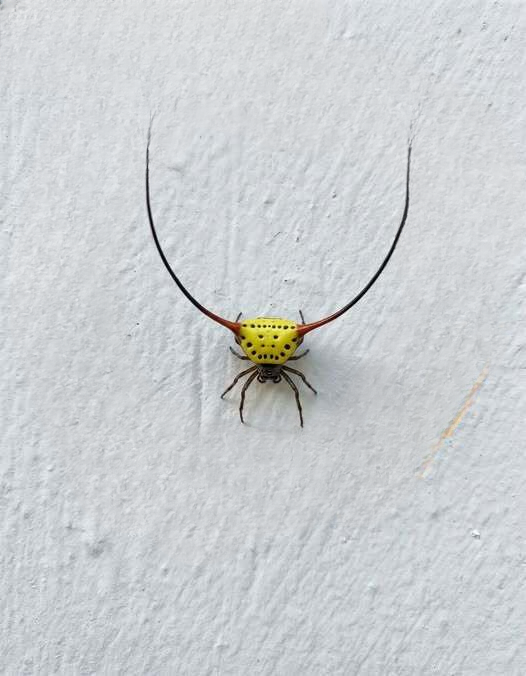
A Spiny Orb-Weaver in the Garage: Discovering the Remarkable Beauty of an Unusual Spider
Finding an unfamiliar spider inside your garage can be an unexpected experience, especially when its appearance is unlike anything you have seen before. With its distinctive body shape, unusual markings, and striking spines, a spiny orb-weaver can look almost unreal at first glance. Yet these fascinating spiders are part of the natural world, and learning about their appearance, behavior, and role in the environment can turn an unsettling discovery into an opportunity to appreciate local wildlife.
An Unexpected Discovery in the Garage
It was an ordinary evening, and there was nothing unusual about stepping into the garage to look for something I needed. I switched on the light, glanced around the familiar space, and then noticed something on the wall that immediately caught my attention.
At first, I could not tell exactly what I was looking at. The small creature had a body shape that seemed different from the spiders I usually encountered. Its outline was unusual, and several pointed projections gave it a distinctive appearance.
I stopped for a moment to take a closer look.
The garage was quiet, and the spider remained still against the wall. Its unusual shape made it easy to notice, particularly against the relatively plain background.
My first reaction was curiosity mixed with caution. I wondered whether it was a species I had never seen before, whether it was dangerous, and how it had found its way indoors.
Rather than attempting to touch it, I kept a little distance and examined its appearance more carefully.
That brief encounter raised a question that many people have when they discover an unfamiliar animal in their homes: should they be worried, or is the creature simply another part of the natural environment?
The answer often begins with identification.
What Is a Spiny Orb-Weaver?
The name spiny orb-weaver is commonly associated with certain spiders in the genus Gasteracantha, although the precise species depends on the region and the spider’s physical characteristics.
These spiders are known for their distinctive abdomens, which can have several prominent projections resembling small horns or spines. Depending on the species, their bodies may display combinations of white, yellow, red, black, or other contrasting colors.
Their unusual appearance makes them stand out from many other spiders.
Some spiny orb-weavers have broad, relatively flattened abdomens with several conspicuous spines extending from the sides. Their markings can create striking patterns that make them look more like tiny pieces of natural sculpture than familiar household spiders.
However, not every spider with a spiny or unusually shaped abdomen belongs to the same species. Several unrelated spiders can have projections, bumps, or distinctive body markings.
For accurate identification, it helps to consider the spider’s size, color, abdomen shape, number and arrangement of spines, web structure, and geographic location.
A clear photograph can be especially useful when consulting a reputable wildlife identification resource or local arachnology expert.
It is also worth remembering that finding a spider indoors does not necessarily mean it has established a population inside the building. It may have entered accidentally or been carried inside with plants, equipment, boxes, or other outdoor materials.
Why Does This Spider Have Such Unusual Spines?
One of the most interesting features of a spiny orb-weaver is its body shape.
The projections along the abdomen give these spiders an appearance that is quite different from the smooth, rounded bodies of many familiar species. Although the exact function and significance of these structures can vary among spiders, their shape is believed to play a role in defense against potential predators in some spiny orb-weaver species.
In the natural world, an unusual appearance can be an advantage. Predators often rely on visual cues when deciding whether to approach potential prey. Body shape, coloration, and surface structures can influence how an animal is perceived.
However, it would be inaccurate to assume that every spine has a single purpose or that the spider is necessarily dangerous because it looks intimidating.
The spines are not evidence that the spider possesses venom that is unusually harmful to humans. Like many spiders, orb-weavers use venom primarily to subdue their prey, which generally consists of small insects and other arthropods.
Their appearance may seem alarming, but an unusual body shape should not be confused with an increased medical risk.
The best approach is to observe the spider without handling it and use reliable identification information before drawing conclusions about its behavior or safety.
Are Spiny Orb-Weavers Dangerous to People?
Many people feel uneasy around spiders, especially those with unfamiliar markings or unusual body structures. That reaction is understandable, but appearance alone is not a reliable measure of danger.
Spiny orb-weavers are generally regarded as posing little risk to people when left undisturbed. They are not typically considered aggressive toward humans, and their natural behavior is focused on catching small prey rather than approaching people.
As with many spiders, a bite may be possible if the animal is trapped against the skin or handled. However, the exact risk depends on the species, and a spider should not be identified as harmless solely from a vague description or photograph.
If you discover an unfamiliar spider in your garage, avoid picking it up with your bare hands. Keeping a respectful distance allows you to observe it without creating an unnecessary opportunity for a bite.
If the spider is in a location where it could be accidentally touched, moved, or crushed, consider relocating it carefully using an appropriate container and a stiff piece of paper, provided you can do so safely.
If you are uncertain about the species or uncomfortable handling it, asking a local wildlife expert or pest-control professional for advice is a reasonable alternative.
Anyone who experiences a suspected spider bite followed by severe pain, difficulty breathing, widespread swelling, or other serious symptoms should seek urgent medical assistance. Do not rely on a visual identification alone to decide whether a bite requires treatment.
The important point is to respond proportionately. An unfamiliar spider deserves caution, but its unusual appearance does not automatically mean that it presents a serious threat.
Why Spiders Sometimes Enter Garages and Sheds
Garages, sheds, basements, and other storage spaces provide conditions that can attract a variety of small animals.
These spaces may contain sheltered corners, stored boxes, unused equipment, and relatively undisturbed areas where spiders can build webs or find places to rest.
Outdoor lighting may also attract insects at certain times, indirectly creating feeding opportunities for spiders that hunt near buildings.
Small openings around doors, windows, vents, and utility lines can allow spiders to enter. Some may also arrive on items brought in from the garden or carried from one storage area to another.
The presence of a single spider does not necessarily indicate a pest problem. Spiders are common in many environments, and one individual may have entered by chance.
If you frequently encounter spiders indoors, a few simple maintenance measures may help reduce unwanted entry.
- Seal gaps around doors and windows where practical.
- Repair damaged screens and improve the fit of garage doors.
- Reduce unnecessary clutter in storage areas.
- Inspect gardening equipment and outdoor items before bringing them inside.
- Clean corners and remove abandoned webs when appropriate.
- Store boxes and other belongings in a way that makes inspection easier.
These steps can help manage indoor spider encounters without requiring the unnecessary use of pesticides.
The Role of Orb-Weavers in the Environment
Although spiders may not be everyone’s favorite creatures, they perform important functions in many ecosystems.
Orb-weavers construct webs that allow them to capture flying or crawling insects. Their prey can include flies, mosquitoes, moths, and other small arthropods, depending on the spider species and its habitat.
By feeding on insects, spiders contribute to natural food webs and help regulate populations of certain invertebrates.
They also serve as prey for other animals, including some birds, reptiles, and predatory insects. This makes them part of a larger ecological network in which each organism plays a role.
Spiders are therefore not simply visitors that appear in inconvenient places. They are predators with an established place in the environment.
A spiny orb-weaver that appears near a garage may have been living in nearby vegetation or may have arrived while searching for a suitable place to build a web.
Understanding this ecological role can change how people respond to spiders. Instead of immediately treating every encounter as a problem, it may be possible to leave an outdoor spider undisturbed where it can continue its normal activities.
Of course, the decision can depend on the location. A spider in a frequently used doorway may need to be moved, while one in a quiet outdoor corner may not require any intervention.
How to Identify an Unfamiliar Spider
If you encounter a spider with unusual markings or spines, careful observation can help you determine what it might be.
Start with its overall shape. Notice whether the abdomen is rounded, flattened, elongated, or covered with projections. Spiny orb-weavers often have a distinctive abdomen that makes them easier to recognize than some other spiders.
Look at its coloration. Note the main body color and any contrasting markings. Photographs taken in natural light may provide more useful detail than images captured under strong artificial lighting.
Observe the web, if present. Many orb-weavers construct circular or wheel-shaped webs, although web structure varies among species and not every individual will be found in a visible web.
Estimate its size without touching it. A photograph that includes a familiar object nearby can provide scale, provided you do not place that object close to the spider.
Consider your location. The geographic region can be important because different spider species inhabit different parts of the world. A species commonly found in one country may be absent from another.
Finally, consult a reputable identification guide, university extension service, museum, or knowledgeable local expert.
Avoid relying entirely on viral photographs or social media captions. Images can be mislabeled, and dramatic descriptions sometimes exaggerate the danger associated with a species.
Accurate identification helps you make better decisions about whether the spider should be left alone, moved outdoors, or assessed by a professional.
Should You Remove a Spiny Orb-Weaver From Your Garage?
Whether you should move the spider depends largely on its location and the circumstances.
If it is outdoors or in a quiet part of the garage where nobody is likely to disturb it, leaving it alone may be the simplest option.
If it is directly beside a doorway, on equipment that you need to handle, or in an area where children or pets could come into contact with it, relocation may be appropriate.
Before moving an unfamiliar spider, make sure that you can do so without touching it directly. A container and a stiff piece of paper can sometimes be used to guide a small spider into a secure receptacle, but this method should only be attempted when it is safe and the spider can be approached without risk.
If you cannot confidently identify the species or feel uncomfortable moving it, seek assistance rather than taking unnecessary risks.
Avoid spraying pesticides simply because a spider looks unusual. Chemical treatments can affect other organisms and may not be needed for an isolated encounter.
If a persistent spider problem develops, focus first on entry points, clutter, and the conditions that allow spiders to settle indoors. Professional advice can help determine whether further treatment is justified.
Learning to Appreciate the Small Creatures Around Us
The unexpected appearance of a spiny orb-weaver can serve as a reminder of how much wildlife exists around ordinary homes.
Gardens, garages, sheds, and outdoor walls are connected to the wider environment. Small creatures often move between these spaces without attracting attention until they appear somewhere unexpected.
Their unusual forms can encourage curiosity about adaptation, behavior, and the diversity of life.
A spider that initially looks frightening may turn out to be an interesting predator with a specialized body shape and an important ecological role.
This does not mean that everyone must feel comfortable around spiders. Personal reactions vary, and maintaining reasonable boundaries is perfectly understandable.
However, learning about unfamiliar species can replace some of the uncertainty with useful knowledge. Knowing what an animal is, how it behaves, and whether it presents a genuine risk makes it easier to respond calmly.
The goal is not to ignore legitimate safety concerns. It is to distinguish between evidence-based caution and fear based only on appearance.
Final Thoughts
Discovering a spiny orb-weaver in a garage can be surprising, particularly if its unusual body shape makes it appear unlike any spider you have encountered before.
Yet these distinctive spiders demonstrate the variety and complexity of the natural world. Their appearance, web-building behavior, and role as insect predators make them interesting subjects for observation.
If you encounter one, avoid handling it directly, take a photograph if you want to identify it, and consult a reliable source when necessary. If it is in an inconvenient location, consider safe relocation or professional assistance.
Most importantly, remember that an unusual appearance is not proof of danger. Accurate identification and sensible precautions are more useful than assumptions based on fear.
Sometimes, an unexpected visitor is simply an opportunity to discover something new about the wildlife sharing our surroundings.