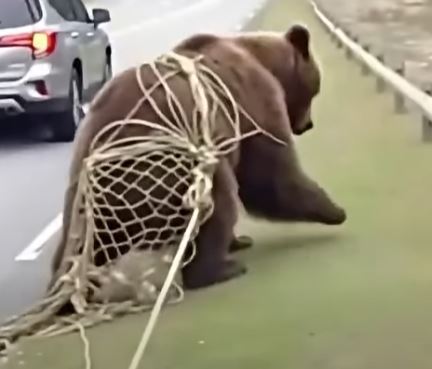
A Driver Encounters an Injured Bear on a Highway: A Story About Wildlife Safety and Compassion
It was shortly after sunrise when Daniel Harper was driving along a quiet highway surrounded by dense woodland. A thin layer of morning fog remained between the trees, and the road was still relatively empty.
Daniel had traveled the route many times before. The highway passed through an area where wildlife was common, so seeing animals near the road was not unusual. Deer, foxes, birds, and other animals occasionally appeared along the roadside.
That morning, however, Daniel noticed something that immediately caught his attention.
An animal was near the roadway.
As he approached, he realized it was a bear.
The bear appeared to be having difficulty moving and was positioned dangerously close to the traffic lanes. Daniel slowed his vehicle and carefully considered what to do.
His first instinct was to help, but he also understood that approaching a wild bear could be extremely dangerous.
Rather than treating the situation like a rescue that he could handle by himself, Daniel contacted the appropriate authorities and kept his distance.
What followed became a memorable experience that reminded him of the importance of respecting wildlife while also taking responsible action when an animal appears to be in distress.
An Unexpected Sight on the Highway
Driving through wooded areas requires extra attention because animals can enter roadways without warning.
Highways that pass through forests can serve as crossing points for wildlife. Animals may move between feeding areas, water sources, shelter, and other parts of their habitat.
Most encounters happen quickly.
A driver might see an animal at the edge of the road and watch it disappear into the trees. In other cases, an animal may cross directly in front of a vehicle.
Daniel had encountered wildlife on the road before, but the situation that morning was different.
The bear did not appear to be moving normally.
Instead of continuing without stopping, Daniel slowed down and moved his vehicle into a safe position away from traffic.
His decision was important because stopping in the wrong location could create another hazard for other motorists.
Why Injured Wildlife Can Be Difficult to Help
When people see an injured animal, the natural reaction may be to approach it.
For domestic animals, such as dogs or cats, approaching carefully may sometimes be appropriate.
Wild animals are different.
Even an animal that appears weak, frightened, or injured can react unpredictably when a person comes near.
A bear is particularly powerful and can move quickly when it feels threatened.
An injured animal may also be under considerable stress.
Pain, fear, confusion, and unfamiliar surroundings can cause wildlife to behave differently from how it normally would.
This is why wildlife professionals generally recommend keeping a safe distance rather than attempting a hands-on rescue.
Daniel Kept His Distance
Daniel wanted to make sure the bear was not struck by another vehicle.
He remained inside or near his vehicle at a safe distance while assessing the situation.
Instead of approaching the animal directly, he contacted local authorities who could determine the appropriate response.
This distinction is important.
Helping wildlife does not always mean physically touching or moving the animal.
Sometimes the safest and most effective action is simply to report its location to people who have the training and equipment to respond.
The Importance of Calling the Right People
Wildlife emergencies can involve several different agencies depending on the location.
Possible responders may include wildlife officers, conservation agencies, police, highway authorities, animal-control professionals, or licensed wildlife rehabilitators.
The appropriate organization depends on the species, location, road conditions, and circumstances.
When reporting an injured animal, providing clear information can make the response easier.
Useful details can include:
- The exact road or highway
- The direction of travel
- A nearby landmark or exit
- The animal’s approximate location
- Whether the animal is in the traffic lane
- Whether vehicles are approaching the area
- Whether the animal appears mobile
- Any obvious hazards
Drivers should avoid putting themselves in danger while trying to collect information.
If possible, the safest approach is to remain in a secure location and provide information from there.
Why Drivers Should Not Approach a Bear
Bears are wild animals and should be treated with caution even when they appear calm.
A bear that is lying down may not necessarily be helpless.
It could be resting, frightened, injured, protecting a nearby food source, or responding to a perceived threat.
Approaching it can increase stress and create a dangerous situation for both the person and the animal.
This is especially important when a bear is near a roadway because traffic, noise, and human activity can already make the animal feel threatened.
A driver should never assume that an injured bear will simply remain still.
Protecting Other Drivers Matters Too
Daniel’s concern was not only the bear’s condition.
A large animal lying near a highway can create a serious traffic hazard.
Drivers may not see the animal until they are close to it. Sudden braking or swerving can cause collisions.
If an animal is in or near the roadway, motorists should slow down carefully and avoid sudden maneuvers.
Hazard lights may be appropriate when safely stopped, depending on local traffic laws and circumstances.
However, drivers should never stand in an active traffic lane to warn others.
Personal safety must remain the first priority.
What to Do When Wildlife Is Near the Road
If you encounter a wild animal near a highway, several basic principles can help.
First, reduce your speed and remain alert.
Second, avoid sudden steering movements.
Third, maintain as much distance as practical.
Fourth, do not attempt to touch or move the animal.
If the animal appears injured, trapped, or unable to leave the roadway, contact the appropriate local authority.
If the animal is already moving away safely, it may be best to allow it to continue without interference.
The correct response depends on the circumstances.
The Difference Between Helping and Interfering
Wildlife encounters can create a difficult balance.
People naturally want to help an animal that appears to be suffering.
At the same time, human intervention can sometimes make the situation worse.
An animal may be injured but still capable of moving to safety.
A person who approaches may cause it to flee into traffic, deeper into an unfamiliar area, or toward other people.
This is why wildlife professionals assess the situation before deciding whether intervention is necessary.
Responsible assistance sometimes means doing less, not more.
Bears and Their Natural Behavior
Bears are intelligent, adaptable animals that occupy a variety of habitats.
Depending on the species and region, bears may live in forests, mountains, wetlands, grasslands, or areas near human development.
They have excellent senses and are capable of traveling considerable distances in search of food and suitable habitat.
Most bears prefer to avoid humans.
Encounters can occur when human development overlaps with bear habitat or when bears are attracted to accessible food.
This is one reason communities in bear country often emphasize secure garbage storage, responsible food disposal, and awareness when traveling through wooded areas.
Why Bears Sometimes Appear Near Roads
Roads can pass through habitats used by wildlife.
A bear may approach a roadside for many reasons.
It could be traveling between areas, searching for food, looking for water, or simply crossing its normal range.
Roads can also fragment natural habitats, forcing animals to cross human infrastructure.
Wildlife crossings, fencing, warning signs, and other conservation measures are sometimes used to reduce vehicle-animal collisions.
These measures can benefit both animals and motorists.
Vehicle Collisions With Wildlife
Large animals can create significant dangers when they enter roadways.
Collisions with deer are common in many regions, while collisions involving larger animals such as bears, elk, moose, or other species can be particularly serious.
Drivers traveling through wildlife habitat should pay attention to warning signs and reduce speed when visibility is limited.
Dawn and dusk can be important periods for wildlife activity.
Fog, rain, darkness, and heavy vegetation can also reduce reaction time.
Staying alert is one of the simplest ways drivers can reduce risk.
What Daniel’s Encounter Demonstrated
Daniel’s decision to stop safely and contact professionals demonstrated an important principle.
Compassion does not require taking unnecessary risks.
He could recognize that the bear needed assistance without assuming that he personally needed to provide that assistance.
By remaining at a safe distance, he protected himself while giving trained responders an opportunity to evaluate the situation.
This is often the best approach when dealing with large wild animals.
Wildlife Professionals Have Specialized Training
Wildlife officers and rehabilitators may have experience handling animals that are injured, sick, trapped, or displaced.
They can evaluate whether an animal requires treatment, relocation, observation, or another form of intervention.
Professionals may also have specialized equipment designed to reduce stress and protect both the animal and people nearby.
A person without that training generally does not have the same ability to predict an animal’s behavior.
This is another reason to contact professionals rather than attempting an independent rescue.
An Injured Animal May Not Look Like You Expect
People sometimes assume that an injured animal will be visibly bleeding or unable to move.
That is not always the case.
An animal can experience internal injuries, exhaustion, illness, dehydration, or other problems that are not immediately visible.
A bear lying near a road might have been involved in a collision, but it could also have another reason for being in that location.
Only a trained assessment can determine what is happening.
Why Photographs Can Be Misleading
When unusual wildlife encounters are photographed, the images may provide only a small portion of the story.
A picture can show where an animal was standing but cannot necessarily reveal why it was there, whether it was injured, or what happened beforehand.
Online posts can sometimes encourage people to make assumptions based on a single image.
Responsible reporting should distinguish between what was observed and what is known.
If an animal’s condition has not been professionally assessed, it is better to say that it appeared to be injured or distressed rather than making a definitive diagnosis.
The Role of Compassion in Wildlife Encounters
People often form strong emotional reactions when they see an animal in difficulty.
That response can be positive because it encourages people to pay attention and report problems.
However, compassion should be combined with knowledge.
The safest way to help wildlife is often to involve people who understand animal behavior and local wildlife regulations.
This approach protects both the animal and the person trying to help.
What Not to Do
When encountering an injured bear or another large wild animal, people should generally avoid several actions.
Do not approach closely to take photographs.
Do not attempt to feed the animal.
Do not attempt to touch it.
Do not try to move it with a vehicle or improvised equipment.
Do not surround the animal with other people.
Do not block traffic while trying to help.
Do not assume that because the animal is injured it cannot defend itself.
Instead, create distance and contact the appropriate authorities.
What to Do if the Animal Moves
If the bear begins moving away from the roadway, drivers should not follow it.
The best option may simply be to allow it to leave the area.
Following wildlife can increase stress and potentially drive the animal toward another road or populated area.
Once authorities have been contacted, providing the animal’s last known direction of travel can be useful.
Again, people should never place themselves in danger to keep track of a wild animal.
The Importance of Wildlife Corridors
Modern conservation efforts increasingly recognize the importance of wildlife movement.
Animals need to travel between different parts of their habitat for food, water, shelter, breeding, and seasonal movement.
Roads can interrupt these natural routes.
Wildlife corridors and dedicated crossings can provide safer alternatives.
In some areas, bridges or underpasses are designed specifically for wildlife.
These structures can reduce collisions and allow animals to move through fragmented habitats more safely.
How Drivers Can Prepare for Wildlife Areas
Drivers who frequently travel through rural or forested areas can take several precautions.
Reduce speed when wildlife signs are present.
Pay particular attention around sunrise and sunset.
Use headlights appropriately.
Scan both sides of the roadway rather than looking only directly ahead.
Avoid distractions such as mobile-phone use.
If one animal crosses the road, remain alert because others may follow.
These habits are useful not only in areas where bears live but anywhere wildlife frequently crosses roads.
What If a Bear Is in the Road?
If a bear is directly in the roadway, the safest response is usually to slow down and create as much distance as possible.
Do not attempt to drive toward it to make it move.
Avoid sudden braking or swerving when other vehicles are nearby.
If the road can be cleared safely, allow the animal time to leave.
If it remains in the roadway or appears injured, contact the appropriate local authorities.
Drivers should follow local instructions and never place themselves between the bear and an escape route.
Respecting Wildlife Means Respecting Its Space
One of the most important principles of wildlife safety is distance.
Wild animals need space to behave naturally.
Even animals that seem calm can become defensive when people approach too closely.
Keeping a respectful distance reduces stress and lowers the risk of conflict.
It also allows wildlife professionals to make better decisions when they arrive.
The Broader Lesson From Daniel’s Experience
Daniel’s encounter was memorable because it combined an ordinary morning drive with an unexpected wildlife situation.
But the broader lesson is useful for anyone who spends time on roads near natural habitats.
Wildlife emergencies do not always require dramatic intervention.
Sometimes the most responsible action is to slow down, remain calm, stay at a safe distance, and contact someone who can help.
This approach