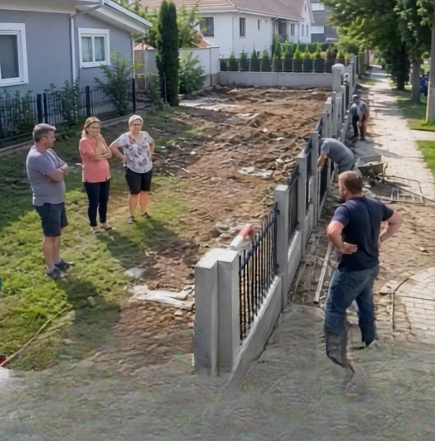
My Neighbor Removed My Fence While I Was Away — So I Had the Property Line Professionally Marked
When I returned home after a week away, the first thing I noticed was how different my backyard looked.
At first, I couldn’t figure out what had changed.
The house looked the same.
The trees were still standing.
My garden was where I had left it.
Even Daisy, my Labrador, was waiting inside and making enough noise to remind me that she had missed me.
But something was missing.
Then I realized what it was.
The fence.
Nearly two hundred feet of wooden fencing that had marked the boundary between my property and the neighboring lot had disappeared.
Completely.
There were no broken panels scattered across the yard. No damaged sections leaning against a tree. No obvious signs of a storm.
Someone had removed it.
And whoever had done it had taken the time to pull out the posts as well.
For several minutes, I simply stood there looking at the open space.
The strange thing was that the missing fence wasn’t the first problem.
The real problem was that I already had a pretty good idea who had removed it.
And I knew exactly why.
The Property I Had Worked for
I live outside a small town in western North Carolina.
It isn’t the kind of place where people spend much time worrying about appearances. Most roads are quiet, neighbors generally know one another, and there is still a sense that people should respect each other’s space.
That’s one of the reasons I moved there.
For much of my adult life, I worked in construction management in Charlotte.
The job was good, but the lifestyle wasn’t what I wanted forever.
There were long commutes, traffic, meetings, deadlines, and constant noise.
By the time I reached my late thirties, I had started thinking seriously about what I wanted the second half of my life to look like.
I didn’t need a huge house.
I didn’t need a swimming pool or an impressive driveway.
I wanted trees.
I wanted quiet.
I wanted room for a garden.
And I wanted enough land that I didn’t feel like I was living directly on top of another family.
After years of saving, I eventually found three wooded acres at the end of a gravel road.
The property wasn’t perfect.
The driveway needed work.
Some of the trees needed clearing.
There were areas where the ground became muddy after heavy rain.
But I loved it.
For the first time in years, I could step outside in the morning and hear birds instead of traffic.
That mattered to me.
Why I Built the Fence
A couple of years after purchasing the property, I decided to install a fence along the boundary between my land and the neighboring parcel.
It wasn’t an extravagant project.
It was a practical one.
I wanted to keep my dog from wandering.
I wanted to protect my vegetable garden from deer.
Most importantly, I wanted a clearly defined boundary.
The fence was about six feet tall and made from pressure-treated wood.
It stretched for just under two hundred feet.
I did much of the work myself.
I rented equipment, dug the post holes, measured everything carefully, and spent several weekends getting the posts properly positioned.
A friend named Caleb helped me with some of the heavier work.
Once the posts were set, we installed the panels one section at a time.
It took longer than I expected.
My back hurt.
My hands were sore.
And there were several moments when I wondered why I hadn’t simply hired someone.
But when we finally finished, I was proud of it.
It wasn’t just a fence.
It represented something I had worked for.
A clear line.
A little privacy.
A safe place for Daisy.
And a reminder that the property was finally mine.
The Fence Became Part of Everyday Life
For years, nobody complained about it.
The neighbors who lived next door when I first installed it were an older couple.
They were quiet and friendly.
We occasionally spoke when we saw each other outside.
They never suggested removing the fence.
They never questioned where it was located.
There were no disputes.
Eventually, they moved away.
The property next door remained vacant for a while.
Then a new family arrived.
Their names were Ethan and Mara Carter.
They appeared friendly enough when they first introduced themselves.
They had two boys, a large SUV, and plenty of plans for the property.
During our first conversation, Ethan mentioned that they were excited about having more outdoor space.
Mara talked about meeting people in the neighborhood.
I welcomed them.
I had no reason not to.
A new neighbor doesn’t automatically mean a problem.
At first, everything was perfectly normal.
We waved when we saw each other.
Sometimes we exchanged a few words.
Their children occasionally played outside.
I continued with my own routine.
Then, about a month after they moved in, Ethan brought up the fence.
The First Conversation
I was outside with Daisy when I noticed Ethan standing near the shared boundary.
He had one hand resting on the top rail.
He wasn’t doing anything in particular.
Just looking at it.
When I walked closer, he turned toward me.
“Have you ever thought about taking this down?” he asked.
I initially thought he was joking.
“Taking what down?”
“The fence.”
I looked at him.
“Why?”
He shrugged.
“It would open everything up.”
I wasn’t sure what he meant.
He explained that he thought the properties would feel more connected without a barrier between them.
He mentioned his children.
He said they would have more room to play.
He talked about making the yards feel like one large outdoor area.
I listened.
Then I explained that the fence served several purposes for me.
My dog needed it.
My garden benefited from it.
And I valued the privacy.
He seemed surprised.
“You’re really attached to it?” he asked.
“It’s been here for years,” I said. “And it works.”
He smiled.
“I just think things could be more open.”
I understood what he meant.
But I didn’t agree.
A Simple Boundary
I told Ethan that I had no intention of removing the fence.
I wasn’t angry.
I wasn’t trying to start a conflict.
I simply didn’t see a reason to change something that was working.
The property line existed regardless of whether there was a fence.
The fence simply made the boundary visible.
Ethan nodded.
“Fair enough,” he said.
I assumed the conversation was finished.
Looking back, I realize I should have paid more attention.
Not because he threatened me.
He didn’t.
But because his interest in the fence didn’t seem to disappear after that conversation.
Then I Left Town
Several weeks later, I took a trip to the Gulf Coast.
It was nothing dramatic.
I wanted a few days away from work and the routine of home.
I spent my time walking near the water, eating seafood, enjoying the warm weather, and generally doing very little.
It was exactly what I needed.
When I returned home, I was still thinking about the trip.
Then I pulled into my driveway.
That’s when I noticed the difference.
The backyard looked unusually open.
At first, I thought perhaps I was simply seeing it from a different angle.
Then I realized the fence wasn’t there.
I parked.
Got out.
And walked toward the backyard.
It was gone.
Someone Had Removed the Fence
I walked the entire length of the former boundary.
Every section was missing.
The wooden panels were gone.
The posts were gone.
Even the hardware had been removed.
There were holes where the posts had previously stood.
Whoever removed the fence had not simply damaged it.
They had dismantled it.
That meant this wasn’t an accident.
Someone had made a deliberate decision to remove a structure that belonged to me.
I stood there for several minutes.
I could have walked directly to the Carters’ house.
I could have confronted Ethan.
I could have started shouting.
But none of those things would have solved the problem.
Instead, I went inside.
I made coffee.
Then I opened the filing cabinet where I kept the documents related to the property.
The Folder
I had kept almost everything.
The original property documents.
A survey.
Receipts from construction work.
Photographs.
Permits and correspondence.
Even photographs from the day I installed the fence.
I wasn’t organized because I expected a dispute.
I was organized because I had worked in construction management for years.
Documentation solves problems.
Memory is unreliable.
Paperwork is much harder to argue with.
I spread the documents across the kitchen table.
Then I looked carefully at the property survey.
The fence had been installed according to the boundary information I had received when I purchased the property.
But instead of assuming everything was correct, I decided to verify it.
That decision changed the entire situation.
I Called a Surveyor
The next morning, I contacted a licensed land surveyor.
I explained what had happened.
I didn’t tell him what I thought about the neighbors.
I didn’t make accusations.
I simply explained that a fence had been removed and that I wanted the property boundary independently confirmed.
He scheduled a visit.
A few days later, he arrived with the equipment needed to locate and mark the boundary.
We walked the property together.
He checked existing markers and compared the physical location with the recorded information available to him.
Then he began marking the line.
Orange stakes appeared along the boundary.
One after another.
They made the invisible line visible again.
And that was when I discovered something important.
The Fence Had Not Been on Their Property
The survey confirmed that the fence had been located on my property.
There was no confusion about which side of the line it belonged to.
That didn’t automatically answer every legal question about who could remove it.
Property laws vary by jurisdiction, and disputes involving fences can depend on factors such as ownership, easements, agreements, surveys, and local regulations.
But the survey gave me something far more useful than an argument.
It gave me documentation.
I now had an independent professional’s work showing where the boundary was located.
That changed how I approached the situation.
I Didn’t Build a Bigger Fence Out of Anger
The original version of my plan had been simple.
Replace the wooden fence.
But after the survey, I decided to make the new boundary more durable.
I contacted a contractor and discussed options.
We considered another wood fence.
We considered vinyl.
We considered a combination of posts and fencing materials that would require less maintenance.
Eventually, I chose a stronger, professionally installed boundary system that was appropriate for the property and compliant with local requirements.
It wasn’t about making the neighbor’s yard look unpleasant.
It wasn’t about punishing anyone.
It was about preventing the same misunderstanding from happening again.
I wanted a boundary that was clear, properly documented, and difficult to misinterpret.
The Carters Came Outside
The construction work had barely begun when Ethan noticed.
He walked toward the property line.
I was standing nearby while the contractor prepared the posts.
Ethan looked at the marked boundary.
Then he looked at me.
“What are you doing?”
“Replacing the fence.”
He glanced at the stakes.
“You had a survey done?”
“Yes.”
He seemed surprised.
“Why?”
“Because the old fence was removed while I was away.”
He didn’t answer immediately.
Instead, he looked toward the area where the original fence had stood.
I didn’t accuse him.
I didn’t need to.
The important thing was that the boundary was now documented.
The Conversation Changed
Ethan’s tone was different from our previous conversations.
He asked whether the survey confirmed the location.
I said yes.
He asked whether the new fence would be exactly along the property line.
I explained that the contractor was installing it according to the survey and any applicable local requirements.
Then he asked something I hadn’t expected.
“Did you really need to do all this?”
I looked at the marked line.
“After the old fence disappeared? Yes.”
There was a long pause.
Finally, he said he hadn’t realized how important the fence was to me.
I told him it wasn’t really about the fence itself.
It was about respecting property boundaries.
That was the point he had missed from the beginning.
A Boundary Is More Than a Physical Structure
The disagreement had never truly been about wood.
It was about assumptions.
Ethan had assumed that because we were neighbors, our outdoor spaces could function as one shared area.
I saw things differently.
Being neighbors does not mean giving up ownership or privacy.
Good neighbors can share tools, help each other during storms, watch each other’s homes, or have conversations across a fence.
But those relationships work best when boundaries are respected.
A fence can be a practical structure.
It can also be a visual reminder that two properties belong to different people.
There is nothing inherently unfriendly about that.
The New Fence Goes Up
Over the next several days, the contractor continued working.
The new posts were installed carefully.
Measurements were checked.
The boundary was followed.
The work took time because I wanted everything done properly.
I didn’t want to rush simply because I was frustrated.
When the project was complete, I walked the entire length of the new fence.
It looked different from the original.
It was sturdier.
The lines were clean.
The gates operated properly.
Most importantly, I knew exactly where it stood.
Daisy immediately discovered the change.
She walked the perimeter as if she were inspecting a new section of her own territory.
Then she returned to her favorite spot in the yard and lay down.
Life began returning to normal.
There Was No Grand Confrontation
The ending wasn’t what someone might expect from a viral neighborhood story.
There was no dramatic argument.
No shouting match.
No police arriving with sirens.
No one standing in the middle of the street.
Instead, there was a survey.
There were documents.
There was a contractor.
And there was a conversation between two neighbors who finally understood that they had very different ideas about property boundaries.
That was enough.
In the weeks afterward, things became more civil.
We weren’t suddenly best friends.
But we could wave again.
And that was fine with me.
Not every neighbor needs to become a close friend.
Sometimes a respectful relationship is enough.
What I Learned
The experience taught me several things.
The first is that property boundaries should never be based solely on memory.
If there is ever a serious disagreement about where a boundary lies, the right response is to consult official records and, when appropriate, a qualified surveyor.
The second lesson is to document improvements made to your property.
Photographs, receipts, permits, contracts, and surveys may seem boring when everything is going well.
But if a disagreement develops years later, those documents can become extremely valuable.
The third lesson is that anger is rarely the best first response.
When I first saw that the fence was gone, I was furious.
I had spent time and money building it.
Someone had removed it without asking me.
But if I had immediately confronted my neighbor while angry, the situation could easily have become worse.
Instead, I gathered information first.
That gave me options.
The Importance of Staying Calm
Neighborhood disputes can become surprisingly complicated.
A disagreement that begins with something as simple as a fence can eventually involve property records, easements, local regulations, contractors, attorneys, homeowners’ associations, or municipal authorities.
That’s why emotions can make things worse.
The strongest response isn’t always the loudest one.
Sometimes the strongest response is simply knowing the facts.
In my situation, the survey answered the most important question.
Where was the property line?
Once that was established, the rest became much easier.
Why I Chose a More Durable Solution
People have since asked why I didn’t simply rebuild the same wooden fence.
The answer is simple.
The original fence had served me well.
But circumstances had changed.
I now knew that the property next door was occupied by people who had different expectations about how the land should be used.
A more durable boundary made sense.
It wasn’t designed to intimidate anyone.
It wasn’t designed to make the neighboring property less attractive.
It was designed to clearly identify where one property ended and another began.
There is a difference between creating a boundary and creating hostility.
I wanted the first.
The Bigger Lesson About Neighbors
Living near other people requires compromise.
You can’t control everything that happens around you.
Your neighbor may plant different landscaping.
They may have children who play outside.
They may enjoy different schedules.
They may have different ideas about privacy.
That’s normal.
But compromise doesn’t mean ignoring ownership.
The healthiest neighborhoods usually have something in common:
People understand where their responsibilities end and someone else’s begin.
They communicate when problems arise.
They don’t assume permission.
And when there is uncertainty, they check the facts.
Looking Back
If I could go back to the day I first met Ethan, I would probably handle the conversation the same way.
He asked whether I would consider removing the fence.
I said no.
That should have been enough.
What happened afterward was unfortunate.
But it also reminded me why clear boundaries exist in the first place.
The fence wasn’t there because I disliked my neighbors.
It wasn’t there because I wanted to isolate myself.
It was there because I owned the property and wanted to use it in a way that worked for me.
After everything was resolved, I stood in the backyard one evening and watched the sun disappear behind the trees.
Daisy was lying nearby.
The garden was quiet.
The new fence followed the property line exactly.
For the first time since returning from my trip, the yard felt normal again.
A Fence Can Represent Something Bigger
People sometimes think of fences as barriers.
And physically, that’s what they are.
But they can also represent clarity.
A fence says:
This is where my responsibility begins.
This is where yours begins.
We can still be neighbors.
We can still be friendly.
We can still help one another.
But we don’t have to share everything simply because we live next door.
That is a healthy principle far beyond property ownership.
Boundaries exist in many parts of life.
They can protect privacy.
They can prevent misunderstandings.
They can make expectations clear.
And when people respect them, relationships often become easier rather than more distant.
The Final Conversation
Several weeks after the new fence was completed, Ethan and I happened to meet near the road.
He looked toward the property.
“I guess that’s going to stay,” he said.
I smiled.
“Yes.”
He nodded.
Then he said something that surprised me.
“I should have talked to you before anything was done.”
I agreed.
That was really all there was to say.
There was no need to revisit every detail.
The boundary was established.
The disagreement was over.
And we could both move forward.
What I Wanted All Along
I never wanted a fight with my neighbors.
I didn’t want their yard to look bad.
I didn’t want to embarrass them.
I didn’t want revenge.
I wanted exactly what I had wanted when I bought the property years earlier:
A quiet place to live.
A safe yard for my dog.
A garden.
Some privacy.
And a clear understanding of where my property ended.
The new fence gave me those things.
But the survey and the documentation gave me something even more valuable.
Certainty.
Final Thoughts
A missing fence can look like a small neighborhood disagreement.
But property boundaries are important, and disputes over them can become complicated quickly.
The best response is usually not to escalate the conflict.
It’s to slow down, gather documentation, verify the facts, and use appropriate professional or legal channels when necessary.
In my case, a survey answered the central question.
The property line was clear.
Once it was confirmed, I could replace the fence properly and move forward.
The experience also changed how I think about boundaries.
A boundary doesn’t have to be hostile.
It doesn’t have to represent a lack of trust.
Sometimes it simply represents clarity.
My neighbor wanted the yards to feel connected.
I wanted mine to remain private.
Neither of us needed to convince the other that our preference was wrong.
We simply needed to respect the fact that we owned different pieces of land.
Today, the fence stands quietly along the property line.
Daisy still runs around the yard.
The garden is still there.
The trees are still standing.
And the neighborhood is quiet again.
The lesson wasn’t that concrete and steel can solve every disagreement.
It was much simpler:
When a boundary matters, make sure everyone knows where it is—and make s