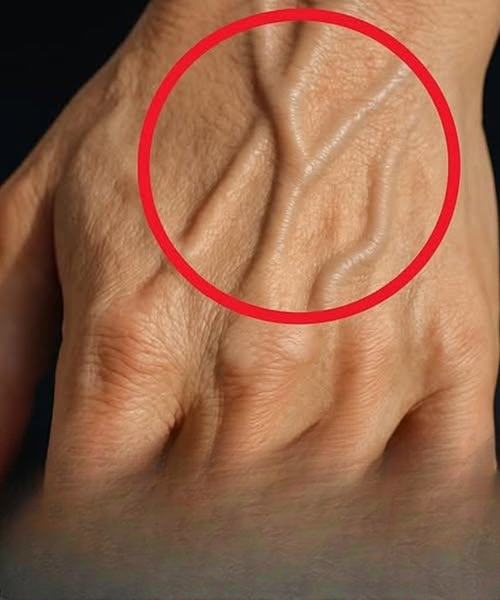
What the Veins on Your Hands Might Reveal About Your Kidney Health
Many people occasionally look down at their hands and notice that the veins seem more visible than they used to be.
Perhaps the veins appear slightly raised. Maybe they look blue or green beneath the skin. In some people, they become especially noticeable after exercise, during warm weather, or when the hands are hanging down for several minutes.
It is easy to wonder whether a change like this could be a sign of an underlying health problem.
One question that sometimes comes up is whether prominent veins on the hands are connected to kidney health.
The short answer is that visible veins on the hands, by themselves, are not a reliable way to diagnose kidney disease.
Hand veins can become more noticeable for many ordinary reasons, including genetics, age, lower amounts of tissue beneath the skin, exercise, heat, hydration changes, and the position of the hands. In some circumstances, changes in circulation can also affect how veins appear.
Kidney disease is different.
The kidneys perform several important jobs throughout the body, including filtering waste and excess fluid from the blood, helping regulate electrolytes, supporting blood pressure control, and contributing to the production of hormones involved in red blood cell production and bone health.
When kidney function becomes impaired, the symptoms can sometimes be subtle, especially in the earlier stages.
That is why kidney health should not be judged simply by looking at the veins on your hands.
Instead, it is more useful to understand why hand veins become visible, what symptoms can actually be associated with kidney problems, which risk factors deserve attention, and when medical evaluation may be appropriate.
Why Are the Veins on Your Hands Visible?
Veins are part of the circulatory system.
They carry blood back toward the heart after tissues throughout the body have used oxygen and nutrients.
Some veins are located close to the surface of the skin. These are called superficial veins, and they can sometimes be seen quite clearly, especially on the hands and forearms.
The visibility of these veins varies considerably from one person to another.
Two people of the same age and general health may have very different-looking hands.
One person may have barely visible veins, while another may have prominent veins that are easy to see.
That difference does not automatically mean that one person has better health than the other.
Several factors influence how noticeable veins become.
Genetics
Genetics play an important role in the way veins appear.
Some people naturally have more prominent superficial veins or thinner skin.
If visible hand veins are common among members of your family, you may simply have inherited a similar physical characteristic.
This can remain completely normal throughout life.
Age
As people get older, the skin gradually changes.
It can become thinner and lose some of its elasticity and underlying support.
Changes in the amount and distribution of body fat can also make superficial veins easier to see.
As a result, someone who had relatively smooth-looking hands when they were younger may notice more prominent veins later in life.
This does not automatically indicate kidney disease or another serious condition.
Exercise
Physical activity can temporarily make veins more visible.
During exercise, blood flow to working muscles increases, and changes in blood vessels and surrounding tissues can make superficial veins stand out more.
People who regularly perform strength training may notice particularly prominent veins in their hands, arms, and forearms.
This is sometimes referred to informally as vascularity.
It can be especially noticeable after lifting weights or performing activities that involve repetitive use of the arms and hands.
Heat
Warm temperatures can affect blood vessels near the surface of the skin.
Blood vessels may widen as the body attempts to release heat.
This can make superficial veins easier to see.
You may therefore notice that the veins on your hands appear more pronounced on a hot day than they do in a cool room.
Hand Position
The position of your hands can also change how veins look.
When your hands hang below the level of your heart, gravity can influence blood pooling in the veins.
As a result, veins may temporarily appear fuller.
If you raise your hands for a while, their appearance may change again.
This is one reason a person may notice different levels of vein visibility throughout the day.
Body Composition
People with less tissue between the skin and underlying veins may naturally have more visible veins.
This can occur in people who are naturally lean, physically active, or have experienced changes in body composition.
Again, visible veins alone do not tell you whether your kidneys are functioning normally.
Does Kidney Disease Cause Visible Hand Veins?
This is where it is important to separate a visual observation from a medical diagnosis.
There is no simple rule that says visible veins on the hands indicate kidney disease.
Kidney disease can affect fluid balance and circulation, but the appearance of ordinary superficial veins on the hands is not considered a dependable screening test for kidney function.
Someone can have very visible hand veins and completely normal kidney function.
Likewise, someone with kidney disease may not have unusually visible veins.
This is why doctors do not diagnose kidney disease by examining whether the veins on someone’s hands are prominent.
Instead, kidney health is assessed using a person’s medical history, risk factors, physical examination when appropriate, blood tests, urine tests, blood pressure measurements, and sometimes imaging or other investigations.
What Does Kidney Disease Actually Affect?
The kidneys are two bean-shaped organs located toward the back of the abdomen.
Their role extends far beyond simply producing urine.
Healthy kidneys continuously filter the blood and help maintain a stable internal environment.
They remove waste products and excess substances through urine.
They also help regulate:
- Fluid balance
- Sodium and other electrolytes
- Blood pressure
- Acid-base balance
- Red blood cell production
- Bone and mineral metabolism
When kidney function declines, some of these processes can become disrupted.
However, the body may compensate surprisingly well during the early stages of kidney disease.
This is one reason kidney problems can sometimes exist without obvious symptoms.
Kidney Disease Can Be Difficult to Notice Early
One of the most important facts about chronic kidney disease is that it may develop gradually.
A person can have reduced kidney function without feeling dramatically different.
That is why people with certain risk factors may benefit from routine medical monitoring even if they feel healthy.
Conditions such as diabetes and high blood pressure are important risk factors for kidney disease.
Other factors can include cardiovascular disease, certain inherited kidney conditions, previous kidney injury, and some medications or medical conditions depending on the individual.
Regular checkups can help identify changes before they become more advanced.
Possible Symptoms of Kidney Problems
Although early kidney disease may cause few symptoms, more advanced kidney problems can be associated with a variety of changes.
These symptoms are not specific to kidney disease, meaning they can have many other causes.
Still, they can be worth discussing with a healthcare professional when they persist or occur together.
Changes in Urination
Changes in urination can sometimes occur when kidney function is affected.
Examples may include:
- Urinating more or less often than usual
- Increased urination at night
- Foamy or unusually frothy urine
- Blood in the urine
- Changes in the appearance of urine
- Difficulty urinating
A single change does not necessarily mean there is a kidney problem.
For example, urine can look different depending on hydration, diet, medications, and other factors.
Persistent or unexplained changes deserve medical attention.
Swelling
When the kidneys are unable to maintain fluid balance properly, fluid can accumulate in the body.
Swelling may occur around the ankles, feet, legs, hands, or sometimes around the eyes.
However, swelling has many possible causes.
Heart conditions, liver problems, certain medications, prolonged sitting, venous problems, and other conditions can also contribute to swelling.
Therefore, swelling should not automatically be attributed to the kidneys.
Fatigue
Persistent fatigue can occur with many health conditions.
In more advanced kidney disease, reduced kidney function can contribute to anemia and changes in the body’s internal chemistry, which may lead to tiredness or reduced energy.
But fatigue alone is not a reliable sign of kidney disease.
Poor sleep, stress, nutritional deficiencies, infections, thyroid conditions, anemia from other causes, and many other factors can produce similar symptoms.
Nausea or Reduced Appetite
More advanced kidney problems can sometimes cause nausea, appetite changes, or an unpleasant taste in the mouth.
These symptoms can also occur with countless other conditions.
If they are persistent or accompanied by other concerning symptoms, medical evaluation is appropriate.
Itching or Dry Skin
Some people with significant kidney impairment develop persistent itching or changes in their skin.
Again, there are many other possible explanations for itching, including allergies, dermatological conditions, medications, and environmental factors.
Muscle Cramps
Changes in electrolytes and fluid balance can contribute to muscle cramps in people with kidney disease.
But muscle cramps are extremely common and usually have many possible explanations.
Exercise, dehydration, medication effects, circulation issues, and muscle strain can all contribute.
Why Looking at One Physical Feature Can Be Misleading
Humans naturally look for visible clues when trying to understand their health.
If a person notices something unusual about their skin, eyes, nails, hands, or feet, it is understandable that they might search for an explanation.
The problem is that many visible features are nonspecific.
The same physical characteristic can appear in