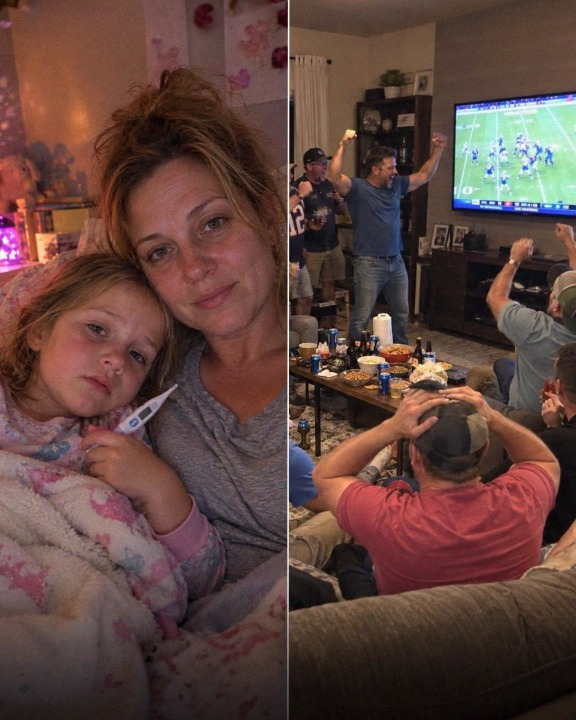
My six-year-old daughter, Emily, had been sick for several days.
As any parent knows, there is something uniquely exhausting about watching your child feel miserable while knowing there isn’t much you can do except stay close, keep them comfortable, and wait for them to recover.
For the first couple of days, Emily had a persistent fever that would improve for a while and then return. I stayed in constant contact with her doctor and followed the instructions we’d been given.
I barely slept.
Every few hours, I checked her temperature. I changed her pajamas when they became damp, brought her water, helped her get comfortable, and stayed beside her whenever she woke up frightened or uncomfortable.
I also took time away from work because there was no way I was going to leave her alone while she was feeling that poorly.
My husband, Glen, knew exactly what was happening.
He saw me sitting beside Emily’s bed.
He saw the thermometer on the nightstand.
He saw the cups of water, medicine, tissues, and everything else we’d accumulated during those long days.
Yet somehow, he seemed to think none of it had anything to do with him.
By the third day, Emily finally started improving.
Her fever had settled, she was drinking more, and she even asked for one of her favorite cartoons.
I was relieved.
More than relieved, actually.
I was exhausted.
I hadn’t had a proper night’s sleep in days, and the house needed cleaning. There were dishes in the sink, laundry waiting to be folded, and several other chores I’d been postponing because taking care of Emily came first.
I remember thinking that evening:
Tonight, maybe I can finally get some rest.
I was standing in the kitchen when Glen walked in.
He looked unusually cheerful.
“Honey, remember there’s a big game tonight?”
I stared at him.
“What game?”
He smiled.
“The football game. I invited some guys over. We’re going to watch it in the living room.”
For a moment, I genuinely thought I’d misunderstood him.
“How many people?”
He shrugged.
“Maybe fifteen.”
I just stared at him.
“Fifteen?”
“Yeah.”
“Glen, Emily has been sick for days.”
“I know.”
“And I’ve barely slept.”
“I know that too.”
“Then why would you invite fifteen people into the house?”
He sighed as if I were making an unreasonable request.
“I already invited them.”
I took a slow breath.
“Could you please call them and tell them to watch somewhere else? A friend’s house, a sports bar, anywhere. Emily needs quiet, and I need sleep.”
Glen shook his head.
“No. I’ve already made plans.”
“But this is our home.”
“Exactly. And I’m allowed to have friends over.”
I couldn’t believe what I was hearing.
“This isn’t about you having friends over. Our daughter is recovering, and she needs a peaceful environment.”
He picked up his phone.
“She’ll be fine.”
I stared at him.
“That’s your answer?”
He shrugged.
“You’re making this much bigger than it needs to be.”
Then he said the sentence that made something inside me snap.
“That’s not my problem.”
I looked at him for several seconds.
“Your daughter being sick isn’t your problem?”
He rolled his eyes.
“That’s not what I meant.”
“It sounded exactly like what you meant.”
He walked away.
I stood alone in the kitchen, completely stunned.
For two days, I had been carrying the responsibility of caring for our daughter almost entirely by myself.
I wasn’t asking Glen to become a full-time caregiver.
I wasn’t asking him to cancel every plan he had forever.
I was asking him to recognize that our child was sick and that our family needed rest.
Instead, he’d chosen his football party.
So I stopped arguing.
I simply said:
“Okay.”
He looked back at me.
“Okay?”
“Yes.”
He smiled, clearly thinking he’d won.
“Great.”
What he didn’t know was that I had just decided I wasn’t going to spend the evening cleaning up after fifteen grown adults.
If Glen wanted to host a football night, he could take responsibility for it.
At around seven, the first guests started arriving.
Then another group.
Then another.
Soon the living room was full.
There were chairs everywhere, bowls of snacks on the coffee table, drinks in the refrigerator, and people talking loudly over one another.
Glen was having the time of his life.
I checked on Emily.
She was resting comfortably in her room.
I reminded everyone that she was recovering and asked them to keep the hallway quiet.
A few people apologized.
Most were respectful.
But as soon as the game started, the noise grew.
Every big play produced shouting.
Every missed opportunity produced groans.
Every exciting moment seemed to shake the walls.
I tried closing Emily’s door.
Then I tried moving her farther away from the living room.
Nothing worked.
Finally, I walked into the living room.
“Glen.”
He barely looked away from the television.
“What?”
“Please keep the volume down.”
“We’re watching the game.”
“I know. But Emily is trying to sleep.”
He waved his hand.
“Guys, keep it down a little.”
For about thirty seconds, everyone lowered their voices.
Then another big play happened.
The room erupted again.
I went back upstairs.
At that point, I realized arguing wasn’t going to accomplish anything.
So I decided to let Glen experience the consequences of his decision.
I went into the kitchen.
And I started preparing something.
Not anything dangerous.
Not anything cruel.
Just something that would make the evening considerably less comfortable for the man who had decided everyone else’s needs could wait.
I gathered a few things from the pantry and refrigerator.
Then I placed everything into a large paper bag.
I smiled to myself.
By halftime, the noise had reached another level.
I could hear Glen laughing from upstairs.
I checked on Emily one more time.
She was asleep.
Finally.
I walked downstairs carrying the bag.
The moment I entered the living room, Glen looked at me.
“Hey, honey! Bring the snacks over here.”
“Sure.”
He smiled.
His friends cheered when they saw the bag.
“Now that’s what I’m talking about!”
I placed it on the coffee table.
Glen reached inside.
Then he froze.
His expression changed immediately.
“What is this?”
His friends leaned closer.
One of them started laughing.
Another said:
“No way.”
Glen looked at me.
“You did this?”
I smiled.
“You wanted a football party, right?”
He looked back into the bag.
Inside were all the things he’d forgotten to prepare for his guests: trash bags, paper towels, cleaning supplies, and a handwritten list.
At the top of the list were three words:
YOUR PARTY. YOUR RESPONSIBILITY.
The room went completely quiet.
Then one of his friends started laughing.
Another shook his head.
“Man, she’s got a point.”
Glen’s face turned red.
“What is this supposed to mean?”
I calmly explained.
“You invited fifteen people into the house without asking me. You knew our daughter was sick. You knew I hadn’t slept. You refused to move the gathering somewhere else.”
He opened his mouth.
I continued.
“So I decided that if you’re old enough to organize a party, you’re old enough to handle what comes afterward.”
His friends exchanged awkward glances.
Glen looked around the room.
“You’re embarrassing me.”
I raised an eyebrow.
“I’m not embarrassing you. I’m asking you to clean up your own mess.”
One of his friends stood up.
“Honestly, Glen, she’s right.”
Another nodded.
“We should probably help.”
Glen looked stunned.
“What?”
His friend grabbed one of the trash bags.
“You invited us. The least we can do is clean up.”
Within minutes, the room that had been filled with shouting became surprisingly quiet.
People began gathering empty plates and cups.
Someone wiped down the coffee table.
Another person collected cans and bottles.
Glen stood in the middle of the room, looking completely defeated.
But I wasn’t finished.
I looked at him and said quietly:
“You know what bothered me most tonight?”
He didn’t answer.
“It wasn’t the football.”
He looked at me.
“It wasn’t even the fifteen people.”
I paused.
“It was hearing you say that our sick daughter’s needs were not your problem.”
His expression changed.
For the first time that evening, he looked genuinely ashamed.
“That isn’t what I meant.”
“Maybe not. But that’s what you said.”
He looked toward the staircase.
“How is she?”
“Sleeping.”
He nodded slowly.
Then he picked up a trash bag.
“I’ll clean everything.”
I didn’t respond.
He walked around the room, collecting the mess he’d helped create.
The party ended much earlier than planned.
And the next morning, something unexpected happened.
Glen came into the kitchen before I had even made coffee.
He looked tired.
“I owe you an apology.”
I said nothing.
“I was selfish.”
I looked at him.
“Yes, you were.”
He nodded.
“I should have helped you with Emily.”
“Yes.”
“I should have canceled the party.”
“Yes.”
He sighed.
“And I should never have said that her being sick wasn’t my problem.”
I finally looked directly at him.
“You’re right.”
He stood there quietly for a moment.
Then he asked:
“What can I do?”
That was the first useful question he’d asked all week.
I pointed toward the laundry.
“You can start there.”
He nodded.
“Okay.”
And for once, he didn’t argue.
That night taught Glen something he should have understood much earlier: being a parent doesn’t mean helping only when it’s convenient.
When your child is struggling, you show up.
When your spouse is exhausted, you help.
And when you make a decision that affects everyone in your home, you take responsibility for the consequences.
Football could wait.
The party could wait.
But his family shouldn’t have had to.