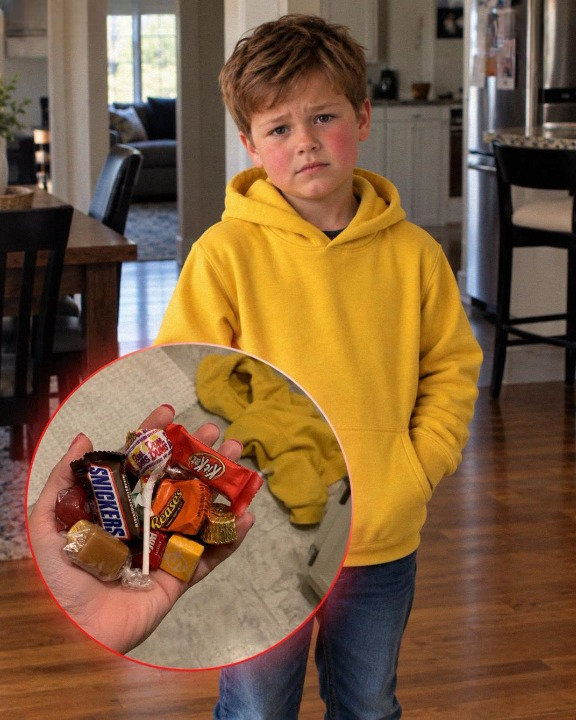
My son Charles had always been a cheerful, energetic ten-year-old who loved school, soccer, and anything involving chocolate. Like most children, he had a serious sweet tooth.
Unfortunately, his doctor had recently told us that he needed to avoid sugary treats for a while.
It wasn’t a punishment. It was simply something we needed to take seriously for the sake of his health.
Everyone in the family knew about it.
His father knew.
His grandmother knew.
And Charles certainly knew.
So one evening, when I was gathering his clothes for laundry, I heard something rattling inside the pocket of his hoodie.
I reached inside.
My fingers closed around a candy wrapper.
Then another.
And another.
I pulled the hoodie inside out and stared.
There were chocolate bars, lollipops, caramels, and several other sweets stuffed into both pockets.
For a moment, I couldn’t understand what I was seeing.
“Charles?”
My son appeared in the doorway.
The instant he saw the candy spread across the table, his expression changed.
He looked frightened.
“Where did you get all of this?”
He lowered his head.
“Please don’t be angry, Mom.”
I immediately softened my voice.
“I’m not angry. I just need you to tell me what’s going on.”
He stood there silently for several seconds.
Then he whispered something that made my stomach tighten.
“Grandma gives them to me.”
I already suspected which grandmother he meant.
“Your grandmother Donna?”
He nodded.
“But why?”
Charles looked toward the floor.
“She says I can have them if I answer her questions.”
“What kind of questions?”
He hesitated.
Then he began explaining.
At first, they sounded like ordinary questions.
Grandma wanted to know where I had gone.
Who I had been with.
What restaurant I had visited.
Whether I had been working late.
But then the questions became more personal.
She wanted to know about Daniel, the man I had recently started seeing.
“She asks if Daniel comes to our house,” Charles said quietly.
I sat down.
“What else does she ask?”
“She asks where you two go together.”
My heart sank.
“Anything else?”
He nodded.
“She asks if he stays overnight. And she asks if you buy him things.”
I couldn’t believe what I was hearing.
My former mother-in-law had never been particularly fond of the fact that I had started rebuilding my personal life after my divorce.
But I had never imagined she would involve Charles.
Then my son said something that hurt even more.
“Grandma says Dad gives you too much money.”
I stared at him.
“She told you that?”
Charles nodded.
“She says Dad works hard for his money and that you shouldn’t spend it on Daniel.”
I took a deep breath.
There was something deeply wrong with an adult putting a child in the middle of financial disagreements between grown-ups.
“Did she say anything else?”
Charles looked nervous again.
“She said maybe you care more about Daniel than me.”
My heart broke.
I reached across the table and pulled my son into a hug.
“Charles, listen to me carefully. None of this is your responsibility.”
He didn’t say anything.
“You never have to answer questions about my private life to earn treats. And you never have to choose sides between your parents.”
He nodded against my shoulder.
Then he whispered:
“Mom, am I expensive?”
I pulled back.
“What?”
“Grandma said Dad gives you money because of me. Does that mean I’m expensive?”
That question hurt more than anything else he’d said.
I took his face gently in my hands.
“You are not a burden. Your dad and I are responsible for taking care of you. Adults handle money. Children should never have to worry about that.”
Charles finally smiled a little.
But there was still something bothering him.
He looked at me and said:
“There’s something else.”
“What is it?”
“Grandma wanted me to take your phone.”
My expression changed.
“When?”
“Last Sunday.”
He explained that Donna had asked him to take my phone while I was showering and bring it to her unlocked.
In exchange, she promised him a large box of chocolates.
Charles shook his head.
“I didn’t do it.”
“I’m glad you didn’t.”
“She said I could have the chocolates if I helped her.”
I hugged him again.
“You did exactly the right thing by saying no.”
He was quiet for a moment.
“Then she ate the chocolates herself.”
I almost laughed despite how serious the situation was.
Instead, I simply told him that adults sometimes made poor decisions, but that wasn’t his fault.
After Charles went to bed, I sat alone in the kitchen thinking about what to do next.
My first instinct was to call Donna immediately.
But I knew that wouldn’t necessarily solve anything.
If I confronted her while I was upset, the conversation could become an argument.
More importantly, Charles needed to be protected from being caught in the middle.
So I called his father, Anthony.
When I explained what had happened, he initially struggled to believe it.
“Are you sure Charles understood what she was asking?”
“I wouldn’t make an accusation based on a misunderstanding. Let him explain it himself.”
I put the phone on speaker.
Charles repeated what his grandmother had said.
Anthony became completely silent.
After several seconds, he asked:
“Did Grandma really ask you to take Mom’s phone?”
Charles nodded.
“Yes.”
Anthony sighed.
“Okay. Thank you for telling us.”
When Charles went back to his room, Anthony and I continued talking.
“I knew Mom was upset about the divorce,” he said, “but I didn’t realize she’d involve Charles.”
“She also told him I’m wasting money on Daniel.”
Anthony sounded frustrated.
“That isn’t true. I know exactly what the support payments are for.”
I didn’t say anything.
Then Anthony surprised me.
“I think we need to deal with this together.”
That was the first time in months that we had truly approached a parenting problem as a team.
We agreed that neither of us would pressure Charles for more information.
We also agreed that we would speak with Donna directly and make it clear that our son was not to be used as a messenger, source of information, or bargaining tool.
The following morning, I woke to loud knocking at the front door.
I opened it and found Donna standing outside.
She looked upset.
In her hands was a small black box.
“How could you do this?” she demanded.
I was confused.
“Do what?”
“Anthony called me.”
I immediately understood.
She held the box toward me.
“Look what he gave me.”
I took it carefully.
When I opened the lid, I was surprised by what I found.
Inside were dozens of printed notes.
They weren’t private photographs or anything dramatic.
They were simply copies of the questions Donna had apparently been writing down whenever she spoke with Charles.
Where had I gone?
Who had I seen?
Was Daniel there?
Had Daniel stayed over?
What had I bought?
How much money had I spent?
Next to some of the questions were little check marks.
I stared at the pages.
Donna suddenly looked embarrassed.
“I never meant for it to become this serious.”
I looked at her.
“You asked a ten-year-old to report on his mother’s private life.”
“I was worried about Anthony.”
“Then talk to Anthony.”
She looked away.
“You don’t understand.”
“No,” I said calmly. “I understand perfectly. Whatever disagreements you have with me or Anthony, Charles shouldn’t be involved.”
She started to defend herself.
“I was only asking questions.”
“And rewarding him with candy for answering them.”
She didn’t respond.
I continued.
“You knew his doctor had told him to avoid those foods. You also knew he was struggling with the temptation. You put him in a position where he had to choose between following his doctor’s advice and getting approval from his grandmother.”
Her expression softened.
“I didn’t think about it that way.”
“That’s exactly the problem.”
A few minutes later, Anthony arrived.
He stood beside me and looked at his mother.
“Mom, this has to stop.”
Donna looked hurt.
“I love my grandson.”
“Then protect him from adult problems.”
The room became quiet.
Anthony explained that his financial arrangements with me were between the two of us and had nothing to do with Charles.
He also told her that if she had concerns about his money, his divorce, or my relationship, she needed to speak directly to him instead of questioning a child.
Donna eventually apologized.
Not perfectly.
Not dramatically.
But sincerely enough that I could see she understood she had crossed a boundary.
The most important conversation, however, was the one I had with Charles afterward.
I told him that he had done nothing wrong.
He hadn’t betrayed anyone by telling me the truth.
He hadn’t caused the argument.
And he wasn’t responsible for fixing the relationship between the adults.
“You did something very brave,” I told him.
He smiled.
“Does that mean I can have candy someday?”
I laughed.
“Someday, we’ll ask your doctor.”
For the first time in days, he laughed too.
That evening, I threw away the candy he wasn’t supposed to have and replaced it with a small snack approved by his doctor.
More importantly, I made sure he understood something that every child deserves to know:
He should never have to earn an adult’s love by keeping secrets.
He shouldn’t have to spy for anyone.
He shouldn’t have to carry conversations that belong between grown-ups.
And most importantly, he should never believe that his parents’ money, relationships, or disagreements are his responsibility.
The situation taught all of us a lesson.
Families can disagree.
Grandparents can worry.
Parents can make mistakes.
But children should never be placed in the middle.
Sometimes the most important thing a parent can do isn’t win an argument.
It’s simply make sure their child feels safe enough to tell the truth.