Before our daughter was born, I would have described my husband, David, as a wonderful partner.
We had been married for several years, and our relationship had always felt balanced. We both worked, shared household responsibilities, and made important decisions together.
Even when life became stressful, I never felt as though I was carrying everything alone.
There was only one part of our marriage that had always been difficult: David’s relationship with his mother, Susan.
Susan was loving toward her son, but she was also extremely involved in his life.
She always had an opinion.
She had advice about our finances, our home, our careers, and even what we ate for dinner.
Sometimes I found it exhausting, but I tried not to make an issue of it.
David was her only child, and I understood that she cared about him.
I also believed that once we became parents, David would naturally understand that his first responsibility was to the family we had created together.
I couldn’t have been more mistaken.
Our daughter was born after a long pregnancy, and like most new parents, we were both exhausted.
During the first few weeks, I expected David to struggle with the adjustment.
I struggled too.
Neither of us knew exactly what we were doing.
There were nights when our daughter cried for hours.
There were days when neither of us had slept properly.
There were moments when I stood in the kitchen wondering whether I had even brushed my hair that morning.
But instead of bringing us closer, the stress seemed to push David in the opposite direction.
He gradually stopped helping.
At first, it was little things.
He would say he was too tired to change a diaper.
Then he would say he needed to sleep because he had work the next morning.
Then he began avoiding nighttime feedings altogether.
Whenever I asked him to help, he would remind me that he was working to support us financially.
“I have to be rested for work,” he would say.
I understood that his job was important.
But I was also working—only my workplace happened to be our home.
I was feeding our daughter, changing her, washing bottles, doing laundry, preparing meals, cleaning, and trying to recover physically while functioning on very little sleep.
Still, I kept telling myself that this was temporary.
Surely things would get better.
Then our three-month-old daughter became sick.
It started with a restless night.
She couldn’t settle.
She cried more than usual and seemed uncomfortable.
By the following morning, it was obvious that something was wrong.
We contacted her pediatrician and followed the advice we were given.
The next two days were some of the most exhausting days of my life.
Our daughter needed constant attention.
I spent hours holding her, comforting her, checking on her, and trying to keep her comfortable.
Whenever she finally fell asleep, I was afraid to move because I didn’t want to wake her.
I survived on quick snacks and lukewarm coffee.
I barely slept.
David, meanwhile, spent much of the time in the guest room.
Whenever I asked whether he could hold her for a while so I could rest, he complained about how tired he was.
By the second night, I was barely functioning.
At around eight o’clock, there was a knock at the door.
Before I could even reach it, Susan walked inside.
She didn’t begin by asking how her granddaughter was doing.
She didn’t ask whether we needed medicine, food, or anything else.
Instead, she headed directly toward the guest room.
I followed her.
“What are you doing?”
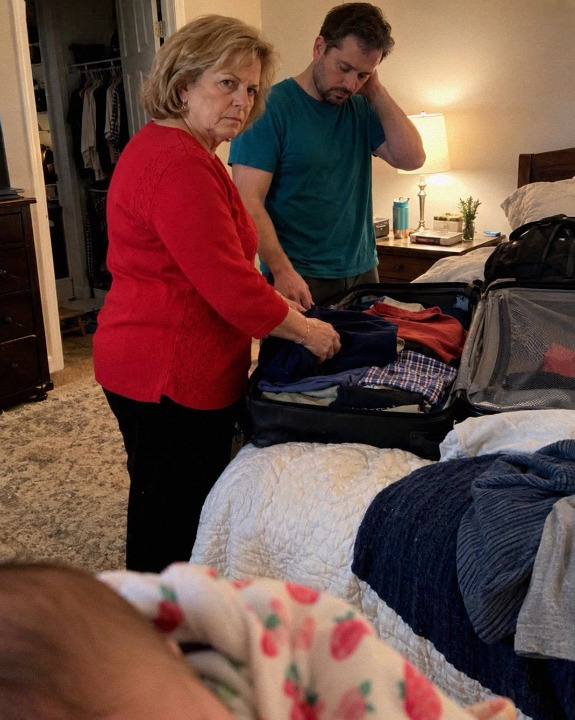
She opened the closet and pulled out a suitcase.
David was standing nearby.
Susan began putting his clothes inside.
I stared at both of them.
“Why are you packing his things?”
Susan didn’t even hesitate.
“My son needs rest,” she said. “He has a job and responsibilities.”
I looked at David.
He wouldn’t meet my eyes.
Susan continued packing.
“He didn’t expect his life to become like this,” she said. “He’s exhausted, and I’m taking him home for a few days.”
I couldn’t believe what I was hearing.
Our daughter was sick.
I had barely slept for two days.
And instead of offering to help me, Susan was taking her adult son away because he was tired.
I looked at David again.
“Are you really going with her?”
He finally looked at me.
“I just need some space.”
That sentence hurt more than anything else.
Not because I wanted him to suffer.
Not because I expected him to stay awake all night.
I simply wanted my husband to understand that parenthood wasn’t something one parent could walk away from whenever it became inconvenient.
But he picked up the suitcase.
Susan walked out first.
David followed.
The door closed.
And suddenly, the house was silent.
I stood there holding our daughter.
For several seconds, I didn’t know what to do.
Then I looked down at her.
She was finally sleeping peacefully.
I sat in the rocking chair and held her close.
I didn’t cry.
I think I had simply become too tired to cry.
Something inside me had changed.
For months, I had been hoping David would eventually realize how much I needed him.
That night, I stopped waiting.
I realized that hoping someone would become a responsible partner wasn’t the same as actually having one.
I needed to think about what was best for my daughter and me.
The next morning, our baby finally seemed more comfortable.
She slept for a longer stretch, and I was able to rest for a little while.
When I woke up, I looked around the house.
David’s things were gone from the bedroom.
His absence didn’t feel like a temporary disagreement anymore.
It felt like a decision.
So I made one too.
I started making phone calls.
Not angry calls.
Not revenge calls.
Practical calls.
I contacted my doctor and asked for advice about my recovery.
I arranged for a family member to help with the baby.
I reviewed our finances.
I gathered important documents.
I started thinking about what life would look like if I had to manage the household independently.
Then I did something I hadn’t done in a very long time.
I put myself first—not above my daughter, but alongside her.
I realized that I couldn’t continue pretending everything was fine.
At around ten in the morning, my phone started ringing.
It was Susan.
I ignored it.
She called again.
Then again.
Finally, I answered.
Her voice was immediately loud and upset.
“How could you do this to us?”
I was confused.
“Do what?”
“You know exactly what you did!”
“No, Susan. I don’t.”
She began accusing me of embarrassing David and making the family look bad.
I listened quietly.
Then she said something that made everything clear.
“You can’t just make decisions without telling us.”
I took a deep breath.
“Us?”
There was a pause.
“Yes. Us.”
I looked at my sleeping daughter.
Then I said something I should have said months earlier.
“Susan, my marriage is not a committee. And my daughter is not a responsibility that you and David can decide to accept only when it’s convenient.”
She became even more upset.
“You are trying to turn him against his own mother!”
“No,” I said calmly. “I’m asking him to be a husband and a father.”
She went silent.
Then she asked what I had done that morning.
I told her.
“I’ve started making arrangements for support. I’ve reviewed our finances. I’ve spoken with my family. And I’ve decided that things cannot continue the way they have been.”
She immediately understood what I meant.
“You wouldn’t.”
“I haven’t decided what the future looks like yet,” I said. “But I know what I won’t accept anymore.”
For the first time, Susan didn’t have an immediate response.
Later that afternoon, David came home.
He looked tired.
He stood in the doorway for several seconds before speaking.
“Can we talk?”
I nodded.
He sat across from me.
“I didn’t think things had gotten this bad.”
I almost laughed.
“How could you not know?”
He looked down.
“I thought you were handling everything.”
“Exactly,” I said. “I was.”
He didn’t argue.
That was the beginning of the conversation we’d avoided for months.
I told him everything I’d been feeling.
I told him how alone I’d felt.
I told him that financial support wasn’t a substitute for being emotionally present.
I told him that being a father wasn’t something he could postpone until our daughter was older.
And I told him that his mother couldn’t make decisions about our marriage for us.
David listened.
Then he admitted something I hadn’t expected.
He had been overwhelmed too.
He had been afraid of failing as a father and had responded by avoiding responsibility.
That didn’t excuse his behavior.
But it helped me understand it.
We agreed that things couldn’t simply return to normal.
We needed boundaries.
We needed honest conversations.
And, most importantly, we needed to decide whether we were both willing to put in the work required to repair our relationship.
David eventually apologized.
Not just for leaving that night, but for every time he had treated parenting as though it were primarily my responsibility.
He also spoke to his mother.
That conversation wasn’t easy.
Susan didn’t suddenly become a different person.
But David finally made it clear that our marriage and our parenting decisions belonged to us.
Months later, things were still imperfect.
Parenthood was still exhausting.
There were still difficult nights.
But David began getting up with our daughter.
He learned her routines.
He attended appointments.
He started helping around the house without waiting to be asked.
And I stopped feeling guilty whenever I needed help.
Looking back, I realize the most important thing I did that morning wasn’t something dramatic.
It wasn’t revenge.
It wasn’t humiliating anyone.
It was choosing to stop pretending.
I had spent so much time trying to keep everyone comfortable that I had forgotten I was allowed to say, “This isn’t working.”
That experience taught me something I’ll never forget:
A family isn’t built by one person carrying everything while everyone else watches.
It’s built through shared responsibility, communication, compassion, and the willingness to show up when life becomes difficult.
Our daughter was only three months old when everything changed.
She won’t remember those exhausting nights.
She won’t remember the arguments.
But I hope she grows up knowing that her parents learned an important lesson during that difficult season.
Love isn’t just about being there when life is easy.
It’s about showing up when you’re tired, overwhelmed, uncertain, and afraid.
That’s when your choices matter most.
And sometimes, the strongest thing you can do for your family is to stop accepting a situation that is hurting you and calmly decide that something has to change.