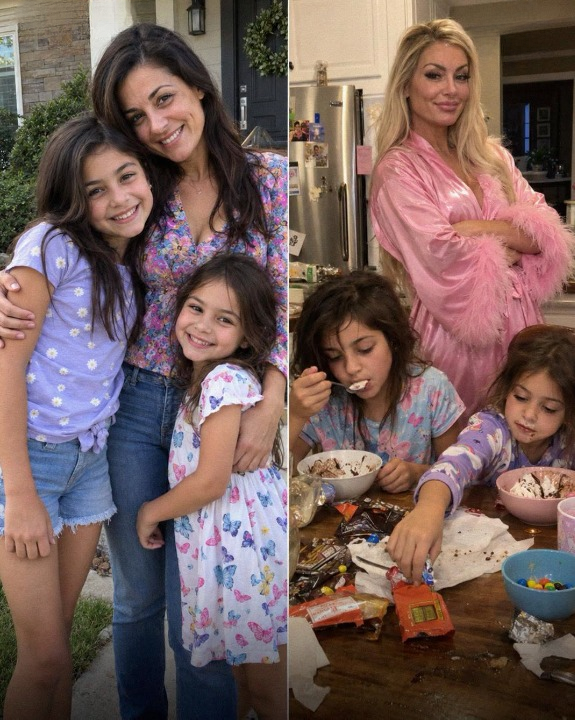
After my divorce from Emmett, I promised myself that I would do everything I could to make the transition as easy as possible for our daughters.
Abby was eleven, and Lily was eight.
They had already experienced enough changes.
Their parents no longer lived together. They had two homes, different routines, and a calendar that seemed to change every few weeks.
I didn’t want them to feel as though they had to choose between us.
So when Emmett began a relationship with Angela, I made a conscious effort to be welcoming.
I told myself that if Angela was going to be part of my daughters’ lives, I wanted the relationship to be peaceful.
At first, everything seemed fine.
Then I began noticing a pattern.
Angela seemed determined to be the “fun” parent.
At my house, the girls had routines.
Homework came before television.
They had reasonable bedtimes.
We tried to eat proper meals instead of replacing dinner with snacks.
I wasn’t trying to make their lives miserable.
I simply believed children needed structure.
Angela seemed to believe the opposite.
When the girls stayed with their father, bedtime apparently became optional.
Homework could wait.
If they wanted candy before dinner, they got candy.
If they wanted to stay up late watching movies, Angela didn’t seem concerned.
At first, I didn’t say anything.
Different households can have different rules.
I understood that.
But eventually, those differences began affecting the girls when they returned home.
One Monday afternoon, Abby came home from school unusually quiet.
I asked her what was wrong.
She hesitated.
“I got a bad grade.”
I sat beside her.
“What happened?”
She looked embarrassed.
“I didn’t finish my assignment.”
I was surprised.
Abby normally took school very seriously.
“Why didn’t you finish it?”
She shrugged.
“Angela said I could do it later.”
I sighed.
“Did you remember to do it before bed?”
“No.”
I didn’t lecture her.
Instead, I helped her understand what went wrong and encouraged her to speak with her teacher.
But it happened again.
And again.
Then there was Lily.
She started waking up during the night after spending weekends at her dad’s house.
One morning, she looked exhausted.
“Mom, I’m tired.”
“Did you sleep well?”
She shook her head.
“Angela let us stay up really late.”
I asked what they had been watching.
When she told me, I was surprised.
They had been watching movies that I didn’t consider appropriate for their ages.
I wasn’t interested in criticizing Angela’s entertainment choices.
But I did think my daughters needed more sleep.
The next time I picked them up, I decided it was time to have a conversation.
Angela opened the door.
I tried to remain calm.
“I want to talk about the girls’ routine.”
She smiled.
“Okay.”
“They’ve been coming home exhausted. Abby has missed assignments, and Lily has been having trouble sleeping.”
Angela shrugged.
“They’re fine.”
“I don’t think they’re trying to cause problems. I just think they need a little more consistency.”
Angela leaned against the doorway.
“You have so many rules.”
“They’re children.”
“They need to have fun too.”
“I agree. I’m not against fun. But homework and sleep are important.”
She smiled.
“You know, sometimes I think you’re a little too strict.”
I didn’t respond immediately.
Then she added, “Maybe that’s why they like coming here.”
That comment bothered me.
Not because I wanted my daughters to prefer my house.
I wanted them to feel comfortable in both homes.
Emmett walked over.
Instead of helping us find common ground, he immediately sided with Angela.
“Let them enjoy themselves,” he said. “They’re kids.”
I looked at him.
“I want them to enjoy themselves too. But enjoying childhood doesn’t mean ignoring everything they’re responsible for.”
Angela smiled.
“See? This is exactly what I’m talking about.”
I took a breath.
“Okay.”
Emmett looked surprised.
“Okay?”
“Yes. I’m not going to argue about this at the door.”
I left with the girls.
But I spent the entire drive home thinking about what had happened.
I realized I had been approaching the problem from the wrong direction.
I didn’t need to compete with Angela.
I didn’t need to prove that I was the better parent.
And I certainly didn’t need to make the girls feel as though they were caught between two adults.
What I needed was information.
I needed to know exactly how the different routines were affecting them.
So over the next few weeks, I paid attention.
I kept track of missed assignments.
I noted when the girls complained about being tired.
I talked with their teachers.
I also asked the girls simple questions without suggesting answers.
How did they feel on Monday mornings?
Did they enjoy their weekends?
Were they worried about anything?
Their answers told me more than I expected.
They loved spending time with their father.
They also loved Angela.
But they were confused by the different expectations.
One weekend, Abby told me something that changed my perspective.
“Mom, Angela says you’re too serious.”
I smiled sadly.
“Do you think I’m too serious?”
Abby shook her head.
“No. I know you just want us to do well.”
That was when I knew this wasn’t about winning.
It was about making sure my children didn’t have to carry the consequences of inconsistent adult decisions.
The following Friday, the girls were getting ready to leave for their dad’s house.
Before they went, I handed Abby a small box.
She looked at me curiously.
“What’s this?”
“It’s for Angela.”
Lily immediately became interested.
“What is it?”
“Something that might help.”
They looked at each other.
I smiled.
“Just give it to her.”
They left.
I didn’t explain anything else.
About an hour later, my phone rang.
It was Emmett.
I didn’t answer.
A minute later, he called again.
Then again.
By the fourth call, I knew something had happened.
Finally, I answered.
“What is it?”
His voice sounded frustrated.
“Where did you get this?”
I knew immediately what he meant.
“The box?”
“Yes.”
“Open it?”
There was a pause.
“Angela opened it.”
“And?”
He sighed.
“You included a notebook.”
“Yes.”
The notebook contained a simple record of the girls’ routines over the previous several weeks.
It included missed assignments, sleep problems, teacher comments, and notes from our pediatrician recommending a consistent sleep schedule.
I hadn’t written anything insulting.
I hadn’t attacked Angela.
I hadn’t called her irresponsible.
I simply documented what was happening.
But there was something else inside the box.
A letter.
I had written it for both Emmett and Angela.
It explained that I wasn’t asking them to copy every rule in my house.
I wasn’t asking them to stop having fun.
I wasn’t even asking for identical households.
I was asking for a few basic things to remain consistent.
Homework needed to be completed.
The girls needed enough sleep.
Entertainment needed to be age-appropriate.
And most importantly, the adults needed to communicate rather than making the children responsible for navigating disagreements.
Emmett was silent for several seconds.
Then he said, “You should have talked to me.”
“I did.”
Another pause.
“Okay,” he said quietly. “You did.”
For the first time, he seemed to understand that I hadn’t created the problem.
I had simply stopped pretending it didn’t exist.
The next morning, something unexpected happened.
Emmett called again.
This time, his voice was completely different.
“I talked to Angela.”
“And?”
“We’ve been making things harder for the girls.”
I didn’t say anything.
He continued.
“Abby has three assignments she’s behind on.”
“I know.”
“Lily’s teacher says she’s been falling asleep during morning lessons.”
“I know.”
He sighed.
“I didn’t realize it had gotten that bad.”
That sentence was difficult to hear.
Because I had been trying to explain it for weeks.
But instead of arguing, I said, “Then let’s fix it.”
We agreed on a few basic rules that both households would follow.
The girls could still have movie nights.
They could still eat treats.
They could stay up a little later on special occasions.
But schoolwork would be completed, bedtime would be reasonable on school nights, and the adults would communicate about anything affecting their health or education.
A few weeks later, I noticed a difference.
Abby stopped coming home exhausted.
Lily stopped waking up during the night as often.
Their teachers said they seemed more focused.
And something else changed.
The girls stopped talking about which house was more fun.
They simply enjoyed being with both parents.
One afternoon, Angela approached me at school pickup.
“I owe you an apology,” she said.
I wasn’t expecting it.
She continued.
“I thought you were trying to control everything. I didn’t realize the girls were struggling.”
“I wasn’t trying to control your home.”
“I know that now.”
She looked embarrassed.
“I also realize I was trying too hard to be the fun adult.”
I smiled.
“You don’t have to compete with me.”
She nodded.
“And you don’t have to compete with me either.”
That made us both laugh.
The situation taught me an important lesson.
Parenting after divorce can become complicated very quickly when adults start competing for a child’s affection.
One parent becomes the strict one.
Another becomes the fun one.
One house has rules.
The other house has fewer.
And eventually, the children become caught in the middle.
But children don’t need a perfect parent.
They need adults who can cooperate.
They need consistency, reassurance, and permission to love everyone in their family without feeling guilty.
The little box I gave Angela wasn’t meant to embarrass her.
It wasn’t revenge.
It was documentation, a letter, and an invitation to look honestly at what was happening.
And sometimes, that’s more powerful than an argument.
Because when emotions take over, people can disagree about intentions.
But when you calmly look at the facts and ask, “Is this actually helping the children?” the conversation changes.
Today, our parenting arrangement isn’t perfect.
No family is.
But the girls have routines that work in both homes, and the adults communicate much more often.
Most importantly, Abby and Lily no longer feel as though they have to choose sides.
And that was what I wanted all along.
I never needed to be the “good mom.”
I never needed Angela to be the “bad stepmom.”
I just wanted my daughters to have two homes where they felt loved, respected, and secure.
In the end, that mattered far more than winning any argument.