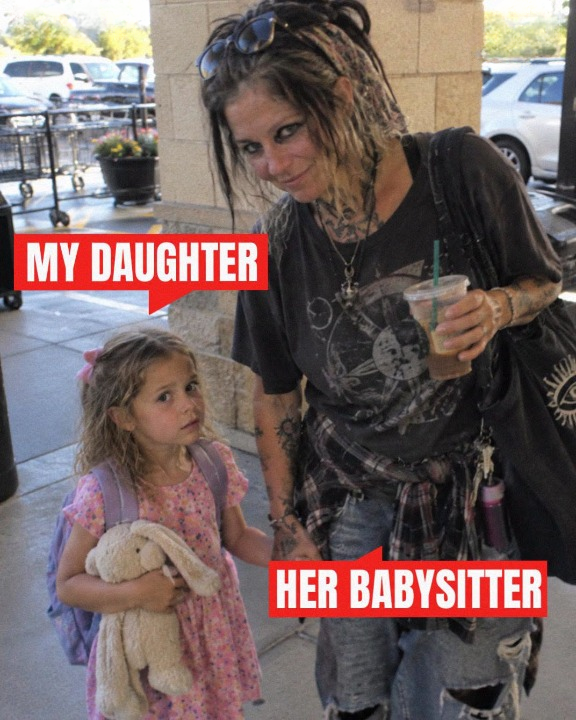
For nearly a year, my daughter Emma had been completely comfortable with her babysitter.
Every afternoon, she would wait eagerly by the window, watching for the familiar car to pull into the driveway. The moment the babysitter arrived, Emma would hurry toward the door with a smile on her face.
There had never been a reason for me to worry.
The babysitter had always seemed dependable, patient, and kind. Emma appeared happy in her care, and I had never noticed anything that made me question the arrangement.
Then, one Tuesday evening, everything changed.
I was getting Emma ready for bed when she suddenly reached for my hand.
She held it tightly.
At first, I thought she was simply tired. But when I looked into her eyes, I realized something was different.
She wasn’t sleepy.
She was frightened.
“Mom,” she whispered.
I sat beside her on the edge of the bed.
“What is it, sweetheart?”
Emma glanced toward the bedroom doorway before lowering her voice.
“I don’t want her to come back.”
I felt a strange heaviness in my chest.
“The babysitter?”
Emma nodded.
I tried to stay calm.
“Did something happen today?”
She didn’t answer.
I gently asked again.
“Did she say something that made you uncomfortable?”
Emma shook her head.
“Did she hurt you?”
Again, she shook her head.
I waited, hoping that giving her time would make it easier for her to talk.
But Emma simply pulled the blanket closer and whispered:
“I’m scared.”
Those two words were enough to make me take her seriously.
I didn’t know what had happened, and I didn’t want to frighten her further by making assumptions. But I knew one thing immediately.
The babysitter would not be returning to our house.
The Babysitter’s Unexpected Reaction
The next morning, I contacted her and told her that we would no longer need her help.
She sounded surprised.
“Did I do something wrong?” she asked.
I told her that I needed some time to understand what Emma was experiencing.
There was a long pause.
Then her voice changed.
“Emma must have misunderstood something.”
I didn’t respond.
I thanked her for her help during the past year and ended the conversation.
I wasn’t accusing her of anything. I simply knew that my daughter’s sense of safety had to come first.
For the rest of the day, Emma remained unusually quiet.
She didn’t want to play.
She barely touched her lunch.
And every so often, she looked toward the living room window.
“What are you looking for?” I asked.
“Nothing,” she said.
But I could tell that something was bothering her.
I decided not to push.
Whatever had frightened her, I wanted her to know that she could tell me when she was ready.
Then, just before sunset, someone knocked on our front door.
An Unexpected Visitor
I opened the door and found my elderly neighbor, Mr. Harris, standing on the porch.
He was seventy-eight years old and had lived on our street for decades. He was the kind of neighbor who noticed everything, from a broken fence to an unfamiliar car parked nearby.
But that evening, he looked unusually serious.
“I think this belongs to Emma,” he said.
He held out a small pink sneaker.
I immediately recognized it.
It was Emma’s favorite shoe.
I looked at him in confusion.
“Where did you find this?”
Mr. Harris pointed toward the end of the street.
“The old house.”
My stomach tightened.
The property had been empty for years. The house had once belonged to an older couple, but after they moved away, nobody had lived there for a long time.
“Emma hasn’t been anywhere near that place,” I said.
“I know,” Mr. Harris replied.
He paused.
“That’s why I thought you should see this.”
I took the sneaker from his hand.
There was something unsettling about seeing one of my daughter’s belongings in a place she had never visited.
Then Mr. Harris told me something that made the situation even more confusing.
“I saw your former babysitter near the house earlier today.”
I stared at him.
“Are you sure?”
He nodded.
“I saw her leaving the property.”
For a moment, neither of us said anything.
There were several possible explanations.
Perhaps she had simply been walking past.
Perhaps someone else had borrowed her car.
Perhaps Emma’s shoe had been misplaced somewhere else and somehow ended up there.
I didn’t know.
But I knew I couldn’t ignore the situation.
A Difficult Decision
I went back inside and found Emma sitting quietly on the couch.
I didn’t show her the sneaker.
Instead, I asked her a simple question.
“Emma, have you ever been near the old house?”
She immediately shook her head.
“No.”
“Are you sure?”
“Yes.”
I believed her.
Children can become confused about details, but fear should never be dismissed simply because an explanation isn’t immediately available.
I told Mr. Harris that I was going to contact the authorities and let professionals determine what had happened.
He agreed.
I called for assistance and explained what I knew without adding assumptions.
I told them about Emma’s concerns, the shoe, the empty house, and the fact that Mr. Harris had seen the babysitter nearby.
The dispatcher asked several questions.
I answered each one as carefully as I could.
Then I looked at the clock.
It was getting late.
I wanted someone to check the property as soon as possible.
The Waiting Felt Endless
While we waited, Emma sat beside me.
I wrapped an arm around her shoulders.
“You did the right thing by telling me you were scared,” I said.
She looked at me.
“Am I in trouble?”
“No.”
Her eyes filled with tears.
“You promise?”
“I promise.”
That was when she finally told me something else.
She said that earlier that week, the babysitter had received a phone call while they were sitting in the car.
Emma hadn’t heard the entire conversation.
But she remembered one sentence.
“You can’t keep doing this.”
I asked Emma if she knew who the babysitter had been talking to.
She shook her head.
“No.”
That didn’t prove anything.
People say many things during phone conversations, and children don’t always understand the context.
Still, it gave me another detail to share with the authorities.
Mr. Harris Remembered Something Else
While we waited, Mr. Harris remained on the porch.
Suddenly, he called my name.
“I just remembered something.”
I stepped outside.
“What?”
He pointed toward the old property.
“There was another vehicle there earlier.”
“What kind?”
He described it as a dark-colored car.
“Did you recognize it?”
“No.”
Then he added something even more important.
“I noticed someone carrying a cardboard box into the house.”
My heart began racing again.
But Mr. Harris immediately reminded me that we didn’t know what any of it meant.
“That’s why we should let the officers handle it,” he said.
He was right.
Fear can make people connect unrelated details.
I didn’t want to turn uncertainty into accusations.
I wanted answers.
The Investigation Begins
A short time later, officers arrived in the neighborhood.
They first spoke with me and Mr. Harris.
They asked Emma some basic questions as well, but they were careful not to overwhelm her.
Then they went toward the old house.
We remained at a safe distance.
Minutes passed.
Nobody spoke.
Finally, one of the officers returned.
He didn’t look alarmed.
Instead, he looked thoughtful.
“We found something that may help explain what happened,” he said.
I waited.
Inside the house, they had discovered several items that suggested someone had been using part of the property recently.
There were also signs that the building had been entered more than once.
But there was no immediate indication that Emma had been inside.
That distinction mattered.
The pink sneaker still needed an explanation.
So did the babysitter’s visit.
The Missing Piece
The officers eventually spoke with the babysitter.
Her explanation was unexpected.
She admitted that she had visited the property, but she said she hadn’t taken Emma there.
She claimed that someone had asked her to deliver a package.
She also said she had found the pink sneaker near the back entrance.
According to her, she had picked it up because she recognized it as Emma’s.
But instead of returning it immediately, she said she became worried that someone else might be watching her.
Her explanation raised even more questions.
Why had she been visiting the property?
Who had asked her to deliver the package?
And why had she never mentioned any of this?
The authorities continued asking questions.
Eventually, they discovered that the babysitter had been involved in a misunderstanding with another person connected to the property.
The situation was complicated, but it was not the story I had feared.
Most importantly, there was no evidence that Emma had been harmed or taken to the abandoned house.
What Emma Had Actually Noticed
Later that evening, Emma finally explained why she had become frightened.
She hadn’t witnessed anything dangerous happening to her.
Instead, she had noticed unusual behavior around the babysitter.
She had seen unfamiliar people waiting near the street.
She had heard conversations she didn’t understand.
And she had noticed that the babysitter seemed increasingly nervous.
Emma had interpreted those things as a threat.
In a child’s mind, uncertainty can quickly become fear.
But her instincts had still been important.
She had noticed something unusual, and she had trusted her mother enough to speak up.
A Lesson I Would Never Forget
That night, after everything had been explained, I sat beside Emma until she fell asleep.
I thought about how easily I could have dismissed her concerns.
After all, she had loved her babysitter for almost a year.
There had never been an obvious reason for suspicion.
But children don’t always know how to explain why something feels wrong.
Sometimes all they can say is:
“I’m scared.”
And sometimes that is enough reason to stop, listen, and pay attention.
I also realized something about Mr. Harris.
Without his observation, we might never have connected the sneaker with the old property.
He hadn’t solved the mystery himself.
He had simply noticed something unusual and decided it was important enough to tell me.
That small decision made a difference.
A New Chapter for Our Family
We never returned to the old routine.
I found a new childcare arrangement, one that made Emma feel comfortable and secure.
I also encouraged her to tell me whenever something made her uncomfortable, even if she couldn’t explain why.
As for the old house, the authorities continued looking into the circumstances surrounding it.
The property had been connected to several unrelated issues that had nothing to do with Emma.
The babysitter’s involvement was investigated as well, and the situation was eventually clarified.
What remained with me, however, wasn’t the mystery itself.
It was the lesson.
Sometimes the most important warning doesn’t arrive dramatically.
Sometimes it comes as a quiet sentence from a child sitting on the edge of her bed.
Sometimes it comes in the form of a small object found somewhere it shouldn’t be.
And sometimes it comes from an elderly neighbor who simply pays attention.
That evening changed the way I listened to my daughter.
I learned that protecting someone doesn’t always mean immediately knowing what is happening.
Sometimes it means slowing down, taking their concerns seriously, asking careful questions, and getting help from the right people.
Emma had been afraid.
She had not known how to explain everything.
But she knew enough to tell me.
And I will always be grateful that she did.
Because sometimes, listening is the first step toward finding the truth.