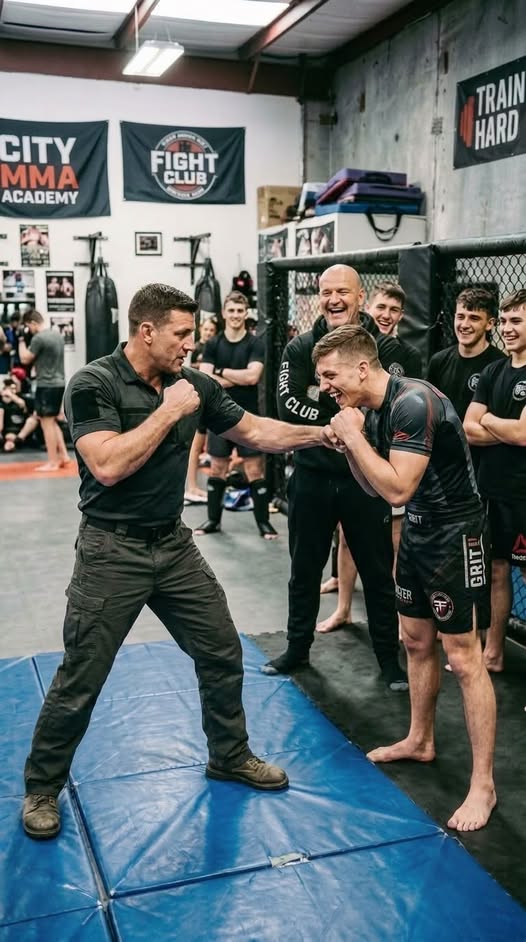
I Spent 15 Years Training Marines in Hand-to-Hand Combat—Then My Daughter Needed Me to Use a Different Kind of Strength
For fifteen years, I taught Marines how to fight.
I taught them how to control distance, how to stay calm under pressure, how to protect themselves and others, and how to make decisions when adrenaline was telling them to react.
But there was one rule I repeated more than any technique.
Training is not an excuse to use force.
Especially against civilians.
Especially when you’re angry.
Especially when someone you love has been hurt.
I believed that rule so strongly that I never imagined I would one day have to test it as a father.
Then my daughter came home with bruises.
And suddenly, everything I had spent years teaching other people became a lesson I had to apply to myself.
Not in a gym.
Not on a training mat.
But in the middle of my daughter’s life.
The First Time I Met Dustin
His name was Dustin.
He was a successful amateur MMA fighter who had recently begun competing professionally.
When my daughter Marcy introduced us, I shook his hand.
He smiled confidently.
Too confidently, perhaps.
But confidence isn’t a crime.
Athletes are often competitive by nature.
Fighters, especially, can carry themselves differently from other people.
So I didn’t judge him based on one handshake.
I simply paid attention.
Marcy seemed happy at first.
She talked about his competitions.
She told us about his training schedule.
She said he was disciplined and ambitious.
I wanted to believe her.
As her father, I also knew that there was a limit to how much I could interfere in an adult daughter’s relationship.
She had to make her own choices.
My job was to remain someone she could come to if she ever needed help.
I didn’t realize how important that would become.
The Changes Were Small at First
The first thing I noticed was that Marcy stopped calling as often.
That wasn’t necessarily unusual.
People become busy.
Relationships change schedules.
Adults build their own routines.
I didn’t want to become the father who treated every change as a warning sign.
Then she started dressing differently.
One particularly hot summer afternoon, she arrived at our house wearing a high-necked shirt with long sleeves.
My wife noticed it too.
She didn’t say anything.
Neither did I.
But later, while we were preparing dinner, my wife quietly said something that made me stop.
“I think she’s trying to cover something.”
I looked at her.
“What do you mean?”
She hesitated.
“I’ve noticed marks on her arm.”
My wife is a nurse.
She sees injuries every day.
She knows that bruises can have many explanations.
She also knows when something doesn’t look ordinary.
“Did she tell you what happened?”
“She said she bumped into something.”
Neither of us wanted to jump to conclusions.
But we started paying closer attention.
The Smile That Changed
A few weeks later, Marcy came over for dinner.
She was sitting at the table with her sisters when someone made a joke.
Everyone laughed.
Marcy smiled too.
But something about it seemed different.
Her mouth smiled.
Her eyes didn’t.
As a father, I can’t explain how I knew.
I simply did.
After dinner, I caught her near the front door.
“Everything okay?”
She looked at me.
“Yeah.”
“You sure?”
She nodded.
“I’m fine, Dad.”
I didn’t push.
Instead, I said something I’d told my children for years.
“If you ever need somewhere to go, you don’t have to explain first.”
She gave me a quick hug.
“Thanks.”
Then she left.
I watched her car disappear down the street.
I wish I had known what was coming.
The Night She Finally Told Me
Several days later, Marcy arrived at our house unexpectedly.
It was late.
She was crying.
My wife immediately stood up.
I walked toward her.
“What happened?”
Marcy shook her head.
“I don’t know what to do.”
We sat down.
She told us that Dustin had become increasingly controlling.
He wanted to know where she was.
Who she was talking to.
Why she hadn’t answered immediately.
He became angry when she disagreed with him.
She said arguments sometimes became physical.
My heart started pounding.
I asked whether she was safe at that moment.
She nodded.
Then she whispered something that changed the entire conversation.
“He told me I can’t leave.”
My wife sat beside her.
“Marcy, listen to me. You are not trapped.”
Marcy began crying harder.
“He said his family has connections.”
I looked at my daughter.
“Connections to what?”
“I don’t know. He just keeps saying that nobody will believe me and that I’ll regret leaving.”
For a moment, the old Marine instructor in me wanted to stand up and solve the problem immediately.
But I knew better.
Anger is not a plan.
The Rule I Had Taught for Fifteen Years
During my years as a Marine hand-to-hand combat instructor, I saw what happens when people allow adrenaline to make decisions for them.
A person becomes focused on winning.
But protecting someone isn’t always about winning a confrontation.
Sometimes the strongest move is refusing to create another dangerous situation.
I looked at my daughter.
“You’re coming home with us.”
She shook her head.
“What about Dustin?”
“We’ll deal with the situation properly.”
“He’s going to be furious.”
“I know.”
“But Dad—”
I interrupted gently.
“You’re not going back there tonight.”
She finally nodded.
The Hospital Call
The next day, my phone rang.
It was my wife.
She was at the hospital.
“Marcy is here.”
My stomach dropped.
“What happened?”
“She has a concussion and several bruises.”
I stood up immediately.
“What did she say?”
My wife lowered her voice.
“She says she fell down the stairs.”
There was a long silence.
We both knew that explanation needed to be handled carefully.
A fall can cause serious injuries.
But given what Marcy had previously told us, we couldn’t simply ignore the possibility that something else had happened.
I drove to the hospital.
This time, I didn’t think about Dustin.
I thought about my daughter.
Sitting Beside Her Hospital Bed
Marcy looked exhausted.
She had a bruise near her face and several other injuries.
I sat beside her.
I didn’t demand an explanation.
I didn’t interrogate her.
I simply took her hand.
After several minutes, she whispered:
“I’m sorry.”
“For what?”
“For causing all this.”
I shook my head.
“You didn’t cause anything.”
She started crying.
“I should have left sooner.”
“You left when you were ready.”
She looked at me.
“Are you angry?”
I thought carefully before answering.
“I’m angry about what happened.”
“But?”
“But I’m not going to let anger make decisions for us.”
She nodded.
That was the moment I realized what my real job was.
Not to prove I could beat Dustin.
To make sure my daughter was safe.
Why I Went to the Gym
I did eventually go to Dustin’s gym.
But I didn’t go there to fight him.
I went because I wanted to understand what kind of environment he was surrounded by.
And because I knew that if I confronted him emotionally, I might make the situation worse.
The gym was busy.
Music played in the background.
People were training.
Heavy bags swung from their chains.
Dustin was standing near the mats with several other fighters.
When he saw me, his expression changed.
Then he smiled.
“Well, look who’s here.”
I didn’t respond to the provocation.
His coach looked at me.
“You need something?”
“Yes.”
I looked directly at Dustin.
“I want you to understand something.”
He folded his arms.
“Go ahead.”
“My daughter has been injured.”
He shrugged.
“She fell.”
“I’m not here to argue with you.”
That surprised him.
“Then why are you here?”
“To tell you that Marcy is not coming back.”
The smile disappeared from his face.
The Threat I Refused to Answer
Dustin stepped closer.
“You don’t get to decide that.”
“No,” I said calmly. “She does.”
He laughed.
“You think you can just take her away?”
I looked at him.
“I don’t have to take anyone anywhere. She’s an adult.”
The coach stepped between us.
“Maybe you should leave.”
I nodded.
“That’s fine.”
Dustin looked surprised.
He had probably expected an argument.
Maybe he expected me to challenge him.
Maybe he expected me to react to the reputation he had built as a fighter.
Instead, I simply turned around.
As I walked toward the door, he called after me.
“You think you’re tough because you trained Marines?”
I stopped.
Then I turned around.
“I trained Marines to control themselves.”
The gym became quiet.
I continued.
“That’s exactly what I’m doing.”
Then I walked out.
The Investigation
After that day, our family focused on Marcy.
My wife helped her understand her medical care.
We encouraged her to speak with professionals who could help her understand her options.
We documented what she remembered.