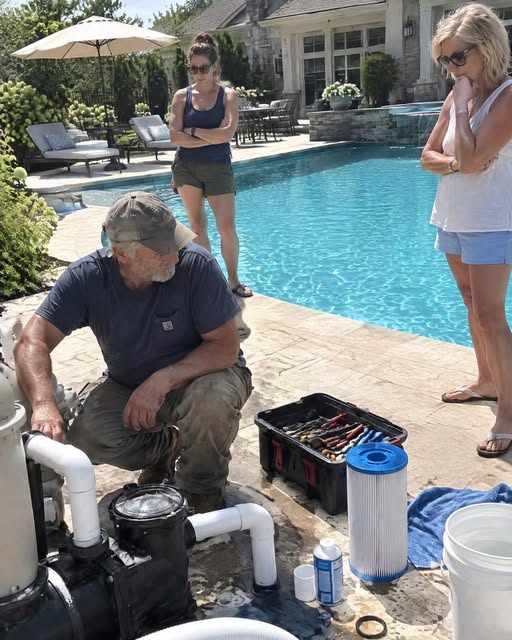
My father had been repairing swimming pools for twenty-nine years.
At sixty-one, experience had made his work look almost effortless. He could hear a struggling pump and often tell what was wrong before running a single test. He could look at cloudy water and identify the likely problem immediately.
Most importantly, Dad documented everything.
My name is Julie Marsh. I’m twenty-eight, and I work as an executive assistant for Richard Emory at Marsh Capital Management.
When Richard mentioned that the pool at his Lakeview Drive home needed extensive repairs, I recommended my father.
Dad inspected the forty-foot gunite pool and found a mess: a failed pump, damaged plumbing, a ruined filtration system, and water that had turned dark green.
He prepared an itemized estimate for $7,800.
Richard signed it.
Dad began Monday.
Nine days later, the pool was transformed.
The water was crystal clear. The waterfall ran smoothly, and the spa circulated perfectly.
“It’s beautiful,” I told Dad when I stopped by.
“Yes,” he said.
Then he paused.
“It is.”
Two days later, Melissa Emory refused to pay him.
Richard’s wife claimed the $7,800 invoice was excessive and offered only $3,000.
Dad reminded her that Richard had signed the estimate.
Then she argued that only Richard had signed the original agreement.
Dad calmly produced another document.
Before starting every job, he had both property owners sign a work authorization referencing the original estimate.
Richard had signed it.
So had Melissa.
“She knows exactly what she agreed to,” I told him.
“Yes.”
“Then why is she refusing?”
Dad looked at me.
“Because she thinks she can.”
Then his expression changed.
“There’s something else.”
“What?”
“When I went back to discuss the payment, she mentioned your job.”
My stomach tightened.
“What did she say?”
“She reminded me that her husband employs his daughter.”
I immediately understood.
Melissa was trying to make Dad believe that demanding his money could somehow put my career at risk.
“Dad, I can talk to Richard.”
“No.”
“Why?”
“I want to handle it myself.”
Then he added:
“And I have something.”
“What?”
“I’ll tell you tomorrow.”
The following morning, at 7:46, my phone rang.
Dad.
“Get over here.”
“Where?”
“Richard’s house.”
“What happened?”
“Your boss just found out what was underneath his pool.”
I froze.
“What are you talking about?”
“I’m not alone.”
“Who’s there?”
Dad gave me a name: Eleanor Marks, an elderly woman who had lived on the street for fifty years.
I grabbed my keys.
When I arrived at Lakeview Drive, two police vehicles were parked outside.
Richard was arguing with an officer.
Melissa stood nearby, pale and shaken.
Dad was beside an elderly woman with silver hair and a folder under her arm.
She approached me.
“Are you Julie?”
“Yes.”
“My name is Eleanor Marks.”
She looked toward the pool.
“I was here when this house was built. I was here before it existed too.”
I had no idea what she meant.
“Your father will explain,” she said.
Then she looked directly at me.
“But before he does, you should know something. What happened here is not his fault.”
I found Dad.
“What is going on?”
He led me toward the driveway.
“Remember that calcium buildup I mentioned?”
“Yes.”
“The pipe had failed in an unusual way.”
“So?”
“So I excavated around it.”
“And?”
“I found a box.”
I stared at him.
“A box?”
“A sealed metal box buried underground.”
Dad explained that while working around the damaged plumbing, he had discovered something that clearly didn’t belong to the modern pool installation.
The property had originally belonged to a Hungarian immigrant named Tibor, a watchmaker who had died decades earlier.
Eleanor knew him.
She told us Tibor had owned a valuable collection of watches and clocks. He had once told her that he had hidden his finest pieces because he didn’t trust banks.
After Tibor and his wife died, their son sold the property.
The original house was demolished.
Richard eventually built his home there.
And somewhere during all those years, the collection disappeared from everyone’s knowledge.
Until Dad found the box.
“What was inside?” I asked.
“Twelve pieces,” Dad said. “Mostly pocket watches. One small clock.”
“Why are the police here?”
“Because I called them.”
Dad had photographed the box, documented exactly where it was found, and contacted Eleanor.
He hadn’t opened it privately and he certainly hadn’t taken it home.
The items appeared to belong to someone else’s family.
So he had done what he believed was the only proper thing.
He had documented everything and called the authorities.
Richard, however, believed that because the box had been discovered beneath his property, the contents belonged to him.
The officers weren’t making a final ownership decision. They were securing the collection while its history and rightful ownership were investigated.
I looked at Dad.
“You found something potentially worth thousands of dollars and just called the police?”
Dad shrugged.
“It wasn’t mine.”
That was Dad.
Simple.
No complicated explanation.
No attempt to justify himself.
It wasn’t his.
Therefore, he didn’t take it.
While the officers documented the discovery, Richard’s attorney arrived.
His name was Garrett.
He examined Dad’s photographs, the discovery log, and the chain-of-custody notes.
Then he turned to the pool documents.
He looked at the original estimate.
Then at the work authorization signed by both Richard and Melissa.
“The authorization references the estimate directly,” Garrett said.
“Yes,” Dad replied.
“To avoid disputes?”
“To avoid ambiguity.”
Garrett spoke privately with Richard.
A few minutes later, he returned.
“My client would like to settle the outstanding invoice today.”
Dad nodded.
“The full $7,800?”
“The full $7,800.”
Dad simply said, “That’s the invoice.”
The check would be ready by four.
I turned to Dad.
“Did you know this was going to happen?”
“No.”
“But you knew the box would give you leverage.”
Dad looked at me.
“I knew I had handled the box correctly.”
Then he pointed toward the pool.
“After Melissa brought your job into a payment dispute, I wasn’t coming back here alone.”
That stopped me.
“You thought she was threatening you?”
“I thought she was reminding me that she believed your job gave her leverage.”
“Are you going to confront Richard?”
“No.”
“Why?”
“Because Richard is smart.”
Dad looked toward the house.
“He’ll figure out what his wife said.”
Then he gave me the answer that sounded so ordinary it almost made me laugh.
“My job was to fix the pool.”
He pointed toward the clear water.
“I fixed it.”
“My job now is to get paid.”
He paused.
“I’m getting paid.”
Later that afternoon, Dad returned for the check.
Richard stood near the pool.
Garrett handed Dad an envelope.
Dad counted the money.
$7,800.
Exactly.
“This is correct,” he said.
Richard looked uncomfortable.
Dad didn’t demand an apology.
Instead, he reached into his jacket and handed Richard a laminated card.
“The system should run well for years if it’s maintained properly.”
Richard looked surprised.
“You prepared a maintenance schedule?”
“I prepare one for every job.”
Even after everything that had happened, Dad remained professional.
On the drive home, I stared at him.
“You really gave him a maintenance schedule?”
“Yes.”
“After they tried not to pay you?”
Dad started the truck.
“Being professional doesn’t depend on whether the other person behaves professionally.”
He glanced at me.
“It depends on whether I do.”
The next afternoon, Eleanor called.
Tibor’s son, Martin, had arrived from New Mexico.
He wanted to meet Dad.
We went to Eleanor’s house.
Martin stood when Dad entered.
“You found something my family believed was lost forever.”
Dad nodded.
“And you did the right thing.”
“It wasn’t mine.”
Martin smiled.
The collection had already received a preliminary assessment.
One rare pocket watch, madeYour position in Paris around 1892, was estimated at approximately $40,000.
The entire collection could be worth between $80,000 and $90,000.
Dad barely reacted.
Instead, he explained how carefully he had documented the discovery.
Martin shook his head.
“You preserved the story.”
Dad smiled.
“I kept notes.”
Martin then offered Dad $5,000 as a finder’s fee.
Dad immediately refused.
“That isn’t necessary.”
“It is to me.”
Eventually, Dad accepted.
On the way home, I looked at him.
“Five thousand dollars.”
“Yes.”
“For finding a box.”
“For doing what I was supposed to do.”
I smiled.
“Maybe doing what you’re supposed to do has become rarer than it should be.”
Dad considered that.
“You shouldn’t do the right thing because you expect a reward.”
“I agree.”
“You do the right thing because it’s right.”
He paused.
“And sometimes good things happen.”
“Sometimes?”
“Sometimes.”
That evening, my phone rang.
Richard.
“Julie,” he said. “I want you to know that what Melissa said about your employment was inappropriate.”
I stayed silent.
“Your position here depends on your performance,” he continued. “And your performance has been excellent.”
“Thank you.”
There was a pause.
“Your father is very thorough.”
I glanced at Dad.
“Yes.”
“I underestimated how thorough.”
“I won’t again.”
After the call ended, Dad asked who it was.
“Richard.”
“And?”
“He said my job is safe.”
Dad nodded.
“I knew it would be.”
“How?”
“Because Richard is smart.”
He tapped the notebook resting on his dashboard.
“I knew the work was correct. I knew my records were complete. I knew the box wasn’t mine. And I knew I’d contacted the right people.”
He looked at me.
“If somebody tried to use something against me, there wasn’t much there for them to use.”
I smiled.
“That doesn’t put you in a powerful position.”
Dad shook his head.
“What does it put you in?”
“A clean one.”
We drove through the late-afternoon light.
I looked at Dad’s worn jacket, his aging truck, and the old notebook on the dashboard.
For twenty-nine years, he had built his reputation by doing ordinary things extraordinarily well.
He fixed what he was hired to fix.
He documented his work.
He didn’t take what wasn’t his.
He called the right people.
And when someone tried to avoid paying him while suggesting his daughter’s job could become part of the dispute, he didn’t threaten anyone.
He simply stood behind his work.
For twenty-two years, Tibor’s watches had remained buried beneath a swimming pool.
They weren’t gone.
They were waiting.
Waiting for a failing pipe.
Waiting for an unusual calcium deposit.
Waiting for someone experienced enough to notice.
And perhaps waiting for someone who would find something valuable and still understand one simple truth:
Finding something that isn’t yours doesn’t make it yours. It gives you a responsibility to handle it correctly.
Dad understood that immediately.
He got paid.
Martin recovered his family’s collection.
My job remained secure.
And a box buried for twenty-two years finally returned to the family it belonged to.
As Dad drove us home, he glanced at the road ahead.
“Things done right have a way of coming back to the surface,” he said.
Then he kept driving.
THE END