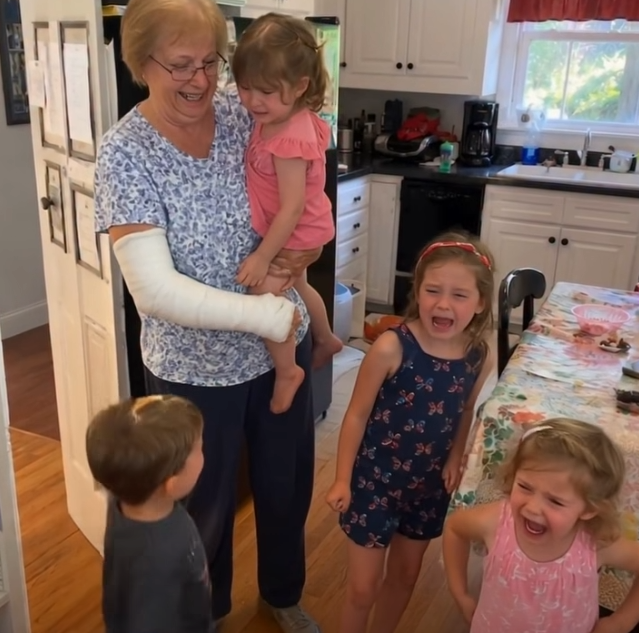
Family often comes together during life’s unexpected moments.
Sometimes that means celebrating joyful occasions, and other times it means stepping in to help someone through a difficult recovery. When my mother broke her arm after an accidental fall, I never imagined the situation would teach our entire household one of the most important lessons we’ve ever learned.
Looking back now, I’m grateful everything ended the way it did.
But at the time, I was frustrated, worried, and determined to make sure my mother received the rest she deserved.
My mother, Linda, was sixty-eight years old.
She had always been incredibly independent.
Even after retirement, she volunteered at the local library, tended a beautiful vegetable garden, and somehow still found time to bake cookies for every grandchild’s birthday.
She rarely asked anyone for help.
That’s why it was so difficult watching her struggle after her accident.
She slipped while carrying groceries into her house and fractured her arm in several places.
The injury required surgery, followed by a cast that extended from above her elbow down to her wrist.
Her orthopedic specialist gave very clear instructions.
“No lifting.”
“No repetitive movement.”
“Most importantly, give your arm time to heal.”
The estimated recovery period was at least two months.
I didn’t hesitate.
“You’re staying with us until you’re feeling better.”
At first, Mom resisted.
“I don’t want to inconvenience anyone.”
“You won’t,” I assured her.
“Our house has plenty of room.”
Besides, with four energetic children running around, I secretly thought having Grandma nearby—even if she was resting—would lift everyone’s spirits.
My husband, Carl, agreed without hesitation.
“Of course she should stay here,” he said.
I appreciated his support.
At least, I thought I did.
The following morning began like every other weekday.
Breakfast.
School lunches.
Backpacks.
Work emails.
Morning traffic.
Everything seemed normal until my phone rang just before lunchtime.
It was the daycare center.
“Mrs. Harper?”
“Yes?”
“We wanted to check in because no one arrived to pick up Emma today.”
My heart dropped.
Our nanny, Sarah, always handled daycare pickup while Carl and I finished work.
“I’ll be there immediately.”
I left work, drove across town, and picked up my confused three-year-old daughter.
Thankfully everything was fine.
Emma simply wondered why Sarah hadn’t come.
Driving home, I assumed there had been some misunderstanding.
Instead, I walked into the kitchen to find Carl making coffee as though nothing unusual had happened.
“Where’s Sarah?”
He looked surprisingly calm.
“I let her go.”
“You what?”
He shrugged.
“Your mom’s living here now.”
“I figured we don’t need a nanny anymore.”
For several seconds I genuinely thought he was joking.
He wasn’t.
He continued explaining his reasoning.
“Your mom’s already here during the day.”
“It just made financial sense.”
Before I could respond, my mother quietly entered the kitchen.
She had obviously overheard everything.
“If it helps the family,” she said gently, “I can probably keep an eye on the kids.”
Even wearing a cast, Mom always tried to make everyone else’s life easier.
That’s simply who she was.
But I immediately shook my head.
“No.”
“The doctor specifically said you need to rest.”
Carl didn’t seem convinced.
“Lots of grandparents help with childcare.”
“She’d just be spending time with the kids.”
I looked at him in disbelief.
“Watching four children isn’t ‘just spending time.'”
“It’s work.”
“And she’s recovering from surgery.”
The conversation ended without much resolution.
Later that afternoon I called Sarah.
Fortunately, she hadn’t accepted another position yet.
I apologized for the confusion and asked whether she’d be willing to continue working with us.
Thankfully, she agreed.
I thought the problem had been solved.
Unfortunately, I was wrong.
The next evening I arrived home earlier than usual.
The scene inside stopped me in my tracks.
Mom stood carefully balancing my youngest granddaughter on one hip while stirring soup with her good hand.
Laundry sat unfolded on the couch.
Three children were asking homework questions simultaneously.
The dishwasher beeped.
A timer rang.
The phone vibrated on the counter.
She smiled when she saw me, but exhaustion covered her face.
“What happened?”
“Oh,” she said softly.
“Carl had an afternoon meeting.”
“I didn’t want everyone waiting.”
I immediately helped settle the children and guided Mom into a comfortable chair.
Her arm clearly bothered her despite her attempts to hide it.
Later that evening, after everyone had gone to bed, I couldn’t stop thinking about what had happened.
I didn’t want another argument.
I wanted understanding.
Then an idea came to me.
Not a plan for revenge.
A lesson in perspective.
The following Saturday, I asked Carl whether he could handle the household for just one day.
“No problem,” he said confidently.
“How hard could it be?”
Perfect.
That morning I scheduled something unusual.
Mom and I spent the day together.
We visited a botanical garden.
Stopped for lunch.
Browsed a local bookstore.
Enjoyed an afternoon that required absolutely no lifting, cooking, or childcare.
Before leaving, I quietly left Carl a detailed schedule.
Breakfast.
Soccer practice.
Music lessons.
Lunch.
Laundry.
Homework.
Dinner.
Bath time.
Bedtime.
Medication reminders.
Snack schedules.
School permission slips.
Pediatric appointment forms.
Nothing unusual.
Simply everything Sarah and I typically coordinated each day.
By early afternoon my phone buzzed repeatedly.
“Where do you keep the extra lunch containers?”
“Which child likes strawberries without the stems?”
“Did anyone feed the dog?”
“Emma refuses to wear matching socks.”
Mom smiled every time another message appeared.
“You should answer him.”
“I will.”
“Eventually.”
When we returned home that evening, the house wasn’t disastrous.
But it certainly wasn’t calm.
Carl sat on the living room floor surrounded by toy blocks.
The washing machine beeped.
A casserole remained half-finished on the counter.
Three children talked over each other while the youngest proudly showed us a finger painting.
Carl looked exhausted.
“I have no idea how you both do this every day.”
Mom sat beside him.
She smiled kindly.
“It’s rewarding.”
“But it’s also work.”
He nodded slowly.
“I see that now.”
Then he surprised both of us.
“I owe both of you an apology.”
He turned toward Mom first.
“I wasn’t thinking about your recovery.”
“I only saw numbers on a budget.”
“I forgot there are real people behind every responsibility.”
Then he looked at me.
“And I underestimated everything that happens while I’m focused on my own work.”
The following Monday he called Sarah personally.
He apologized for the confusion and assured her how much our family appreciated everything she did.
He also insisted Mom focus entirely on healing.
Over the next several weeks something unexpected happened.
Carl became much more involved in daily routines.
He handled school pickups twice a week.
Prepared dinner on Wednesdays.
Managed bedtime on Fridays.
Not because anyone forced him.
Because he finally understood how much invisible work had always been happening around him.
Meanwhile, Mom gradually recovered.
Her cast eventually came off.
Physical therapy helped restore strength in her arm.
The children loved having Grandma nearby—not because she entertained them every minute, but because she told stories, played board games, and simply spent time with them whenever she felt well enough.
One evening, several months later, Carl quietly said something I’ll never forget.
“I used to think paying for help meant we were taking the easy way out.”
“Now I understand it allows everyone to stay healthy enough to enjoy being a family.”
That simple realization changed our household.
We stopped measuring contributions only by money.
Instead, we began recognizing the value of time, effort, caregiving, and emotional support.
Some responsibilities are visible.
Others happen quietly behind the scenes.
Both matter.
Looking back, my mother’s broken arm healed exactly as her doctor predicted.
But something else healed too.
Our family’s understanding of partnership.
Sometimes the most valuable lessons don’t come from arguments.
They come from walking in someone else’s shoes—even if only for a single day.
And that lesson has made our family stronger ever since.