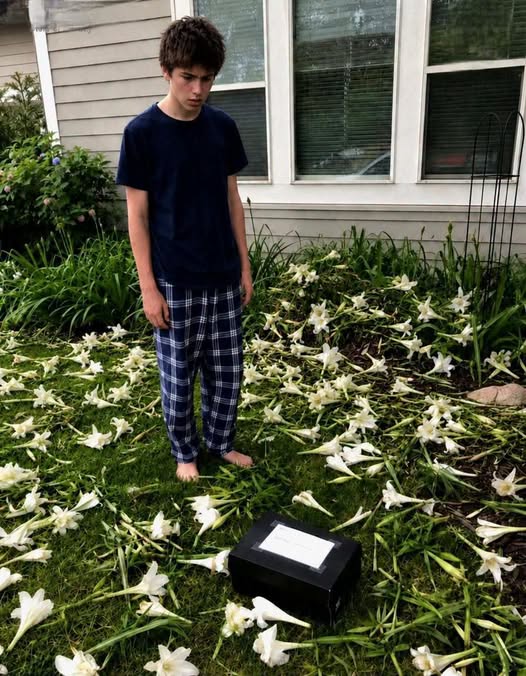
For ten years, every single June brought a quiet, sacred ritual to our front yard. Ever since he was five years old, my son Logan had planted a white lily beside our front porch to honor the twin sister he lost at birth. He guarded those flowers fiercely, making sure no neighborhood kids, stray pets, or lawn equipment ever disturbed them.
But on the morning of his fifteenth birthday, everything changed when Logan ran outside and screamed at the top of his lungs.
Every single white bloom had been cut down, leaving only bare, upright stems scattered across the damp morning grass. Right in the middle of Lily’s garden sat a mysterious black box with his name written across it in bold ink.
The evening before had felt entirely normal on the surface. Logan had been watering the patch with the garden hose, casually talking about how strange it felt to grow up as someone’s twin when you had never actually met them. When I pressed my husband, Alex, for more details about the hospital night all those years ago, he brushed it off. He stuck firmly to the old story: that Lily had stopped breathing immediately after birth and that he had managed everything while I was heavily sedated. But his tense posture, tight grip on the charcoal bag, and evasive answers left a cold knot in my stomach.
By morning, however, that carefully constructed version of reality completely collapsed.
Part 2: The Black Box
Taped to the lid of the black box was an envelope with a note written in cramped, unfamiliar handwriting:
Your mother told you what she was told. But neither of you knows what really happened to Lily. Open the box, Logan. It’s time you learned the truth.
With trembling hands, Logan lifted the lid.
Inside lay a tiny knitted cap with a faded pink stripe, two hospital birth bracelets bearing their names, and a photograph facedown at the very bottom. When Logan turned the photo over, he let out a breathless, broken cry.
It captured two newborns lying side by side under a hospital blanket—Logan, and Lily, with her tiny hand curled gently around his fingers.
Before we could even process what we were looking at, Alex stepped out of the house, fully dressed as if he had been awake for hours. He didn’t look surprised at all. In fact, he was the one who had cut the flowers and left the box.
With a heavy heart, Alex confessed that he had kept those items hidden away for fifteen years. Even more shocking, he admitted the devastating truth: Lily hadn’t died right away. She had survived for a few hours.
Alex claimed he kept it secret out of a misguided sense of protection, fearing the truth would break us. But every year he waited had only made the secret heavier, turning a painful memory into an unbreachable wall.
Part 3: Seeking the Truth
Desperate for real answers, we drove to meet the elderly neonatal nurse who had cared for them that night, tracking down the only person who truly knew what happened in those quiet hospital hours.
She received us with profound gentleness, explaining how Alex had wrestled alone with whether to bring Logan close to his sister while I was recovering. She filled in the missing pieces, lifting the heavy fog of confusion that had clouded our lives for a decade.
The burden of secrecy had fractured our family’s trust, but the nurse’s words reminded us that honesty, however painful, was the only path forward.
Part 4: Healing in the Light
Returning home, Logan gathered the crushed stems and chose two white lilies to take to the cemetery. Sitting beside her headstone, he finally let go of the heavy, silent guilt he had carried for years—the secret burden of celebrating birthdays while his sister had none.
Back home, instead of placing both flowers at the grave, he put one in a simple glass of water right on the kitchen table. When I asked if it was for Lily, he shook his head and said, “For us.”
For the first time in a decade, our family faced the truth together, realizing that true healing doesn’t come from hiding the past, but from standing side by side in the light.