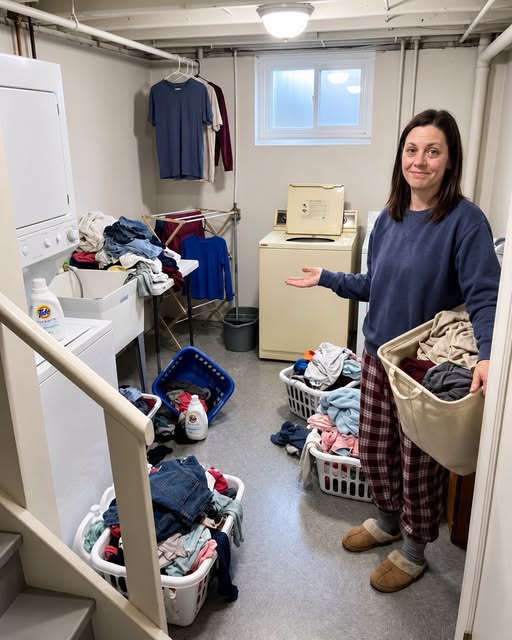
I Finally Stopped Doing My Daughter-in-Law’s Laundry — Then I Found Something Unexpected
For months, I had quietly accepted a situation that was becoming increasingly uncomfortable.
My daughter-in-law, Vanessa, had developed a habit of bringing bags of dirty laundry to my house whenever she visited.
At first, I didn’t think much of it.
Families help one another. Parents help their adult children. Grandparents help with grandchildren. When someone is busy, offering a little extra assistance can feel like a normal part of family life.
So when Vanessa first arrived with a basket of clothes and asked whether I could wash them along with my own laundry, I agreed.
It seemed harmless.
I certainly wasn’t going to create tension over one basket of clothes.
What I didn’t realize was that one basket would eventually turn into a weekly routine.
And before long, I wasn’t simply helping my family.
I was doing their laundry.
It Started With One Basket
The first time Vanessa brought the laundry, she carried a small basket into my house.
“Would you mind washing these with your clothes?” she asked.
I looked at the basket and smiled.
“Of course.”
There wasn’t much inside.
A few shirts, some children’s clothes, and a handful of everyday items.
I put everything into the washing machine later that afternoon and returned the clean clothes to her before she left.
The following weekend, Vanessa brought another basket.
Then another.
Eventually, she started bringing two baskets.
Then three.
What had once been an occasional favor had quietly become something I was expected to do every weekend.
By then, I had noticed another change.
Vanessa no longer asked.
She would arrive with my son and their children, carry several bags downstairs, and leave them beside my washing machine.
There was no longer a question.
No “Would you mind?”
No “Do you have time?”
The laundry simply appeared.
And somehow, everyone seemed to assume that I would take care of it.
The Saturday Routine
Saturday gradually became predictable.
My son and his family would arrive around midday.
The children would run into the backyard.
My son would sit down and talk with me about work, sports, or whatever happened to be going on that week.
Vanessa would bring the bags.
Three large bags became the usual amount.
Sometimes there were even more.
I would spend part of the afternoon sorting clothes, loading the machines, moving everything into the dryer, folding it, and eventually placing it back into bags.
It wasn’t particularly difficult work.
But it took time.
And as I got older, I began to realize that I didn’t want every Saturday afternoon to revolve around laundry.
I had my own things to do.
I enjoyed gardening.
I liked reading.
I had friends I wanted to visit.
There were places I wanted to go and things I wanted to accomplish.
I was 68 years old.
I had spent decades taking care of other people.
There was nothing wrong with helping my family occasionally.
But I didn’t want to become responsible for an entire household’s laundry.
The Conversation I Had Been Avoiding
Eventually, I decided I needed to say something.
One Saturday, after Vanessa had brought another collection of bags downstairs, I waited until the children were outside.
Then I spoke to her.
“Vanessa,” I said calmly, “I don’t mind helping once in a while. But this has become a regular thing. I’m not able to keep doing everyone’s laundry every weekend.”
She looked at me as though I had said something unexpected.
Then she laughed.
“You’re home all day anyway.”
I didn’t immediately answer.
It wasn’t the words themselves that bothered me most.
It was the assumption behind them.
Being retired did not mean I had nothing to do.
Being home did not mean my time belonged to everyone else.
And being a mother and grandmother didn’t automatically make me responsible for household chores that belonged to another family.
I looked toward my son.
I expected him to say something.
Instead, he continued looking down at his plate.
He didn’t defend me.
He didn’t defend his wife.
He simply remained silent.
For some reason, that silence hurt more than Vanessa’s comment.
I Decided Not to Argue
I could have continued the conversation.
I could have explained myself.
I could have reminded Vanessa that she was perfectly capable of doing her own laundry.
I could have asked my son why he had never said anything.
But I was tired of arguing about it.
So I decided to handle the situation differently.
The following weekend, Vanessa arrived carrying four bags.
Four.
She walked toward the basement as though nothing had happened.
I smiled.
“Leave them downstairs.”
She looked at me carefully.
Perhaps she thought I had changed my mind.
Maybe she assumed that our previous conversation had simply been forgotten.
She left the bags beside the washing machine.
But I didn’t start a load.
Instead, I waited.
Later that afternoon, while everyone else was outside enjoying the warm weather, I went downstairs.
The four bags were still sitting exactly where Vanessa had left them.
I stood there for a moment.
Then I decided what I was going to do.
I wasn’t going to argue.
I wasn’t going to lecture anyone.
I wasn’t going to throw the clothes away or damage anything.
I was simply going to return the responsibility to the people it belonged to.
I Sorted Every Bag
I opened the first bag.
It contained my son’s clothes.
I separated them carefully.
The second bag contained the children’s clothing.
I sorted those as well.
The third contained a mixture of Vanessa’s clothes and several other items.
I separated those too.
Finally, I opened the fourth bag.
As I worked, I had one simple goal.
Everyone would get their own clothes back.
Nothing would be washed.
Nothing would be dried.
Nothing would be folded.
Everything would remain exactly as it had arrived.
Dirty.
Unwashed.
Unfolded.
It was a quiet boundary.
I wasn’t trying to punish anyone.
I simply wanted to make it clear that if they brought dirty clothes to my home, they couldn’t automatically assume that I would take responsibility for them.
But then something unexpected caught my attention.
The Clothes I Didn’t Recognize
Mixed into Vanessa’s clothing were several men’s dress shirts.
I stopped sorting.
They weren’t shirts I recognized.
I had seen my son wear many different types of clothing over the years.
These weren’t among them.
At first, I assumed there had to be an innocent explanation.
Perhaps they belonged to someone else.
Perhaps Vanessa had accidentally packed them.
Perhaps my son had purchased something new and I simply hadn’t seen it.
There were plenty of ordinary possibilities.
I continued sorting.
Then I found a pair of expensive-looking trousers.
They didn’t appear to be my son’s size.
I stared at them for a moment.
Then I noticed several white button-down shirts.
They were exceptionally clean compared with the rest of the laundry.
Attached to them were dry-cleaning tags.
That made me pause again.
Why were those clothes mixed in with everything else?
I didn’t know.
And I wasn’t willing to invent an explanation.
I Reached for My Phone
For a moment, I considered calling my son downstairs.
My hand moved toward my phone.
I could have asked him directly.
“Are these yours?”
But I stopped.
There was a difference between noticing something unusual and knowing what it meant.
I didn’t have enough information to accuse anyone of anything.
The clothes might have had a completely ordinary explanation.
Maybe Vanessa had borrowed them.
Maybe they belonged to a relative.
Maybe they had been included in the wrong bag.
Maybe they were being taken somewhere for someone else.
There were countless possibilities.
And I didn’t want to turn a few unfamiliar items into an accusation.
So I put my phone down.
I reminded myself why I had gone downstairs in the first place.
The issue wasn’t the clothes.
The issue was the responsibility that had gradually been placed on me.
I Finished Sorting
I continued.
Vanessa’s clothes went into one bag.
My son’s clothing went into another.
The children’s clothes were placed into their own bags.
The unfamiliar items stayed with the clothing in which I had found them.
I didn’t investigate further.
I didn’t search through pockets.
I didn’t open drawers.
I didn’t look through personal belongings.
I simply sorted what had already been placed in front of me.
When I was finished, the four bags were neatly separated.
Each person could now take responsibility for their own clothes.
I carried the bags back to the area where they had originally been left.
Then I went upstairs.
No confrontation had taken place.
No argument had happened.
For the first time in months, I felt strangely calm.
The Moment Everything Changed
Around six o’clock, Vanessa announced that she was going downstairs to collect the laundry.
I was in the kitchen preparing something to drink when I heard her footsteps disappear down the stairs.
A few seconds passed.
Then I heard her voice.
“What did you do?”
Everyone stopped talking.
My son looked toward the basement.
The children became quiet.
Then Vanessa called again.
Her voice sounded different this time.
My son stood up and went downstairs.
The children followed him.
I stayed where I was.
I wasn’t trying to create a scene.
A few moments later, the house became unusually quiet.
Then I heard my son’s voice.
“Vanessa… whose clothes are these?”
I stopped what I was doing.
The question hung in the air.
Everything Was Suddenly Visible
Earlier, the unfamiliar clothing had been mixed among several large bags.
It had been easy to overlook.
Now everything was separated.
The dress shirts were together.
The trousers were together.
The white button-down shirts with the dry-cleaning tags were visible.
There was no longer a pile of miscellaneous clothing hiding them.
Whatever explanation existed for those clothes would now have to be given openly.
I slowly walked toward the basement.
When I reached the stairs, I could see my son standing near the laundry area.
Vanessa was beside him.
Her expression had changed.
My son looked at the clothing, then at his wife.
Neither of them spoke for several seconds.
I didn’t say anything either.
I had no idea what those clothes meant.
And even then, I didn’t want to make assumptions.
My Son Asked a Simple Question
“Vanessa,” my son said again, “why are these here?”
She looked at the clothes.
Then she looked at him.
I stood several steps away.
The situation was no longer about laundry.
It had become a family conversation.
I could feel the tension in the room, but I refused to add to it.
I hadn’t brought those clothes into the house.
I hadn’t put them into the bags.
I hadn’t searched for them.
They had simply been among the items I was asked to wash.
The only thing I had changed was refusing to wash them.
That distinction mattered to me.
I Explained What I Had Done
Eventually, I spoke.
“I didn’t go through anyone’s things,” I said. “I only separated the laundry because I wasn’t going to wash it anymore.”
My son looked at me.
“I found those while sorting,” I continued. “I didn’t know what they were, and I didn’t make any assumptions.”
Vanessa remained silent.
My son looked back at the clothing.
The room felt uncomfortable.
But at least the situation was finally being discussed openly.
For months, everyone had been comfortable with me quietly handling the laundry.
No one had questioned whether I wanted to do it.
No one had asked whether I had the time.
No one had considered that perhaps I was tired of the arrangement.
It had taken one simple boundary to change the situation.
Sometimes Boundaries Reveal More Than Arguments
Looking back, I realize that I didn’t actually discover anything by sorting those clothes.
I simply created a situation in which everything could be seen clearly.
Had I washed all four bags as usual, the unfamiliar clothing would probably have gone through the machine with everything else.
I might never have noticed the dry-cleaning tags.
The shirts might have disappeared into the ordinary rhythm of laundry.
Nothing would have been discussed.
The same routine would have continued the following Saturday.
And the Saturday after that.
Instead, I stopped.
Not be