I thought my wedding day would be remembered for the music, the flowers, the photographs, and the moment my husband and I finally said our vows.
I never imagined that one of the most memorable moments would involve something as simple as a box of envelopes.
The wedding had gone beautifully.
Our families had spent months helping us prepare. My mother had been involved from the beginning, quietly putting money aside for years because she wanted to contribute to the celebration.
My husband’s mother, Linda, had also contributed financially.
Everyone had helped in different ways, and I was grateful.
At least, that’s how I felt that evening.
The reception was in full swing. People were laughing, talking, taking photographs, and congratulating us.
I was still wearing my wedding dress when my cousin approached me near the bar.
She looked unusually serious.
“Can I ask you something?”
“Of course.”
She glanced toward the gift table.
“Is your mother-in-law supposed to be handling the envelopes?”
I frowned.
“What do you mean?”
My cousin nodded toward the corner of the room.
“Just look.”
I turned around.
And there was Linda.
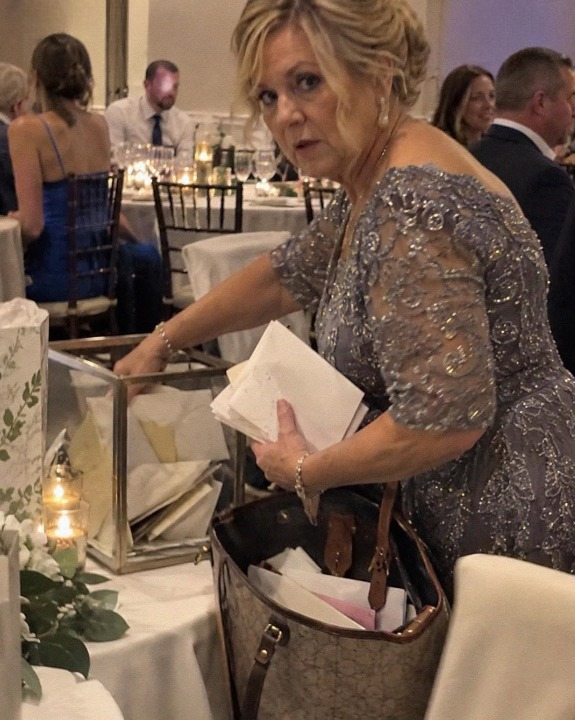
She was standing beside the gift table with a large tote bag sitting on a nearby chair.
At first, I assumed she was simply helping organize the gifts.
Then I noticed what she was doing.
She was taking envelopes from the card box and placing them into her bag.
I stood there for a moment, trying to understand what I was seeing.
Maybe there was an explanation.
Maybe she had been asked to move them.
Maybe someone had told her to collect them.
I didn’t want to make assumptions on my wedding day.
So I walked over.
“Linda?”
She turned around.
“Oh, sweetheart!”
I pointed toward the bag.
“Are you moving the cards?”
She smiled as if everything were completely normal.
“Yes. I’m just putting them somewhere secure.”
I looked at the card box.
“They’re already secure.”
She laughed gently.
“Don’t worry. I know what I’m doing.”
Then she explained her reasoning.
She had contributed a significant amount toward the wedding, and she apparently believed that some of the money contained in the envelopes should be set aside to help cover those expenses.
I was stunned.
I hadn’t expected that interpretation.
To me, the envelopes were gifts given to my husband and me by friends and relatives who had traveled, celebrated with us, and wanted to help us begin our married life.
The idea that they should be divided according to who had paid for what was something I had never considered.
I looked around the room.
Our guests were still enjoying themselves.
Nobody appeared to know what was happening.
I felt my face getting warm.
For a moment, I wanted to confront Linda right there.
But before I could say anything, I noticed my mother standing near the entrance.
She had seen us.
She knew exactly what was happening.
Our eyes met.
I expected her to walk over.
Instead, she gave me a very small shake of her head.
Don’t do this here.
Don’t turn the reception into an argument.
I understood.
So I took a breath.
“Okay,” I said quietly.
Linda smiled and returned to what she was doing.
I walked away.
But I was furious.
The Morning After the Wedding
The next morning, I went to my mother’s house.
I barely touched the breakfast she prepared.
I was still thinking about the previous evening.
I wanted to call Linda.
I wanted to ask my husband why this had happened.
Most of all, I wanted somebody to tell me that I wasn’t imagining how uncomfortable the situation had been.
My mother poured me a cup of coffee and sat across from me.
She listened patiently.
When I finished explaining everything, I expected her to agree that I should confront Linda.
Instead, she said:
“No.”
I looked at her.
“No?”
“Not the way you’re thinking.”
I sighed.
“Then what am I supposed to do?”
My mother leaned back in her chair.
“You don’t solve a family problem by creating another family problem.”
I was frustrated.
“So we just ignore it?”
“Absolutely not.”
That answer surprised me.
She continued.
“You’ve just gotten married. Linda is now part of your family too. You’re going to see her at birthdays, holidays, anniversaries, and family gatherings for years.”
I knew she was right.
My mother wasn’t telling me to accept behavior that made me uncomfortable.
She was telling me to think beyond one evening.
Then she reached for my phone.
“Call her.”
I stared at her.
“Right now?”
“Yes.”
“What am I supposed to say?”
“Invite her to dinner.”
I couldn’t believe what I was hearing.
“You’re inviting her to dinner?”
My mother smiled.
“Yes. Tomorrow night. I’ll cook.”
I thought she had lost her mind.
But there was something about her calmness that made me stop arguing.
So I called Linda.
She answered quickly.
“Hello?”
“Hi, Linda. Mom would like to invite you to dinner tomorrow evening.”
There was a pause.
“Really?”
“Yes.”
She sounded surprised.
“Of course. I’d be happy to come.”
After we hung up, I looked at my mother.
“Why are you doing this?”
She smiled.
“Because sometimes people behave differently when they’re sitting at a dinner table instead of standing in the middle of a crowded room.”
The Dinner
The following evening, Linda arrived at my mother’s house.
My husband came with her.
I was nervous.
I wasn’t sure whether the evening would be awkward.
My mother, however, behaved as though nothing unusual had happened.
She welcomed them warmly.
She served dinner.
She asked about their week.
She even talked about the wedding photographs.
For almost an hour, everything was completely normal.
Then, after dessert, my mother placed a folder on the table.
Linda looked at it.
“What’s that?”
My mother smiled.
“I thought we could clear up something from the wedding.”
The room became quiet.
My husband looked at me.
I didn’t say anything.
My mother opened the folder.
Inside were copies of the wedding budget, receipts, and a simple record of the expenses each family had agreed to cover.
She didn’t accuse Linda.
She didn’t raise her voice.
She simply explained how the finances had been arranged.
Then she said something that changed the tone of the conversation.
“I think there may have been a misunderstanding about the envelopes.”
Linda looked uncomfortable.
“I thought we had agreed that contributions toward the wedding would be reimbursed from the gifts.”
My mother shook her head.
“That’s not how we understood it.”
Linda looked at me.
“I honestly thought that was the arrangement.”
For the first time, I realized something important.
Perhaps the situation had been based partly on an assumption rather than a deliberate attempt to cause trouble.
That didn’t mean I had to agree with her.
But it meant there was room for a conversation.
Setting a Boundary
My mother continued calmly.
“The gifts belong to the newly married couple. If there are questions about the wedding expenses, those should be discussed separately.”
Linda nodded slowly.
“I understand.”
Then she looked at me.
“I’m sorry if I made you uncomfortable.”
I appreciated the apology.
But there was still one issue.
“I understand that you contributed to the wedding,” I said. “And I’m genuinely grateful. But I don’t want anyone removing cards or gifts without talking to us first.”
Linda nodded.
“That’s fair.”
My husband finally spoke.
“I should have made that clear too.”
I looked at him.
He admitted that he hadn’t realized his mother intended to handle the envelopes that way.
That conversation was probably the most important part of the entire evening.
Not because everyone suddenly agreed about everything.
But because we had finally discussed the issue openly.
What Happened to the Envelopes?
My mother suggested that we simply return everything to the card box and count the gifts together.
That was exactly what we did.
The envelopes were brought back.
We counted them carefully.
Nothing dramatic happened.
There was no shouting.
No one stormed out.
We simply established a clear understanding.
The wedding gifts were ours as a married couple.
The money contributed toward the wedding had already been discussed separately.
And any future financial questions would be handled through a conversation rather than assumptions.
It was surprisingly simple.
A Different Kind of Lesson
Later that night, my mother pulled me aside.
“You understand now?”
I smiled.
“Maybe.”
She laughed.
“You were ready to have a huge argument.”
“I was.”
“And what would that have accomplished?”
I thought about it.
Probably very little.
It would have embarrassed everyone.
It might have created resentment between families.
And we would still have had to see Linda at future gatherings.
My mother wasn’t teaching me to stay silent.
She was teaching me the difference between avoiding conflict and handling conflict wisely.
Sometimes a boundary needs to be stated clearly.
Sometimes an assumption needs to be corrected.
And sometimes the best way to solve a difficult family situation is to sit down together when everyone has had time to calm down.
Looking Back
I still think about that night whenever someone asks me what the most important part of getting married is.
It’s not just the ceremony.
It’s not the flowers.
It’s not the photographs.
It’s learning how to build a life with another person while also navigating two families, different expectations, different traditions, and occasionally very different opinions.
My mother understood that before I did.
She knew that embarrassing someone publicly would probably make the situation worse.
Instead, she created a private setting where everyone could speak honestly.
That dinner didn’t magically make every future disagreement disappear.
But it established something valuable.
A boundary.
A conversation.
And a better understanding of what everyone expected going forward.
The wedding itself became a beautiful memory again.
When I look through the photographs now, I don’t think about the envelopes.
I remember the music.
I remember my husband’s expression when he saw me walking toward him.
I remember my friends dancing.
I remember my mother’s smile.
And most importantly, I remember the lesson she taught me the morning after my wedding:
You don’t have to choose between staying silent and starting a fight. Sometimes there is a third option — stay calm, speak clearly, and give everyone a chance to understand what happened.
That lesson has stayed with me long after the wedding decorations were packed away.
And, in the end, the envelopes were never really the most important part.
The real value was learning how to handle a difficult family moment without allowing one misunderstanding to define an entire relationship.