My Deaf Little Sister Made a Baseball Sign for Grandpa—Then a Player Noticed What Happened
Andrea was only eleven, but she already understood something many adults never learn: sometimes the smallest moments can carry the biggest memories.
She was born deaf, and from the time she was a baby, our family had to find different ways to communicate, celebrate, and share everyday experiences with her.
Unfortunately, not everyone understood that.
Our mother left when Andrea was only six months old. She told our grandfather that she couldn’t imagine raising a child who couldn’t hear her.
Grandpa never accepted the idea that Andrea’s deafness made her life smaller.
Instead, he learned sign language.
Then he taught the rest of us.
He made sure Andrea never felt as though she had to apologize for being different.
One of the things Grandpa loved most was baseball.
He wasn’t a professional baseball expert or anything like that. He simply loved the game and enjoyed teaching us about it.
He would sit with Andrea and me at the kitchen table, draw baseball diamonds on old napkins, and explain everything from innings and strikes to stealing bases.
Andrea became obsessed with the game.
She learned the rules so well that eventually she could challenge a bad call faster than anyone else in the family.
Grandpa would laugh whenever she corrected him.
Those afternoons became some of our favorite memories.
Then, two years ago, Grandpa died.
After that, baseball changed for us.
It wasn’t just a sport anymore.
Whenever Andrea and I watched a game together, it felt like we were sitting at that old kitchen table again, listening to Grandpa explain another rule or argue about an umpire’s decision.
So when Andrea’s eleventh birthday approached, I wanted to give her something meaningful.
I couldn’t afford much, but I managed to save enough money for two seats near the field to watch her favorite team play.
When I told her, she nearly jumped out of her chair.
She immediately began planning what she would wear.
But she also had another idea.
She wanted to make a sign.
Not something printed from the internet.
She wanted to make it herself.
For three evenings, Andrea sat at the kitchen table working on it.
She carefully drew every letter.
She erased crooked lines.
She started over when the spacing wasn’t right.
Finally, she showed me the finished sign.
It said:
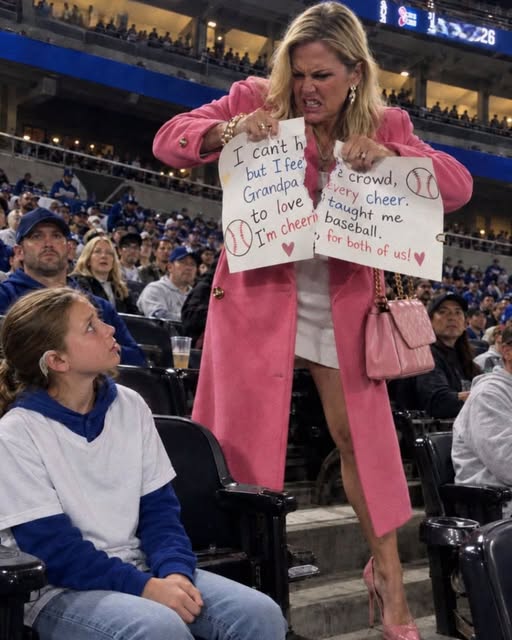
“I can’t hear the crowd, but I feel every cheer. Grandpa taught me to love baseball. I’m cheering for both of us.”
I had to look away for a moment.
Andrea just smiled.
She was proud of it.
On game day, she carried that sign into the stadium like it was something precious.
During warmups, she held it above her head, watching every player on the field.
She was so excited that she could barely sit still.
Then we heard a voice behind us.
“Could you put that down?”
I turned around.
A woman sitting directly behind us was staring at the sign.
She was dressed elegantly, wearing an expensive-looking coat and several pieces of jewelry that reflected the stadium lights.
I assumed she simply couldn’t see around the sign.
So I lowered it.
“I’m sorry,” I said. “She just wants her favorite player to notice it.”
The woman shook her head.
“I paid a lot of money for these seats,” she replied. “I didn’t pay to look at someone’s cardboard sign all afternoon.”
I tried to keep the conversation calm.
Andrea couldn’t hear what the woman was saying, but she could see her expression.
She looked at me and signed a question.
I signed back that everything was okay.
I didn’t want her birthday to become an argument.
For a few minutes, Andrea kept the sign down.
But then her favorite player came onto the field.
She couldn’t contain her excitement.
Slowly, she lifted the sign again.
The woman behind us immediately reached forward.
Before I could react, she grabbed the sign from Andrea’s hands and tore it down the middle.
The sound of the cardboard ripping seemed strangely loud.
Andrea froze.
She stared at the two pieces in the woman’s hands.
Then the woman dropped them onto the ground.
Andrea crouched down and quietly picked them up.
Her hands were shaking.
She looked at me.
Then she signed something I’ll never forget:
“Don’t fight. Grandpa wouldn’t want our day ruined.”
I felt my chest tighten.
She was eleven years old.
She had every reason to be upset.
Yet she was thinking about protecting the memory of Grandpa and protecting our day.
I started to tell her that it wasn’t her fault.
But before I could finish, I noticed something happening around us.
People were pointing toward the field.
Several fans were looking in our direction.
Andrea looked up too.
Her favorite player was standing near the railing.
And he was looking directly at her.
He had seen what happened.
He had noticed the sign.
He had noticed it being torn apart.
And now he was watching Andrea carefully.
The player removed his batting gloves and handed them to someone nearby.
Then he raised both hands.
Andrea’s eyes widened.
He was signing to her.
At first, she seemed unsure.
Then she realized what he was saying.
Her expression changed completely.
She looked at me, then back at him.
I signed to her that she should answer him.
Her hands trembled as she began signing back.
The player smiled.
He pointed toward the two pieces of cardboard.
Then he made a gesture that Andrea immediately understood.
He wanted to know what the sign had said.
Andrea held up the pieces.
I explained.
The player listened.
Then he looked back toward Andrea.
He pointed toward his heart and then toward her.
Andrea’s eyes filled with tears.
But they weren’t tears of embarrassment anymore.
She was smiling.
The player then turned toward the woman sitting behind us.
The entire section seemed to grow quiet.
He didn’t shout.
He didn’t insult her.
He simply looked at the torn sign, then at Andrea, and finally back at the woman.
Then he gestured toward the stadium staff.
A staff member came over.
The player said something to him, and the staff member listened carefully.
Within a minute, the situation was being handled calmly.
The woman suddenly seemed much less confident than she had a few moments earlier.
Her teenage son, who had laughed when Andrea’s sign was torn, stopped smiling.
The player wasn’t trying to create a spectacle.
Instead, he did something much more meaningful.
He asked the staff member for a fresh piece of cardboard.
Then he asked Andrea if she wanted to make another sign.
Andrea looked at me.
I smiled.
She nodded.
A few minutes later, she was holding a new sign.
It wasn’t exactly the same as the first one.
This time, the player had added something to it.
A simple message:
“I see you, Andrea. Keep cheering.”
The section around us erupted in applause.
Andrea couldn’t hear the applause.
But she could see it.
She could see hundreds of people standing.
She could see people smiling.
She could see strangers giving her thumbs-up.
And she could see her favorite player pointing toward her from the field.
That was enough.
For the rest of the game, Andrea held the new sign proudly.
The woman behind us stayed quiet.
Eventually, she leaned forward and quietly apologized.
Andrea couldn’t hear the words, so I signed the message to her.
Andrea looked at the woman for a moment.
Then she nodded.
She didn’t make a big scene.
She simply picked up her sign again and turned toward the field.
The game continued.
And somehow, the moment that had started with a torn piece of cardboard became one of Andrea’s most unforgettable birthdays.
On the way home, she kept talking about the player.
She wanted to know everything he had said.
She asked me to describe his expressions again.
Then she looked down at the new sign in her lap.
She traced the words with her fingers.
Finally, she signed something to me.
“Grandpa would have liked him.”
I smiled.
“I think he would have.”
Andrea leaned against the car window and looked down at the sign.
The cardboard was wrinkled.
The corners were bent.
There were still visible marks where the original sign had been torn.
But she didn’t want to throw it away.
She wanted to keep both versions.
Because the first sign reminded her of Grandpa.
And the second reminded her that sometimes, when something goes wrong, a stranger can choose to make the moment better.
Years from now, she may not remember every inning of that baseball game.
She may not remember the final score.
But I know she’ll remember standing near the field, holding a handmade sign, and discovering that someone had noticed her.
Not because she was deaf.
Not because people felt sorry for her.
But because she was simply a young fan who loved baseball, loved her grandfather, and wanted to share that love with the game.
And that was something worth celebrating.