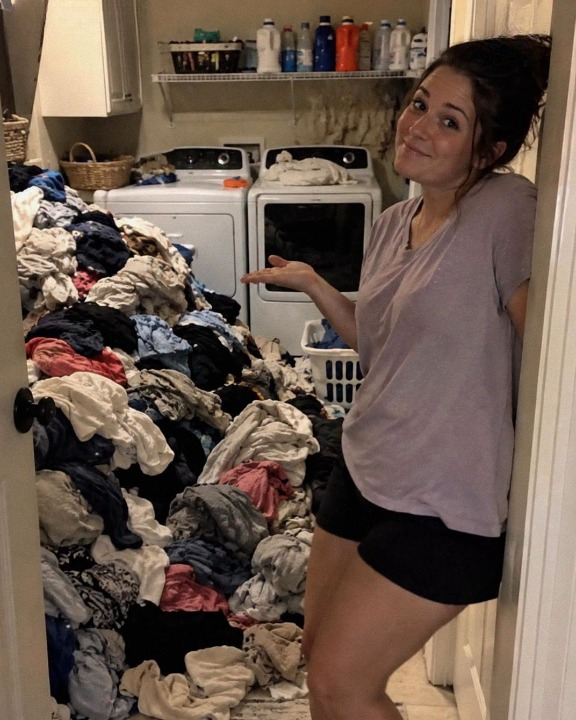
It started with a single laundry basket.
My daughter-in-law, Vanessa, arrived at my house one Saturday morning carrying a small basket of clothes.
She smiled and placed it beside my washing machine.
“Would you mind putting these in with your laundry?”
I looked at the basket.
Then at her.
It didn’t seem like a big request.
I was already doing a load that day, and she was visiting with my son and their children.
“Sure,” I said.
She thanked me.
I didn’t think much of it.
After all, families help one another.
If I could make things a little easier for my son and his family, I was happy to do it.
What I didn’t realize was that the one basket would eventually become a weekly routine.
One Basket Became Several
The following weekend, Vanessa brought another basket.
Then another.
At first, she still asked.
“Would you mind washing these?”
Eventually, the question disappeared.
She would simply arrive with the family, place the clothes near my washing machine, and continue with whatever everyone else was doing.
Before long, Saturday visits looked almost identical.
My son would arrive with Vanessa and the children.
The kids would run into the backyard.
My son would help with something around the house.
And Vanessa would quietly leave several bags of laundry near the washing machine.
Sometimes there were two bags.
Sometimes three.
Once, there were four.
I would wash everything.
Then dry it.
Then fold it.
Then stack the clothes neatly.
By the time they were ready to leave, their clean laundry would be waiting.
At first, I didn’t mind.
But eventually, I realized something.
I wasn’t helping occasionally anymore.
I had become responsible for a weekly household chore that wasn’t mine.
I Wasn’t as Young as I Used to Be
I was sixty-eight.
I still enjoyed being active.
I cooked.
I took care of my home.
I spent time with my grandchildren.
I enjoyed gardening and reading.
But I wasn’t interested in spending my weekends washing several people’s clothes.
I had already raised my children.
I had spent decades doing laundry.
I wasn’t looking to continue managing another household’s washing.
Still, I didn’t want to create tension.
Vanessa was my daughter-in-law.
She was the mother of my grandchildren.
I wanted our relationship to remain positive.
So I kept quiet longer than I should have.
The Conversation I Had Been Avoiding
One Sunday afternoon, I finally decided to say something.
Vanessa had just arrived with another large bag.
I looked at it.
Then I looked at her.
“Vanessa, can I talk to you for a minute?”
She nodded.
“I don’t mind helping occasionally,” I said. “But I’ve noticed I’ve been doing your family’s laundry almost every weekend.”
She smiled awkwardly.
“Oh.”
“I’m getting tired.”
She laughed.
“But you’re home most of the time.”
That sentence caught me off guard.
I didn’t want to argue.
I simply said:
“Being home doesn’t mean I have unlimited time or energy.”
She didn’t respond.
My son was sitting nearby.
I looked at him.
He seemed uncomfortable.
He stared at his plate.
That hurt more than I expected.
I wasn’t asking him to take sides.
I simply wanted him to understand that I needed some consideration too.
I Expected the Situation to Change
After that conversation, I assumed things would improve.
For one weekend, they did.
Vanessa didn’t bring any laundry.
I thought perhaps she had understood.
Then the following Saturday, she arrived with several bags again.
She placed them beside my washing machine.
I looked at the bags.
Then at her.
She smiled.
“These can go with yours.”
I realized something.
Talking about the problem hadn’t been enough.
I needed to establish a clear boundary.
The Next Weekend
The following Saturday, Vanessa arrived with even more laundry.
Four large bags.
She carried them downstairs and left them beside the washing machine.
I didn’t say anything.
Instead, I smiled.
“Okay.”
She looked surprised.
“Okay?”
“Yes. Leave them downstairs.”
She seemed pleased.
I could almost see the relief on her face.
Then everyone went outside.
The children played in the yard.
My son helped me move some garden furniture.
Vanessa joined the others.
I went downstairs.
The four bags were sitting beside my washing machine.
I looked at them for several seconds.
Then I did something different.
I didn’t start the washer.
I Sorted Everything
Instead, I opened the bags.
I sorted the clothing carefully.
One pile for Vanessa.
One for my son.
One for the children.
I wasn’t trying to damage anything.
I wasn’t trying to embarrass anyone.
I simply wanted to understand exactly what I had been taking responsibility for every weekend.
As I sorted the clothes, I noticed something unusual.
There were several items I didn’t recognize.
Some were men’s dress shirts.
Others were trousers.
There were also several white button-down shirts with dry-cleaning tags still attached.
I stopped.
I knew my son’s clothing.
Some of these items clearly didn’t belong to him.
I looked through the rest of the bags.
There were even more unfamiliar pieces.
For a moment, I wondered whether there had been a mistake.
Perhaps Vanessa had accidentally brought someone else’s laundry.
Perhaps she was helping a friend.
Perhaps there was another explanation.
I considered calling my son.
Then I decided not to.
I didn’t want to make assumptions.
So I did what I had originally planned.
I separated the clothing into organized piles.
Then I placed everything back into the bags.
Nothing had been washed.
Nothing had been damaged.
Everything was exactly where it belonged.
I went back upstairs.
Dinner Continued Normally
That evening, everyone ate together.
The children talked about school.
My son told a funny story about work.
Vanessa seemed completely relaxed.
Nobody mentioned the laundry.
At around six o’clock, Vanessa stood up.
“I’ll grab the clothes.”
I nodded.
She walked downstairs.
A few moments later, I heard her call my name.
Then she came back upstairs.
“Where’s everything?”
“It’s downstairs.”
“You didn’t wash it?”
“No.”
She looked surprised.
“But you always wash it.”
“I know.”
She stared at me.
I calmly explained:
“I told you last week that I couldn’t keep doing everyone’s laundry.”
She didn’t answer.
My son looked toward us.
The room became quiet.
The Conversation We Should Have Had Earlier
Vanessa finally said:
“I thought you didn’t mind.”
“I didn’t mind helping sometimes,” I replied.
“But somewhere along the way, helping became an expectation.”
She looked down.
I continued.
“I love having you all here. I love spending time with the children. I want to help my family when I can.”
I paused.
“But I don’t want my weekends to revolve around washing several bags of laundry.”
My son finally spoke.
“Mom’s right.”
Vanessa looked at him.
He continued.
“I should have noticed.”
That was the first time I felt some of the tension leave the room.
Then We Talked About the Unfamiliar Clothes
My son noticed the bags were separated.
“Why are there clothes in different piles?”
I explained that I had sorted everything because I wasn’t sure what belonged to whom.
Vanessa looked uncomfortable.
Then she admitted that some of the clothing belonged to a few relatives.
She had been helping organize laundry for family members who were temporarily staying with them.
She had started bringing everything together because it was easier to transport the bags to my house.
I was surprised.
“Why didn’t you tell me?”
She shrugged.
“I thought you wouldn’t mind.”
I smiled gently.
“That’s the problem. You shouldn’t assume.”
She nodded.
The Important Part Wasn’t the Laundry
At that point, I realized the laundry wasn’t really the biggest issue.
The bigger problem was communication.
Vanessa had assumed I was willing to keep helping.
I had assumed she understood that I was becoming overwhelmed.
Neither assumption was correct.
We had simply stopped talking honestly about it.
I told her that I was happy to help occasionally.
If she had an emergency or needed assistance one week, she could ask.
But I didn’t want to become responsible for another household’s regular laundry.
She agreed.
My son agreed.
And the matter was settled.
The New Arrangement
After that conversation, things changed.
Vanessa stopped bringing bags of laundry to my house.
Instead, she bought an additional laundry basket for their home.
My son began helping with washing and folding.
The children were even given small responsibilities appropriate for their ages.
One of them started matching socks.
Another helped put folded clothes into drawers.
Vanessa later joked:
“I should have taught them these things much earlier.”
I laughed.
“Better late than never.”
Our Relationship Actually Improved
Interestingly, once the laundry disappeared from our Saturday routine, our visits became more enjoyable.
We had more time to talk.
The children and I spent afternoons outside.
My son and I started taking walks together.
Vanessa and I occasionally cooked together.
There was no longer an unspoken expectation hanging over every visit.
That made a huge difference.
I didn’t feel resentful.
She didn’t feel awkward.
And everyone seemed more relaxed.
What I Learned
I had spent weeks worrying that setting a boundary would damage my relationship with my daughter-in-law.
Instead, it improved it.
I realized that avoiding a difficult conversation doesn’t always preserve peace.
Sometimes it simply creates quiet resentment.
If I had continued washing those clothes while feeling frustrated, eventually I might have exploded over something much bigger than laundry.
By speaking honestly, I gave Vanessa an opportunity to understand how I felt.
And she gave me an opportunity to understand why she had behaved the way she did.
Neither of us had intended to create a problem.
We simply needed clearer communication.
My Son’s Perspective
A few weeks later, my son and I were sitting outside.
He brought up the situation himself.
“Mom, I should have helped more.”
I smiled.
“You should have.”
He laughed.
“I deserved that.”
Then he became serious.
“I honestly didn’t realize how much you were doing.”
I told him that was exactly why I had needed to speak up.
“I don’t expect you to know everything I’m feeling.”
He nodded.
“But I do expect you to listen when I tell you.”
“Fair enough.”
He smiled.
Vanessa’s Apology
Later that month, Vanessa came over without any laundry.
She walked into the kitchen carrying a small cake.
“I brought something.”
I laughed.
“No laundry?”
“No laundry.”
We both laughed.
Then she became serious.
“I really am sorry.”
I told her it was okay.
She shook her head.
“No. I want you to know that I understand now.”
She explained that she had become overwhelmed with work, the children, and household responsibilities.
Bringing everything to my house had seemed like a convenient solution.
She hadn’t thought about what that convenience meant for me.
“I should have asked instead of assuming,” she said.
I smiled.
“That’s all I wanted.”
The Four Bags Became a Family Story
Eventually, the incident became something we could laugh about.
Whenever Vanessa visited without laundry, I would jokingly ask:
“Are you sure you didn’t forget something?”
She would smile.
“No, I checked the car twice.”
The children found the whole thing funny.
They started teasing their mother whenever she carried a basket.
“Mom, don’t forget Grandma has retired from laundry.”
I would laugh.
“I absolutely have.”
A Simple Lesson About Boundaries
People sometimes think setting boundaries means being harsh.
It doesn’t.
A boundary can be simple.
“I can help occasionally, but I can’t do this every week.”
That’s all I needed to say.
The important part was actually following through.
When I stopped doing the laundry, nobody’s world fell apart.
My son and Vanessa adjusted.
The children learned to participate.
And I got my weekends back.
More importantly, I stopped carrying quiet resentment.
Final Thoughts
Looking back, I don’t regret helping my family.
I would still help Vanessa if she genuinely needed me.
I would still wash a load of clothes during an emergency.
I would still do anything reasonable to make life easier for my children and grandchildren.
But helping should be a choice.
It shouldn’t quietly become an obligation simply because someone assumes you’ll continue doing it.
That Saturday, when Vanessa brought four bags of laundry to my house, I could have argued.
I could have complained.
I could have embarrassed her.
Instead, I chose something much simpler.
I let the laundry remain exactly where it was.
That decision created the conversation we had been avoiding.
And once we finally talked honestly, everything became easier.
There was no dramatic family breakup.
No shouting.
No lasting resentment.
Just a mother who explained that she needed a boundary, a daughter-in-law who finally understood it, and a son who realized that helping his own family shouldn’t automatically mean expecting his mother to do everything.
Today, our Saturday visits are much more enjoyable.
The washing machine belongs to me again.
The laundry room is quiet.
And when Vanessa arrives, she brings the things that actually matter:
Her family.
Her stories.
Her sense of humor.
And, thankfully, no giant bags of laundry.
Sometimes a family doesn’t need a dramatic lesson.
Sometimes all it needs is one honest conversation and the courage to say, respectfully: