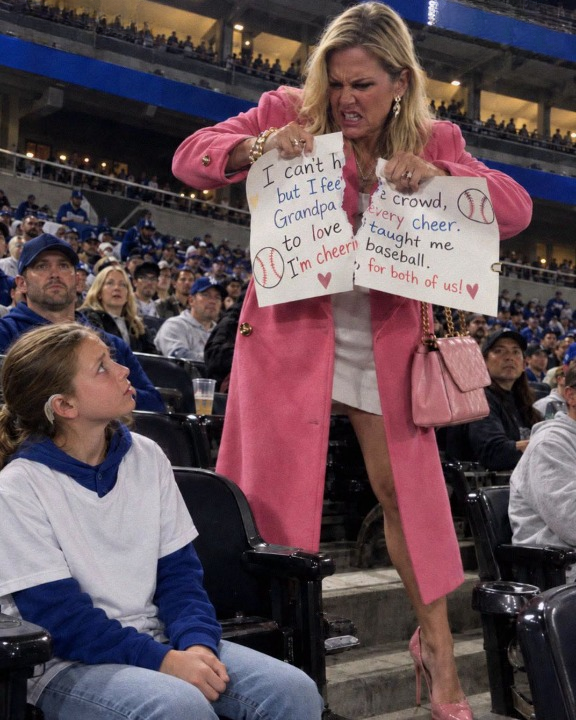
My little sister, Andrea, is eleven years old.
She was born deaf, but she has never allowed that to stop her from enjoying the things she loves.
If anything, Andrea has always had a remarkable way of finding her own way to experience the world.
She communicates through sign language, reads expressions carefully, and notices details that many people overlook.
One of the things she loves most is baseball.
That love began with our grandfather.
The Man Who Taught Us Baseball
Our grandfather played an enormous role in both of our lives.
After our mother left when Andrea was still a baby, Grandpa stepped in and became one of the most important people in our family.
He never treated Andrea as though she was incapable of doing something because she couldn’t hear.
Instead, he learned sign language so that he could communicate with her.
Then he taught both of us baseball.
I still remember sitting at the kitchen table while Grandpa drew baseball diamonds on pieces of paper.
He explained the rules.
He demonstrated different plays.
He taught us how to keep score.
And whenever we misunderstood something, he patiently explained it again.
Andrea loved every minute of it.
She might not have been able to hear the crack of a bat or the roar of a stadium, but she understood the excitement of the game in her own way.
She could see the players.
She could watch the crowd.
She could feel the energy around her.
And, most importantly, she could share the experience with the people she loved.
After Grandpa passed away two years ago, baseball became even more meaningful to us.
Whenever Andrea watched a game, she often said that it made her feel close to him.
A Special Birthday Gift
For Andrea’s eleventh birthday, I wanted to give her something she would remember for years.
I had been saving money for months.
Eventually, I managed to buy two seats close to the field for a game featuring her favorite team.
When I told her, she couldn’t believe it.
She immediately started planning what she would wear.
Then she decided she needed a sign.
Not just any sign.
She wanted to make it herself.
For three evenings, Andrea sat at the kitchen table working on it.
She carefully outlined every letter.
She erased mistakes.
She started over when she wasn’t satisfied.
Finally, she showed it to me.
It said:
“I can’t hear the crowd, but I feel every cheer. Grandpa taught me to love baseball. I’m cheering for both of us.”
I had to look away for a moment because the message brought tears to my eyes.
Andrea was incredibly proud of it.
She couldn’t wait for her favorite player to see it.
The Game Begins
When we arrived at the stadium, Andrea was practically bouncing with excitement.
She held the sign above her head during warmups.
Every few minutes, she’d look toward the field to see whether her favorite player had noticed it.
I kept encouraging her.
“Keep holding it up. Maybe he’ll see it.”
She smiled.
For a while, everything was perfect.
Then someone behind us spoke.
“Could you put that down?”
I turned around.
A woman sitting in the row behind us was looking directly at the sign.
She appeared irritated.
I politely explained that my sister had made the sign herself and was hoping her favorite player would notice it.
The woman responded that she had paid a lot for her seats and didn’t want to have to look at a sign.
I tried to keep the situation calm.
“We’ll move it when the play starts,” I said.
She didn’t seem satisfied.
Andrea couldn’t hear what the woman was saying, but she could see the expression on her face.
She looked at me.
I signed that everything was okay.
I didn’t want her birthday to become stressful.
The Moment Everything Changed
A few minutes later, Andrea raised the sign again.
She was excited.
She was watching the field.
She was hoping her favorite player might finally notice the message.
Then the woman reached forward.
Before I could react, she grabbed the sign and pulled it away from Andrea.
The cardboard tore.
The carefully written message split down the middle.
Andrea froze.
She stared at the pieces in her hands.
The excitement disappeared from her face.
Then she crouched down and began collecting the torn pieces.
I was furious.
But before I could say anything, Andrea looked at me.
She signed:
“Don’t fight. Grandpa wouldn’t want us to ruin the day.”
That stopped me.
She was upset, but she didn’t want an argument.
She wanted to enjoy the game.
So I helped her gather the pieces.
Then Something Unexpected Happened
A few moments later, people around us started pointing toward the field.
I looked up.
Andrea’s favorite player was looking directly toward our section.
At first, I wasn’t sure what he was watching.
Then I realized.
He had seen what happened.
He had seen Andrea holding the sign.
He had seen it being torn.
And now he was looking directly at her.
He walked toward the edge of the field.
Then he removed his batting gloves.
Andrea noticed him.
Her eyes widened.
The player raised his hands.
Then he began signing.
Andrea immediately recognized what he was doing.
He was communicating with her.
Andrea Couldn’t Believe It
For a few seconds, she simply stared.
Then her face changed.
She smiled.
The player signed a simple message asking whether she was okay.
Andrea nodded.
He then pointed toward the torn sign.
Andrea held it up.
He gave her an encouraging gesture.
Then he pointed toward the field and signed that he had seen her message.
I had never seen my sister’s face light up like that.
The entire situation had changed in seconds.
The moment that had started with disappointment was becoming one of the most memorable experiences of her life.
The Player Made a Thoughtful Gesture
The player spoke briefly with a nearby staff member.
A few minutes later, someone from the stadium approached us.
They asked Andrea if she would like to keep the torn sign.
She nodded.
Then they told her that the player wanted to give her something.
It wasn’t anything extravagant.
It was simply a signed baseball and a short handwritten message thanking her for supporting the team.
Andrea held it carefully.
She looked at me.
Then she looked at the field.
She was smiling again.
The Woman Behind Us Was Quiet
The woman who had torn the sign had watched everything.
She didn’t say anything.
The attention from the field had made it clear that Andrea’s sign wasn’t just an obstruction.
It was something meaningful to a young fan.
Eventually, the woman apologized.
She admitted that she had reacted without understanding the situation.
Andrea didn’t hear the original comments, but she understood the apology when I explained it.
She looked at me.
Then she nodded.
For Andrea, the matter was finished.
She didn’t want revenge.
She didn’t want anyone embarrassed.
She simply wanted to watch the game.
That was another lesson I learned from my little sister.
The Game Became Even More Special
After that, Andrea kept the torn sign in her lap.
She didn’t try to hold it above her head anymore.
Instead, she watched the game carefully.
Every once in a while, she looked toward the field.
Her favorite player waved in her direction.
She waved back.
The smile never left her face.
When the game ended, Andrea was still talking about it.
She told me that she had been sad when the sign was torn.
But she was happier because the player had noticed it anyway.
That was the part she remembered most.
Grandpa Was Still Part of the Day
On the way home, Andrea held the signed baseball carefully in her hands.
She looked at the message on it several times.
Then she said something that made me emotional.
“Grandpa would have loved today.”
I agreed.
He would have been proud of her.
Not because she had a special sign.
Not because a professional baseball player noticed her.
He would have been proud because she handled a difficult moment with patience and kindness.
Grandpa always taught us that loving baseball was about more than the score.
It was about the people.
The memories.
The traditions.
And sharing something you love with others.
The Sign Became a Keepsake
When we got home, Andrea asked me not to throw the torn sign away.
Instead, she wanted to keep it.
She placed the two pieces inside a folder along with her ticket and the signed baseball.
I asked her why she wanted to save something that had been damaged.
She smiled.
“Because it’s part of the story.”
She was right.
The sign wasn’t perfect anymore.
But it represented the entire day.
The excitement.
The disappointment.
The unexpected kindness.
And the moment when a player took the time to communicate with a young fan.
What I Learned From Andrea
That day reminded me that accessibility and inclusion are not just about providing accommodations.
They are also about making people feel welcome.
Andrea doesn’t need everyone to understand exactly what her life is like.
She simply wants to enjoy the same things other kids enjoy.
She loves baseball.
She loves her family.
She loves making signs.
She loves cheering for her favorite team.
And she loves remembering Grandpa.
None of those things are diminished because she experiences the world differently.
In fact, Andrea has taught me that people can experience the same event in completely different ways.
Some fans hear the crowd.
Andrea sees the crowd.
Some people hear the crack of the bat.
Andrea watches the ball leave the bat.
Some people hear the cheers.
Andrea feels the excitement around her.
And all of those experiences are valid.
A Small Gesture Made a Huge Difference
The baseball player didn’t need to stop.
He could have continued preparing for the game.
He could have ignored the situation.
Instead, he took a moment to communicate directly with a young fan.
That small gesture meant everything to Andrea.
It showed her that she had been seen.
Not because she was different.
Not because she needed sympathy.
But because she was a fan who had created something special and wanted to share it.
What Happened to the Woman?
The woman eventually apologized to Andrea and to me.
She explained that she hadn’t understood why the sign was so important.
I accepted the apology.
I didn’t want the situation to become something bigger than it needed to be.
People make mistakes.
What matters is whether they’re willing to recognize them and behave differently afterward.
Andrea seemed satisfied with the apology.
Then she went back to looking through her baseball keepsakes.
For her, the situation was already becoming a memory.
The Message We Took Home
The most memorable part of that day wasn’t the torn cardboard.
It wasn’t the uncomfortable interaction.
It wasn’t even the signed baseball.
It was Andrea’s reaction.
She had every reason to be upset.
Instead, she reminded me that Grandpa wouldn’t want us to let one difficult moment ruin something special.
Her words changed the way I looked at the situation.
Sometimes we cannot control what other people do.
But we can control what we do next.
We can choose to respond with patience.
We can choose to protect someone’s dignity.
And we can choose not to let one unpleasant moment define an entire day.
Final Thoughts
Andrea’s handmade sign was torn in half before her favorite player ever had the chance to read it.
But somehow, the message still reached him.
He saw it.
He understood what it meant.
And he took the time to let Andrea know that he had noticed her.
The sign may have been damaged, but its meaning wasn’t.
Grandpa taught Andrea to love baseball.
That love brought her to the stadium.
Her handmade sign expressed something deeply personal.
And an unexpected gesture from her favorite player turned a difficult moment into a memory she will probably carry for years.
As we drove home that night, Andrea held her signed baseball close.
Then she looked at me and smiled.
“Next time,” she signed, “I’ll make an even bigger sign.”
I laughed.
“Maybe we should make two.”
She nodded enthusiastically.
And just like that, the day ended the way it should have:
With my little sister smiling, talking about baseball, and carrying home a memory that was much bigger than the piece of cardboard she had brought to the stadium.
Sometimes, a meaningful moment doesn’t go according to plan.
Sometimes, something gets damaged.
Sometimes, people misunderstand one another.
But a single act of kindness can change the entire direction of a difficult moment.
And for Andrea, that kindness came from someone on the field who took a few seconds to say something incredibly important without speaking a single word:
“I see you. I know you’re cheering. And I’m glad you’re here.