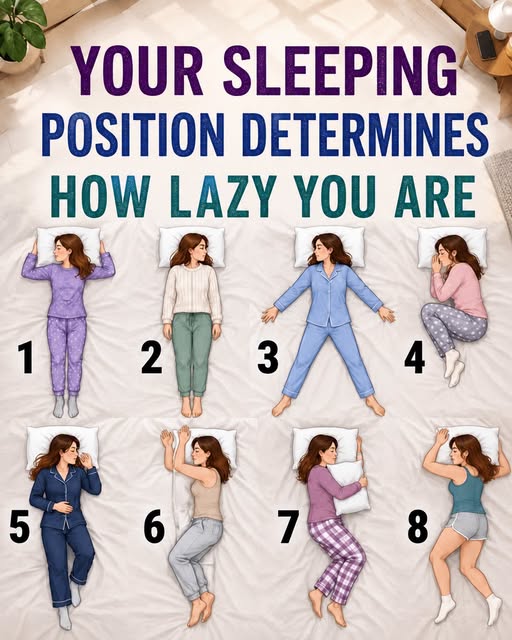
What Your Sleeping Position May Say About Your Sleep Habits
Have you ever woken up in exactly the same position you were in when you fell asleep and wondered whether it says something about you?
Maybe you sleep comfortably on your back, almost as if you are waiting for the day to begin. Perhaps you prefer lying on your side with your knees slightly bent. Or maybe you curl yourself into a compact position and barely move during the night.
Sleeping positions can be surprisingly interesting to observe. They can affect comfort, pressure on different parts of the body, and sometimes the way a person experiences sleep.
But there is one important distinction worth making: your sleeping position does not determine how lazy, hardworking, ambitious, or productive you are.
Personality cannot be reliably judged from the position someone happens to use while sleeping.
Instead, sleeping position is better understood as one small part of a person’s sleep habits and physical comfort.
Why Do People Sleep in Different Positions?
There is no single sleeping position that works perfectly for everyone.
People naturally develop preferences based on comfort, mattress firmness, body shape, previous habits, temperature, and the way they feel when lying down.
Some people prefer sleeping on their back because it allows them to stretch out. Others find side sleeping more comfortable because it feels natural and supported.
Some people move frequently throughout the night, while others remain in roughly the same position for long periods.
These differences are normal.
Your preferred position can also change over time. Someone who has always slept on their stomach may eventually become more comfortable sleeping on their side. Likewise, a person who normally sleeps on their back may change positions because of a different mattress, physical discomfort, pregnancy, an injury, or simply changing habits.
The Back Sleeper
Sleeping on your back is sometimes called the supine position.
In this position, the person lies with their face toward the ceiling while their back rests against the mattress.
For some people, this position feels natural because it allows the body to remain relatively straight. The shoulders and hips can rest evenly against the mattress, depending on the individual’s body shape and the support provided by the bed.
A pillow that supports the head without pushing it too far forward can also affect comfort.
Back sleeping is not necessarily better or worse for everyone. Individual circumstances matter.
For example, some people may notice that lying on their back makes snoring or certain nighttime breathing symptoms more noticeable. People who regularly experience significant snoring, pauses in breathing, or excessive daytime sleepiness may want to discuss those symptoms with a healthcare professional.
The important point is that the position itself does not reveal a person’s personality.
The Side Sleeper
Side sleeping is another very common position.
A person sleeping on their side may keep their legs relatively straight or bend their knees slightly. Some people place one arm under their pillow, while others hug a pillow or keep their arms comfortably in front of them.
Side sleeping can feel comfortable because it allows many people to maintain a natural posture.
A pillow between the knees can also provide additional comfort for some sleepers by helping support the legs and hips.
However, there is no universal rule that says every side sleeper should use a particular arrangement.
Comfort is personal, and small changes in pillow height or mattress support can make a noticeable difference.
The Curled-Up Sleeper
Some people naturally sleep with their knees drawn toward their chest.
This position is often associated with a curled or fetal-like posture.
It can feel comfortable and secure, particularly for people who naturally prefer sleeping on their sides.
The degree of curling varies considerably.
One person may barely bend their knees, while another may curl into a much tighter position.
It is tempting to attach personality traits to this posture and claim that people who sleep this way are more sensitive, cautious, emotional, or even less motivated.
However, such interpretations are not reliable ways to determine personality.
A comfortable sleeping position is primarily a sleeping position.
It should not be treated as a personality test.
The Stomach Sleeper
Some people prefer sleeping on their stomach.
This position can feel comfortable for certain individuals, but it may also place the neck in an awkward position because the head generally has to turn to one side in order to breathe.
The amount of pressure placed on the neck, shoulders, or lower back can vary depending on the person’s body and sleeping surface.
If someone regularly wakes with stiffness or discomfort, experimenting with different pillows or sleeping positions may be worth considering.
Again, there is no meaningful connection between stomach sleeping and being lazy or energetic.
A sleeping preference does not determine someone’s work ethic.
Why the “Lazy Sleeper” Idea Is Misleading
The idea that sleeping positions can reveal how lazy a person is makes for an entertaining headline, but it should not be treated as a scientific conclusion.
Laziness is not something that can be measured simply by looking at how someone sleeps.
A person who sleeps on their side could be highly productive. A person who sleeps on their back could struggle with motivation. Someone who changes positions constantly could be energetic during the day—or simply someone who moves around a lot while sleeping.
Sleep behavior and daytime personality are much more complicated than that.
A person’s motivation can be influenced by many factors, including workload, stress, mood, environment, physical health, sleep quality, personal circumstances, and individual goals.
A sleeping position cannot capture all of those factors.
Your Sleeping Position Can Affect Comfort
Although sleeping position does not reveal whether someone is lazy, it can influence physical comfort.
For example, the way the body is positioned throughout the night can affect pressure on the shoulders, hips, knees, neck, and back.
This is one reason people often experiment with pillows.
A pillow between the knees may be comfortable for some side sleepers. A supportive head pillow may help maintain a more comfortable neck position. Others may prefer no additional pillow beyond the one supporting their head.
The right arrangement depends on the person.
There is no single sleeping setup that guarantees perfect sleep for everyone.
Why You May Move During the Night
Many people assume that they remain in one sleeping position for the entire night.
In reality, sleeping positions can change naturally.
You might fall asleep on your side and wake up on your back. You may move your legs, turn over, adjust your arms, or change positions without remembering doing so.
These movements are a normal part of sleep for many people.
As a result, the position you notice when you wake up may not even be the position you spent most of the night using.
That makes it even less reasonable to use one waking position as a personality test.
Your Mattress Matters Too
Sleeping position is only one part of the equation.
The mattress can influence how comfortable a person feels and whether they naturally stay in one position or move around.
A mattress that feels too firm may create uncomfortable pressure in certain areas. A mattress that is too soft may provide a different type of support.
Personal preference plays an important role.
Body weight, sleeping position, room temperature, bedding, and other factors can all influence how comfortable someone feels during the night.
This is why two people can use the same sleeping position but have completely different experiences.
Pillow Height Can Make a Difference
The pillow is another important part of sleep comfort.
A pillow that is too high or too low may feel uncomfortable depending on the person’s sleeping position and body shape.
Side sleepers often have different support needs from back sleepers because the distance between the head and mattress changes depending on the position of the shoulders.
Stomach sleepers may prefer a thinner pillow because of the way their head is turned.
These are general considerations rather than strict rules.
The goal is simply to find an arrangement that feels comfortable and does not leave you regularly waking with unnecessary stiffness or discomfort.
Does Your Position Change With Age?
It can.
People’s sleep habits are not necessarily fixed throughout life.
Changes in lifestyle, physical comfort, mattress preferences, injuries, pregnancy, aging, and other circumstances can all influence sleeping position.
Someone may have slept on their stomach as a child but prefer side sleeping as an adult.
Another person may become more aware of back or neck comfort and adjust their sleeping arrangement accordingly.
These changes are normal and do not mean that someone’s personality has changed.
What About Sleep Quality?
A person’s sleeping position may sometimes be relevant when considering sleep quality, but it is only one factor.
Sleep quality can be influenced by the amount of sleep someone gets, interruptions during the night, stress, room temperature, light, noise, caffeine, medications, schedules, and many other factors.
If someone consistently wakes feeling exhausted despite allowing enough time for sleep, the issue may be worth investigating rather than blaming their sleeping position.
Persistent snoring, repeated nighttime awakenings, breathing difficulties during sleep, or significant daytime sleepiness can also be reasons to discuss sleep with a healthcare professional.
Your Sleeping Position Is Not a Personality Test
It can be fun to read about personality theories connected to sleeping positions.
People have long enjoyed assigning character traits to the way someone sits, walks, sleeps, or interacts with others.
But entertainment and evidence are two different things.
A person may enjoy sleeping curled up without being particularly shy. A back sleeper is not automatically confident. A stomach sleeper is not necessarily stubborn. And someone who moves constantly during sleep is not necessarily restless during the day.
These descriptions may sound convincing because they are broad enough to fit many different people.
That does not make them reliable personality assessments.
What Your Sleeping Habits Can Tell You
Although sleeping position cannot tell you whether you are lazy, observing your sleep habits can still provide useful information.
You might notice that you consistently wake with neck discomfort after sleeping in a particular position.
You might discover that you sleep more comfortably with a pillow between your knees.
You might realize that changing your mattress or bedding improves your comfort.
Or you might notice that your sleep is repeatedly interrupted regardless of your position.
These observations are much more useful than assigning personality traits to a sleeping posture.
Small Changes Can Improve Comfort
If your current sleeping position feels comfortable and you wake up feeling rested, there may be no reason to change it simply because an article says another position is supposedly better.
If you experience regular discomfort, however, small adjustments may be worth trying.
You could experiment with pillow height, mattress support, the position of your arms, or placing a pillow between your knees if you sleep on your side.
Changes should be gradual.
There is no need to force yourself into a position that feels unnatural simply because it is popular.
When Sleep Problems Deserve Attention
A sleeping position by itself is usually not a reason for concern.
However, persistent sleep problems should not automatically be blamed on posture.
If you regularly experience severe daytime sleepiness, repeated breathing interruptions during sleep, loud persistent snoring, frequent nighttime awakenings, or ongoing pain, consider discussing those symptoms with a qualified healthcare professional.
The important issue is the overall pattern rather than one particular sleeping position.
The Bottom Line
Your sleeping position may say something about what feels comfortable to your body, but it does not determine how lazy you are.
Back sleepers, side sleepers, stomach sleepers, and people who curl up during the night can all have completely different personalities and lifestyles.
Sleep is influenced by many physical and environmental factors, and people naturally develop different habits.
So the next time you wake up in a strange position, there is no need to worry that your sleeping posture has revealed a hidden personality trait.
Instead, consider something more practical: Did you sleep comfortably, did you get enough rest, and do you feel ready for the day?
Those questions tell you far more about your sleep than whether you spent the night on your back, side, or stomach.