It Looks Like an Abandoned Silo, But This Creekside Structure Has a Practical Purpose
Deep in a wooded area beside a creek, a small metal structure can look strangely out of place.
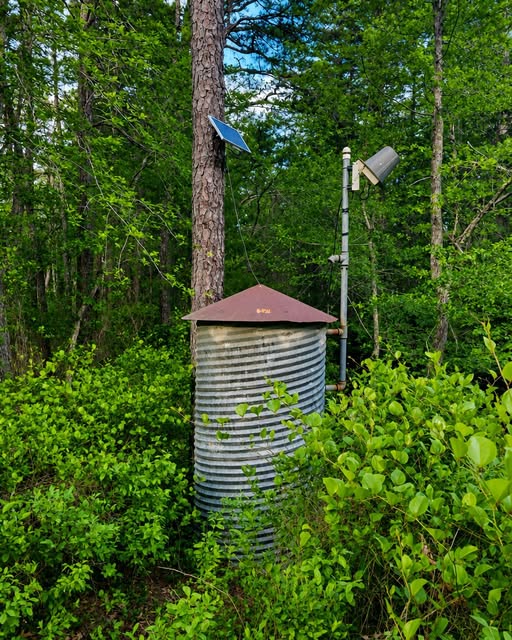
It may resemble an abandoned silo, an old storage container, or even a forgotten piece of agricultural equipment. A short corrugated-metal cylinder sits among the trees, while a small solar panel points toward the sky. Nearby, a pole supports a compact box containing equipment that isn’t immediately recognizable.
At first glance, there may be nothing about the setup that explains why it is there.
But what appears to be an abandoned structure may actually serve a very practical purpose.
In many locations, small monitoring stations are installed near streams and rivers to collect information about changing water conditions. They can operate quietly for long periods, gathering data that helps people understand what is happening in a waterway.
The equipment may not look impressive, but its job can be important.
What Looks Like a Small Silo May Actually Be a Monitoring Structure
The cylindrical metal housing is one of the features that can make this type of installation confusing.
Its shape can resemble something used for storage or agriculture, especially when viewed from a distance.
But monitoring equipment often needs to be protected from weather, animals, debris, and accidental damage.
A sturdy enclosure can provide that protection.
The structure itself may house or protect equipment associated with measuring water levels, environmental conditions, or other characteristics of the nearby stream.
Depending on the installation, the equipment may be connected to sensors positioned near or in the water.
The visible structure is therefore only one part of a larger monitoring system.
Why Would Anyone Put Equipment in the Woods?
A creek can look peaceful and unremarkable on an ordinary day.
Water moves quietly through the channel, trees grow along the banks, and the surrounding landscape may appear almost untouched.
But waterways can change dramatically during storms.
Heavy rainfall can cause water levels to rise quickly. Snowmelt, changing weather patterns, drainage from surrounding land, and other environmental conditions can also influence the amount of water flowing through a creek.
Without measurements, it can be difficult to know exactly how quickly those changes occur.
That is why monitoring stations are often placed in locations where they can observe the waterway continuously.
Instead of relying only on someone visiting the creek occasionally, automated equipment can collect information throughout the day and night.
What Does a Flood Gauge Actually Measure?
A flood gauge or stream gauge can be designed to monitor water level, often referred to as the stage of the water.
The equipment can detect how high the water is relative to a reference point.
That information can then be recorded over time.
A single measurement may not tell us much.
A long series of measurements can tell us considerably more.
For example, data can show how a creek normally behaves during dry periods and how rapidly its water level changes after significant rainfall.
Researchers and water-management agencies can use this information to better understand the waterway.
In some systems, water-level information can also contribute to flood monitoring and public safety.
Why Is There a Solar Panel?
The solar panel is another clue that the structure is probably not abandoned.
A remote monitoring station may be located far away from convenient electrical connections.
Running a traditional power line through a forest can be expensive, disruptive, or impractical.
A solar panel provides another option.
During daylight, the panel can generate electricity that is stored in a battery.
The stored energy can then help power sensors, data-recording equipment, communication devices, or other components of the monitoring station.
This allows the installation to operate in a remote location without requiring a conventional electrical connection.
The panel may look small, but modern monitoring equipment can be designed to operate on relatively modest amounts of energy.
What Is the Box on the Pole?
The box attached to the pole may contain communications or electronic equipment.
A monitoring station needs more than a sensor.
It also needs some way to record and, in many cases, transmit the information that has been collected.
Depending on the specific system, the equipment could include a data logger, communication hardware, power-management components, or other electronics.
The exact configuration varies from one monitoring station to another.
That means it isn’t possible to identify every component simply by looking at a photograph.
However, the combination of a protected enclosure, solar panel, pole-mounted equipment, and nearby waterway is a strong indication that the installation serves a monitoring purpose rather than being an abandoned storage structure.
How Can Water Levels Be Measured?
There are several technologies that can be used to measure water levels.
Some systems use instruments positioned near the water to detect changes in elevation.
Others can use non-contact methods, such as sensors that measure the distance between the instrument and the surface of the water.
A monitoring system may also incorporate additional sensors depending on its purpose.
The important point is that the equipment doesn’t necessarily need to look like a traditional measuring device.
Much of the actual technology can be hidden inside protective housings.
That is one reason a remote monitoring station can appear mysterious to someone passing by.
Why Continuous Monitoring Matters
Imagine visiting a creek once a week.
You might see normal water conditions every time.
But if a major storm caused the creek to rise dramatically on a Tuesday and return to normal by Wednesday, you could easily miss the event.
Automated monitoring solves that problem.
A properly maintained station can collect readings at regular intervals.
Instead of a few isolated observations, researchers can build a detailed record of how the waterway behaves.
This information can be useful for studying floods, droughts, seasonal changes, rainfall patterns, and long-term changes in the watershed.
The Difference Between Water Level and Flow
One important detail is that water level and water flow are not exactly the same thing.
A gauge can directly measure water level, but determining the amount of water flowing through a stream generally requires additional information.
Hydrologists can establish relationships between water level and streamflow using measurements taken under different conditions.
This allows recorded water levels to contribute to estimates of how much water is moving through the channel.
The relationship isn’t identical for every stream.
The shape of the channel, slope, vegetation, debris, and other factors can affect the relationship between stage and discharge.
That is why monitoring stations are more than simple rulers placed beside a creek.
Why Are These Stations Often Unnoticed?
One reason is their relatively small size.
People sometimes imagine scientific monitoring stations as large buildings filled with complicated machinery.
In reality, modern equipment can be surprisingly compact.
A small solar panel, a metal enclosure, a few sensors, and a communications unit may be enough for a remote installation.
The station may also be deliberately placed away from heavily traveled areas.
Its purpose is to monitor the environment, not to attract attention.
Over time, vegetation can grow around the equipment, making it appear even more integrated into the landscape.
From a distance, it can easily be mistaken for something old that has simply been left behind.
Why the Corrugated Metal Housing?
Corrugated metal is commonly used for structures that need to be durable without being excessively heavy.
Its shape provides strength while keeping the material relatively practical to manufacture and install.
For a monitoring station located outdoors, the enclosure may need to withstand rain, snow, wind, temperature changes, and occasional contact with wildlife.
A simple metal housing can provide a protective barrier for equipment without requiring a large permanent building.
The enclosure’s exact design depends on the type of station and the equipment inside it.
What Happens During a Heavy Storm?
A monitoring station becomes particularly useful when conditions change quickly.
During a major rainfall event, water levels can rise rapidly.
The equipment can continue collecting measurements while conditions are changing, providing a record of the event.
This information may help agencies understand how a watershed responds to rainfall and how quickly water levels rise and fall.
In areas where flood information is incorporated into warning systems, stream-gauge data can also contribute to broader monitoring efforts.
However, not every small gauge automatically provides a public warning service.
Some stations are primarily intended for research, long-term data collection, or water-resource management.
What Happens to the Data?
The measurements collected by a monitoring station can be stored electronically.
Depending on the system, information may be transmitted remotely or retrieved during maintenance visits.
Data can then be analyzed alongside other information such as rainfall, weather conditions, watershed characteristics, and historical records.
Over time, these measurements can become part of a much larger database.
A single remote creek may therefore contribute to research covering an entire region.
The small device beside the water is connected to a much bigger system of environmental observation.
Why Long-Term Records Are Valuable
One of the most important benefits of monitoring is the ability to compare conditions over time.
A single storm can be interesting.
Years of data can be much more useful.
Long-term records can help scientists identify seasonal patterns and understand how often particularly high or low water levels occur.
They can also provide information for infrastructure planning, environmental studies, water management, and flood-risk analysis.
Without historical measurements, many of these questions would have to be answered using incomplete observations.
Could It Really Be an Old Silo?
From a distance, the resemblance is understandable.
The cylindrical shape and metal exterior can make the structure look agricultural.
But its surroundings provide additional clues.
The presence of a solar panel is particularly important.
A conventional abandoned storage structure would have little reason to need a working solar power system.
Likewise, a pole-mounted equipment box suggests that the installation is part of a functioning technical system.
The location beside a creek provides another significant clue.
Taken together, these features point toward environmental monitoring rather than storage.
Why Remote Locations Are Useful
A monitoring station needs to observe the environment it is intended to measure.
That means placing equipment near the actual stream or watershed can be more useful than putting it somewhere convenient for people.
Remote locations can also reduce interference.
The equipment is less likely to be disturbed by regular foot traffic, vehicles, or other human activity.
At the same time, remote stations create their own challenges.
Technicians may need to travel through difficult terrain to inspect the equipment, replace batteries, clear vegetation, check sensors, or perform repairs.
Solar power and remote communications can reduce the need for constant visits, but maintenance is still important.
Wildlife and the Environment
Outdoor monitoring equipment has to coexist with the environment around it.
Animals may investigate unfamiliar objects.
Vegetation can grow around equipment.
Branches can fall during storms.
Floodwater can carry debris that may strike or cover nearby components.
For that reason, monitoring stations are generally designed with durability and protection in mind.
The apparent simplicity of the structure doesn’t necessarily reflect how much planning went into placing and maintaining it.
A Quiet Piece of Technology
Perhaps the most interesting thing about a creekside monitoring station is how little attention it demands.
There are no flashing signs.
There may be no large building.
The equipment can sit quietly among the trees for years.
Meanwhile, sensors can continue collecting information about the waterway.
People walking nearby might never realize that the small metal structure is recording environmental data.
It is a good example of how modern technology can become almost invisible when it is designed to work in the background.
Why These Structures Matter
Water is one of the most closely monitored parts of the natural environment.
Understanding how streams respond to rainfall and changing conditions can help communities make decisions about infrastructure, water resources, environmental protection, and flood preparedness.
That doesn’t mean every small monitoring station has a dramatic role.
Often, its value comes from consistency.
A measurement taken today becomes more useful when combined with thousands of measurements collected over months and years.
The quiet structure beside the creek becomes part of a long-term record.
The Landscape Can Be Deceptive
The next time you see an unusual metal cylinder beside a creek, it may be tempting to assume that it is an abandoned piece of farm equipment or an old storage structure.
But modern environmental monitoring equipment can look surprisingly ordinary.
A solar panel, a small enclosure, a pole-mounted box, and a nearby waterway may be clues that the object is still doing its job.
It doesn’t need to look sophisticated to be useful.
In fact, the most effective monitoring equipment is often designed to blend into its surroundings and operate with minimal attention.
A Small Structure With a Bigger Purpose
What initially looks like an abandoned silo may actually be part of a carefully designed system for observing a creek and recording changes in water conditions.
The solar panel provides power.
The sensors gather information.
The electronics record or transmit measurements.
And the surrounding landscape provides the environment being monitored.
None of it is particularly dramatic.
That’s precisely what makes it easy to overlook.
A small metal structure standing quietly beside a creek can be doing something far more practical than its appearance suggests—collecting information that helps people understand how water moves through the landscape.
Sometimes, the most interesting objects in the woods aren’t relics from the past at all.
They’re pieces of modern technology quietly working in the background.