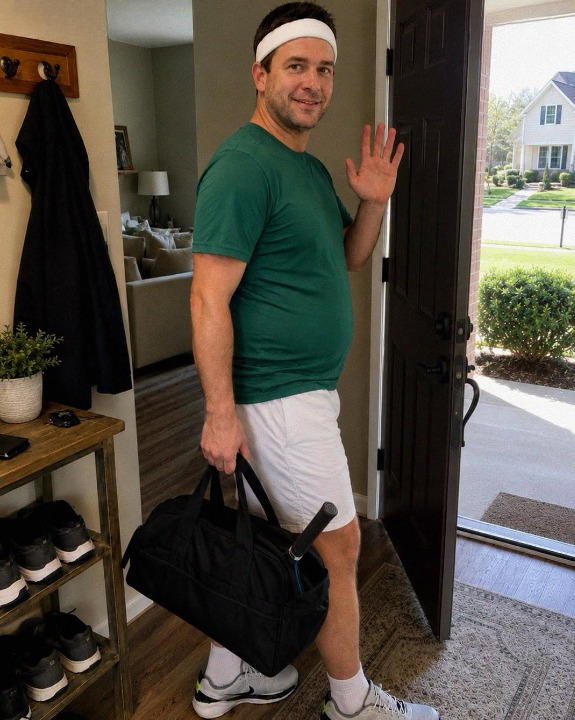
For six months, I believed my husband had discovered a new passion.
Every Sunday morning, Bryson would wake up early, make himself coffee, pack his tennis racket, and tell me he was meeting his friends at the courts.
At first, I was genuinely happy for him.
After years of putting work, family responsibilities, and everyday routines ahead of his own well-being, Bryson had decided he wanted to become more active.
He changed the way he ate.
He started exercising during the week.
He bought a few new outfits.
He even became interested in tennis.
I encouraged him.
“You’re finally taking some time for yourself,” I told him.
He smiled.
“Exactly.”
I never imagined that those Sunday mornings would eventually make me question everything.
For the first few months, everything seemed normal.
Bryson would leave around nine in the morning.
Sometimes he’d return around noon.
Other times, he’d stay out until early afternoon.
He usually came home tired.
I assumed that was because he had been exercising.
Then, about a month before everything changed, his routine began to feel different.
He started coming home later.
Much later.
Instead of returning around noon, he’d sometimes walk through the door after two.
Once, it was nearly three.
I’d ask him how the game went.
“Long match,” he’d say.
Another time, I asked if he’d won.
He laughed.
“I lost badly.”
I teased him about needing more practice.
He smiled.
But something about the way he answered felt distant.
He seemed distracted.
Sometimes I’d ask him a question, and he’d look at me as though he had forgotten I was standing there.
“Are you okay?” I’d ask.
“Yeah.”
“You’re sure?”
“Just tired.”
I wanted to believe him.
After all, people have bad days.
Marriage doesn’t mean you understand every thought your spouse has.
Sometimes someone can simply be stressed.
So I tried not to overthink it.
Then came the conversation that changed everything.
It happened on a Tuesday afternoon.
Bryson was at work.
His best friend, Owen, stopped by our house to return a set of tools he’d borrowed several weeks earlier.
We stood in the driveway talking.
Owen and I had known each other for years.
He was practically part of the family.
After a few minutes, I remembered something.
“So, how’s the tennis going?”
Owen looked confused.
“What tennis?”
I laughed.
“Bryson’s Sunday tennis.”
Owen stared at me.
“Bryson?”
“Yes.”
“What about him?”
“The games you guys play on Sundays.”
He was silent.
Then he shook his head.
“We haven’t played tennis together in months.”
I stopped smiling.
“What?”
“Bryson hasn’t been coming.”
I stared at him.
“Are you sure?”
“Of course.”
“Maybe he plays with someone else.”
Owen shrugged.
“Maybe. But he hasn’t played with us.”
My mind started racing.
“How long has it been?”
“At least three or four months.”
Three or four months.
I felt cold.
Bryson had been telling me for weeks that he was playing tennis with Owen and their friends.
Suddenly, all those late Sundays made sense in a completely different way.
The strange expressions.
The unexplained delays.
The way he sometimes seemed distracted when he returned home.
I thanked Owen and went inside.
I sat at the kitchen table.
I didn’t move for a long time.
My first instinct was anger.
My second was fear.
My third was denial.
There had to be an explanation.
Maybe Bryson had started going somewhere else.
Maybe he had joined another tennis group.
Maybe he had picked up a completely different hobby.
But why hadn’t he told me?
That was what bothered me most.
He hadn’t simply changed his plans.
He had given me the same explanation over and over.
Every Sunday.
I considered confronting him that evening.
I imagined asking:
“Where have you really been?”
But I knew I wasn’t ready for whatever answer he might give.
So I waited.
That night, when Bryson came home, I watched him carefully.
He kissed me.
“How was your day?”
“Fine.”
He put his keys down.
“How was yours?”
“Fine.”
I almost asked him.
But I didn’t.
Instead, I watched him walk into the kitchen.
For the first time in our marriage, I wondered whether I was looking at someone I didn’t fully know.
The following Sunday arrived.
I barely slept the night before.
At breakfast, Bryson acted completely normal.
He made coffee.
Checked his phone.
Looked at the weather.
Then he picked up his racket bag.
“I’ll see you later.”
“Have fun.”
He kissed me.
Then he left.
I stood by the window and watched his car disappear down the street.
My heart was pounding.
I waited.
Five minutes.
Ten.
Fifteen.
Then I grabbed my keys.
I didn’t know exactly what I was going to find.
I only knew that I needed answers.
I followed his car from a distance.
He drove toward the other side of town.
I expected him to head toward a tennis club.
He didn’t.
He passed the sports center.
Then the public courts.
Then several neighborhoods.
Finally, he pulled into the parking lot of a small community building.
I parked farther away.
Bryson got out.
He looked around.
Then he walked inside.
I sat in my car, staring at the building.
I felt nervous.
I didn’t want to invade his privacy.
But he had already created a secret.
I wanted to understand it.
A few minutes later, another car arrived.
A man got out.
Then another.
I recognized one of them.
It was someone I had met before.
Bryson wasn’t meeting another woman.
He wasn’t going to a secret apartment.
He wasn’t even playing tennis.
He was attending a small weekend volunteer program.
I watched through the window as people carried boxes into the building.
There were tables covered with food.
Shelves filled with donated clothing.
Several people were sorting supplies.
I was completely confused.
Why would Bryson lie about this?
I stayed in my car for several more minutes.
Then I decided to go inside.
When I opened the door, Bryson saw me.
His expression changed instantly.
“Why are you here?”
I looked at him.
“That’s what I’d like to know.”
He glanced at the others.
Then he walked toward me.
“Can we talk outside?”
We stepped onto the sidewalk.
I crossed my arms.
“Owen told me you haven’t played tennis with him in months.”
Bryson closed his eyes.
“I knew this would happen.”
“What would happen?”
“You’d find out.”
“Find out what?”
He took a deep breath.
“I’ve been volunteering here.”
I stared at him.
“Since when?”
“About four months.”
“Every Sunday?”
“Almost every Sunday.”
“Why didn’t you tell me?”
He looked embarrassed.
“Because I didn’t want you to come.”
That answer hurt.
“Why?”
He hesitated.
Then he explained.
Several months earlier, Bryson’s father had passed away.
I knew his father had been ill, but I hadn’t realized how deeply the loss had affected him.
Bryson had struggled with grief.
He didn’t know how to talk about it.
He had started volunteering at the community center because his father had once spent years helping local families through a similar program.
Bryson said he initially went alone.
Then he kept returning.
He found the work meaningful.
But he became embarrassed that he was hiding it.
“So why lie about tennis?”
He looked at the ground.
“Because I thought you’d think it was strange.”
I couldn’t believe it.
“Bryson, I would have supported you.”
“I know that now.”
“Then why didn’t you trust me?”
He looked at me.
“I wasn’t hiding something from you because I didn’t love you.”
He paused.
“I was hiding it because I didn’t know how to explain what I was feeling.”
I was still upset.
“That doesn’t make lying okay.”
“I know.”
We stood there quietly.
I finally asked:
“Why did you tell me you were playing tennis with Owen?”
“Because it was easier.”
“Exactly.”
He nodded.
“I kept thinking I’d tell you eventually.”
“But every Sunday, you told another lie.”
“I know.”
That was the part that mattered.
His reason didn’t erase the dishonesty.
I could understand his grief without approving of the way he’d handled it.
We went back inside.
I met the people he had been helping.
They told me how much he had contributed.
I realized that the strange exhaustion I’d noticed wasn’t because he’d been playing tennis.
He had been lifting boxes, organizing donations, delivering supplies, and helping families.
Part of me was relieved.
Another part was still hurt.
Not because of what he had been doing.
Because he had believed he couldn’t tell me.
On the drive home, we barely spoke.
When we arrived, we sat at the kitchen table.
I looked at him.
“I want you to keep volunteering.”
He looked surprised.
“Really?”
“Yes.”
“But you’re angry.”
“I am.”
He nodded.
“But I don’t want you to give up something meaningful just because you handled it badly.”
He reached across the table.
“I’m sorry.”
I didn’t immediately take his hand.
Then I did.
“But we need to talk about this.”
“I know.”
“Next time you need space, tell me.”
“I will.”
“Next time you’re struggling, tell me.”
“I will.”
“And please don’t invent a story because you think the truth will be difficult.”
He smiled sadly.
“Deal.”
A few weeks later, I went with him to the community center.
He introduced me to everyone.
One of the volunteers laughed.
“So you’re the famous wife we’ve heard about.”
I looked at Bryson.
“You’ve been talking about me?”
He smiled.
“Of course.”
I shook my head.
“You had a strange way of showing it.”
He laughed.
And for the first time in weeks, we both did.
The experience changed something between us.
Not because the secret had been harmless.
It wasn’t.
Trust matters.
Honesty matters.
Even when the truth seems difficult.
But I also learned that not every secret hides betrayal.
Sometimes people hide things because they’re embarrassed.
Sometimes they’re struggling with emotions they don’t understand.
Sometimes they’re afraid of being judged.
That doesn’t make deception acceptable.
It simply means that the answer isn’t always the one we fear most.
Looking back, I realize how quickly my imagination filled in the gaps.
I thought my husband was hiding another relationship.
I thought our marriage might be falling apart.
I thought the worst.
The truth was completely different.
Bryson had been trying to find a way to process his grief.
He had chosen the wrong way to keep it private.
But eventually, the truth came out.
And once it did, we had a choice.
We could let the secrecy define our marriage.
Or we could learn from it.
We chose the second.
Bryson still plays tennis occasionally.
But Sunday mornings look different now.
Sometimes I go with him to the community center.
Sometimes I stay home.
And sometimes we simply have breakfast together.
The important thing is that we no longer pretend.
If one of us needs time alone, we say so.
If one of us is struggling, we talk about it.
And if either of us starts something new, we don’t feel the need to invent a story around it.
Because after everything that happened, I learned something I wish I’d understood sooner:
A healthy relationship isn’t built on knowing every detail of another person’s life.
It’s built on knowing that when something matters, you can tell the person beside you the truth.
Even when the truth is uncomfortable.
Especially then.