My name is Chloe, I’m twenty-four years old, and until recently, I believed that moving to a quiet neighborhood would give me the fresh start I had been looking for.
Two months ago, I rented a small house on a peaceful street lined with mature trees.
The houses were modest but well maintained.
Children occasionally rode bicycles along the sidewalks.
People walked their dogs in the evenings.
Most mornings, I could hear birds outside my bedroom window.
After living in a busy apartment building for several years, it felt almost too good to be true.
I imagined that I would finally have a little peace.
I was wrong.
The first warning came on my very first day.
I had barely finished unpacking the kitchen when I decided to introduce myself to the woman who lived next door.
Her name was Diane.
She was in her fifties and had lived in the neighborhood for many years, according to another neighbor I had briefly spoken with.
I thought meeting her would be a nice way to start.
So I baked a pie.
Nothing fancy.
Just something homemade.
I put it in a dish, walked across the small patch of grass between our houses, and knocked on her door.
After a moment, Diane opened it.
“Hi,” I said with a smile. “I’m Chloe. I just moved in next door. I wanted to introduce myself.”
I held out the pie.
“I made this for you.”
She looked at the pie.
Then she looked at me.
Her expression didn’t change.
“This looks like swamp mud,” she said.
I wasn’t sure whether she was joking.
I gave a nervous laugh.
“Well, hopefully it tastes better than it looks.”
She didn’t laugh.
Instead, she crossed her arms.
“I hope you’re not planning on making this place noisy.”
I blinked.
“Sorry?”
“I’ve lived here a long time,” she continued. “I’ve seen people move in and turn their houses into party spots. Loud music. Visitors coming and going. Cars parked everywhere.”
I tried to explain.
“I don’t really throw parties.”
She continued as though she hadn’t heard me.
“And don’t block my driveway.”
“I wouldn’t.”
“And please don’t leave garbage outside.”
“I won’t.”
“I’ve had enough of inconsiderate neighbors.”
I stood there holding the pie.
I hadn’t even finished unpacking.
I didn’t know where the light switches were in half the house.
Yet somehow, Diane had already decided what kind of neighbor I was going to be.
“I really just wanted to introduce myself,” I said.
She shrugged.
“Fine.”
I handed her the pie.
She took it reluctantly.
I turned around and walked home.
I remember standing in my kitchen afterward and wondering what had just happened.
Maybe she had simply been having a bad day.
Maybe she had experienced problems with previous tenants.
Maybe I had caught her at the wrong moment.
I decided to let it go.
For the next few days, I avoided unnecessary interaction.
I kept my music low.
I parked carefully.
I made sure my trash bins were properly placed.
I wanted to show her that I wasn’t the person she seemed to expect.
Then, one evening, I was bringing groceries inside when Diane approached me.
“You need to move your car.”
I looked at the driveway.
“My car isn’t blocking anything.”
“It’s too close to the property line.”
I looked again.
There was plenty of room.
“I can move it if it’s actually causing a problem.”
“It is causing a problem.”
I didn’t want an argument.
So I moved the car.
The next day, she complained about a delivery driver who had briefly stopped near her house.
The day after that, she complained that my porch light was too bright.
Then she said my trash bin was too close to the sidewalk.
Each complaint seemed small by itself.
Together, however, they became exhausting.
I tried to remain polite.
Then one afternoon, Diane confronted me about a noise she claimed had come from my house.
“I heard loud music last night.”
“I wasn’t playing music.”
“Well, I heard something.”
“Maybe it came from another house.”
She frowned.
“I know what I heard.”
I took a breath.
“Diane, I’m trying to be respectful. But I can’t keep apologizing for things I didn’t do.”
Her expression hardened.
“You think you’re better than everyone else.”
“I never said that.”
“You young people always think you know everything.”
At that point, I lost my patience.
“You’re making assumptions about me without even knowing me.”
She stepped closer.
“And you’re already becoming exactly the kind of neighbor I expected.”
I should have walked away.
Instead, I said something I immediately regretted.
“Honestly, you’re being unreasonable.”
She stared at me.
For a few seconds, neither of us spoke.
Then she turned around and walked back toward her house.
I thought that was the end of it.
The next morning, I discovered that it wasn’t.
I walked outside carrying my coffee.
Then I stopped.
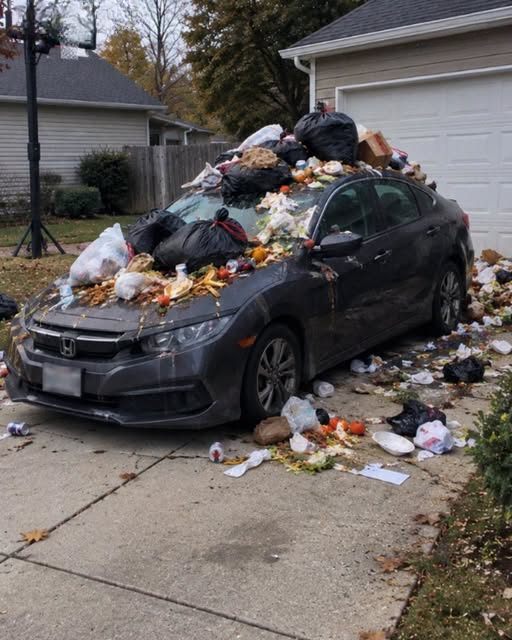
My car was covered in garbage.
Several bags had been placed across the hood and roof.
Other trash had been left around the windshield and doors.
I stood there in disbelief.
For several seconds, I couldn’t move.
Then I looked toward Diane’s house.
Her curtains moved slightly.
I couldn’t see her clearly, but I had a strong feeling she was watching.
I walked over to her front door.
I knocked.
No answer.
I knocked again.
Still nothing.
I returned home and took photographs of the mess.
Then I called the appropriate local service to ask what I should do about the situation.
I didn’t confront her again.
At least, that was my intention.
But by then, our disagreement had already become something larger.
A few days later, my outdoor trash bin was moved.
Then I found a note on my windshield complaining about my parking.
Another morning, one of my flower pots had been moved from the porch.
Nothing was dramatic enough to justify a major response on its own.
But the pattern was becoming impossible to ignore.
I began keeping records.
Dates.
Times.
Photographs.
Descriptions of what had happened.
I also spoke with another neighbor.
Her name was Linda.
When I mentioned Diane, she sighed.
“You’re not the first person she’s had problems with.”
“What do you mean?”
Linda hesitated.
“Diane has always been difficult.”
“Has she done things like this before?”
“Not exactly.”
She paused.
“Just be careful.”
That sentence stayed with me.
I didn’t want a feud.
I didn’t want revenge.
I wanted to live in my house peacefully.
So I tried something different.
I wrote Diane a letter.
I explained that I didn’t want us to continue arguing.
I said I was willing to discuss any legitimate concerns she had, provided we could speak respectfully.
I also asked her to stop interfering with my property.
I left the letter at her door.
For several days, nothing happened.
Then Diane knocked on my door.
I opened it cautiously.
“I read your letter,” she said.
“Okay.”
“I don’t like you.”
I wasn’t expecting such a direct statement.
She continued.
“But I don’t want trouble either.”
I nodded.
“Neither do I.”
For a moment, it seemed as though we might finally find some common ground.
Then she said something that changed the entire conversation.
“You don’t understand what happened here before you moved in.”
“What happened?”
She looked down the street.
“People leave.”
I waited.
“Neighbors come and go,” she said. “They promise they’ll be different. Then they cause problems, and eventually they move away.”
I began to understand that perhaps this wasn’t entirely about me.
Diane had developed a deep distrust of new neighbors.
That didn’t excuse what she had done.
But it gave me some context.
I told her that I wasn’t planning to leave and that I had no interest in making her life difficult.
She nodded.
“I hope that’s true.”
Then she walked away.
For the first time since I moved in, I thought things might improve.
They didn’t.
Several weeks later, an argument between us escalated again.
This time, I decided not to respond.
I contacted the property manager and documented everything.
I also installed additional lighting around my own property and made sure I followed every neighborhood rule.
The situation slowly became less personal.
Instead of arguing directly, we communicated through appropriate channels.
It wasn’t satisfying.
There was no dramatic victory.
No moment when Diane suddenly apologized and admitted that I had been right.
But the conflict began to lose its power over me.
Then, one evening, something happened that I never expected.
I heard sirens in the distance.
I looked outside.
Several emergency vehicles were moving slowly down our street.
Neighbors began stepping onto their porches.
I saw Diane standing outside her house.
She looked frightened.
I walked toward her.
“Are you okay?”
She didn’t answer.
Her attention was fixed farther down the road.
There had been an accident nearby.
No one on our street knew exactly what had happened yet.
People were worried and confused.
I stood beside Diane while we waited for information.
For the first time since I had moved into the neighborhood, neither of us was thinking about parking, trash bins, property lines, or old arguments.
We were simply two people standing outside, concerned about what had happened.
Later that evening, we learned that someone had been seriously injured in the accident.
The news affected everyone.
Our neighborhood, which had once seemed so ordinary, suddenly felt different.
Diane and I barely spoke.
But before I went inside, she looked at me.
“I’m sorry,” she said quietly.
I wasn’t sure what she meant.
“For everything,” she added.
I nodded.
“I am too.”
We didn’t become close friends.
Some disagreements can’t be erased with one conversation.
But something changed.
We stopped looking at each other as enemies.
Months later, Diane and I were still neighbors.
We weren’t particularly close.
Sometimes we waved.
Sometimes we exchanged a few words.
If there was a legitimate problem, we handled it calmly.
The feud that had once seemed so important gradually became a memory.
Looking back, I often think about that first morning when I found my car covered in trash.
At the time, I believed that was the beginning of our conflict.
Now I think it was a warning about something deeper.
We were both carrying assumptions into that neighborhood.
Diane had already decided what kind of person I was.
And I had quickly decided what kind of person she was.
Once those assumptions took hold, every small disagreement became evidence supporting what we already believed.
That is how ordinary conflicts grow.
One comment becomes an argument.
An argument becomes resentment.
Resentment becomes a pattern.
And eventually, people stop seeing each other clearly.
I still wish I had handled that first confrontation differently.
I wish I had simply walked away.
Not because Diane’s behavior was acceptable.
It wasn’t.
But because I learned that responding to anger with more anger rarely produces the outcome you hope for.
Sometimes the strongest response is to create distance, document what matters, communicate clearly, and refuse to let another person’s behavior determine your own.
Our neighborhood eventually became peaceful again.
The trees were still there.
The sidewalks were still quiet.
People still walked their dogs in the evening.
And my little house eventually began to feel like home.
Diane and I never became the friends I had originally hoped we might be.
But we reached something more realistic.
Respectful distance.
And after everything that happened, I realized that sometimes peace doesn’t mean everyone agrees.
Sometimes peace simply means deciding that the argument isn’t worth carrying forever.
That was the lesson I took from the strangest neighbor experience of my life.
A disagreement can begin with something as small as a pie, a parking space, or a misplaced trash bin.
But what happens next depends on the choices people make.
And sometimes, walking away from a feud isn’t weakness.
It is the moment you finally decide that your peace is more valuable than winning.