My Mother Attacked Me, and My Husband Said I Deserved It—Then They Came Back to the Hospital
The steady chirping of the monitor was the first thing I noticed when I opened my eyes.
A blood-pressure cuff tightened around my arm as a nurse checked my vital signs. My face was swollen, my lip was injured, and bruises covered parts of my arms.
For a few moments, I couldn’t remember exactly where I was.
Then everything came back.
The argument.
My mother.
The fear.
And my husband’s message.
A nurse picked up my damaged phone, which had been placed inside a clear belongings bag. The screen was still illuminated.
She glanced at the message and then looked at me.
“Is your husband someone you’d like us to list as your emergency contact?”
For six years, I had become an expert at protecting the people who hurt me.
I had always found an explanation.
He was stressed.
My mother had a difficult personality.
They didn’t really mean what they said.
They loved me, I told myself.
Maybe things would eventually get better.
But lying to protect them had never made anything better.
This time, I looked at the nurse and answered differently.
“No.”
She waited.
“Please remove him from my emergency contact information,” I said. “And I need to speak with hospital security.”
It was the first time I had openly admitted that I was afraid of my own family.
It Started With a Set of Papers
The situation had begun earlier that evening at my house.
My husband had placed several documents on the kitchen table.
They were refinancing papers.
He wanted me to use our house as security for additional borrowing.
There was just one problem.
The house wasn’t his.
I had purchased it several years before we met. My name was on the deed and mortgage, and I had never transferred ownership to anyone else.
I told him I wasn’t comfortable signing anything.
At first, he tried to convince me.
Then he became angry.
When I still refused, he called my mother.
She arrived not long afterward.
I remember being surprised that she had come so quickly.
But I soon realized she wasn’t there to calm the situation.
She supported my husband.
She told me that if I trusted him, I would sign the documents.
I explained that the house was my responsibility and that I wasn’t willing to make such a major financial decision under pressure.
The argument became increasingly heated.
Eventually, my mother took control of the situation in a way I never could have imagined.
She prevented me from leaving and took my phone.
What happened afterward left me injured badly enough to require emergency treatment.
I remember struggling to stay conscious.
Then I remember the sound of an ambulance.
The Message on My Phone
My husband hadn’t been there when the ambulance arrived.
Instead, after I was taken to the hospital, he sent me a message.
It contained only a few words.
You deserved it.
I stared at the screen for a long time.
Those words hurt in a way I couldn’t explain.
Not because they were surprising.
But because they confirmed something I had spent years trying not to acknowledge.
He wasn’t asking whether I was okay.
He wasn’t asking what had happened.
He wasn’t coming to see me.
He was blaming me.
At first, I tried to protect them again.
When hospital staff asked what had happened, I told them I had fallen down the basement stairs.
The explanation came automatically.
I had spent years making excuses for my family, and the habit was difficult to break.
But then I looked at the message again.
And something changed.
I realized that if I continued lying, I wasn’t protecting myself.
I was protecting the people who had harmed me.
So I told the truth.
I Finally Told Someone What Happened
Once I began explaining what had happened, the hospital staff took my situation seriously.
My injuries were documented.
The message from my husband was preserved.
Hospital security also reviewed available footage after learning that my mother had followed me to the hospital and attempted to find out where I had been taken.
For the first time, I wasn’t trying to make the situation sound less serious than it was.
I also made another request.
“I don’t want them to have access to me tomorrow morning.”
The hospital staff arranged for me to be moved to a protected room with restricted access.
It wasn’t about revenge.
It was about making sure I was safe.
And that decision became important much sooner than I expected.
They Came Back
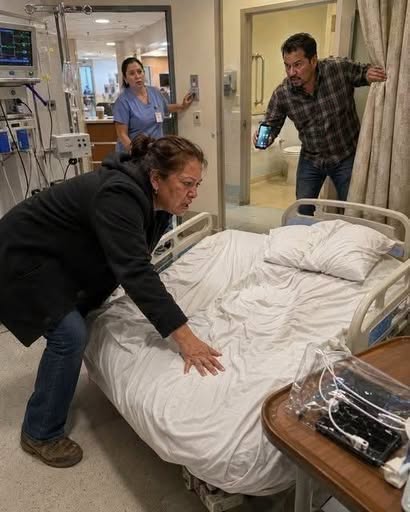
The next morning, I was resting when I heard movement outside the room.
My mother and husband had arrived.
They apparently expected to find me exactly where they had left me.
Instead, the bed was empty.
The room had been prepared for another patient.
My mother immediately demanded to know where I had been moved.
My husband searched the room.
They checked the bathroom and looked behind the privacy curtain.
They seemed confused and increasingly frustrated.
But nobody gave them my location.
I watched part of the situation from a protected area while a nurse remained nearby.
For the first time, I wasn’t the one trying to keep everyone calm.
Other people were protecting me.
Then my husband’s phone rang.
He answered.
His expression changed almost immediately.
A hospital security supervisor had contacted him and told him that an officer needed to speak with both of them at our house.
My mother looked at him.
“What happened?”
He didn’t answer.
They left the hospital together.
Neither of them knew exactly what was waiting for them.
The House Was No Longer the Same
When they arrived home, they found a deputy standing outside.
A locksmith was also there.
My mother noticed several belongings near the porch, including her suitcase and my husband’s duffel bag.
Then she saw the envelope.
Inside were copies of legal paperwork relating to the property and a temporary no-contact order.
The house they had treated as though it belonged to them was legally connected to me.
My husband immediately became angry.
“This is my home,” he said.
The deputy calmly reviewed the property records.
“Your name isn’t listed as the owner.”
My husband stared at the documents.
My mother looked toward the front door.
The situation was suddenly very different from what they had expected.
She turned toward the deputy.
“She can’t do this yet,” my mother said. “She hasn’t signed the papers.”
The deputy paused.
“What papers?”
My mother immediately stopped talking.
My husband turned toward her.
“Stop.”
His voice was quiet, but the meaning was clear.
The deputy looked from one of them to the other.
“What papers are you referring to?”
Neither answered.
For several seconds, there was only silence.
Then my mother looked at my husband.
And something in her expression changed.
She seemed to realize that the two of them were no longer working together.
The Secret Behind the Papers
My husband had spent months telling me that the refinancing would help us financially.
He had described it as a necessary step.
He said we needed access to additional money.
He never told me the entire story.
My mother knew more than I did.
And now, standing on the porch with a deputy beside them, she finally understood that the plan was beginning to unravel.
My husband had expected me to sign the documents.
When I refused, the pressure escalated.
But there was something else behind the request.
Something that explained why my mother had become so determined to make me sign.
The deputy asked again.
“What were those papers?”
My mother looked at my husband.
He wouldn’t meet her eyes.
Finally, she spoke.
What she revealed had nothing to do with helping our family financially.
It was the reason they had been so determined to get control of the house.
And it was also the reason my husband had been willing to let my mother take responsibility for what happened to me.
For the first time, the truth about the refinance documents was beginning to come out.
And once it did, neither of them could pretend that the previous night’s events had happened because of a simple family argument.
The documents, the house, and the attack were all connected.
But I was still in the hospital, recovering and trying to understand how the people I had spent years defending had become the people I needed protection from.
And the next conversation with investigators would force me to confront a truth I had avoided for a very long time.