Why Some U.S. Bills Have Unusual Marks, Symbols, or Stamps
If you’ve ever taken a close look at an older U.S. dollar bill, you may have noticed something unusual.
Perhaps there is a handwritten mark in one corner.
Maybe someone has stamped a small symbol onto the paper.
You might even find initials, numbers, letters, or other markings that don’t appear on newer notes.
At first glance, these markings can seem mysterious.
Why would someone write on a dollar bill?
Who put the mark there?
Does it have anything to do with the government?
And could it tell us something about where the bill has been?
The answer depends on the type of mark.
Some markings found on U.S. currency are official features that are part of the note’s design and production. Others are added later by banks, businesses, collectors, or individuals.
Historically, marked currency can also provide an interesting glimpse into the way money traveled around the world.
Not Every Mark on a Dollar Bill Has the Same Meaning
One of the most important things to understand is that there isn’t one universal explanation for every unusual mark found on U.S. currency.
A printed symbol that appears in the same location on many notes may be part of the official design.
A handwritten initial or stamp placed over the design is something completely different.
This distinction is important because people sometimes see an unfamiliar symbol and assume that it must be an official government marking.
In many cases, it isn’t.
The history of paper money includes many examples of people writing, stamping, signing, or otherwise marking currency as it moved between individuals and businesses.
What Are Chop Marks?
The term chop mark is generally associated with marks placed on coins or other pieces of currency by merchants, money changers, or other parties to indicate that the item had been examined or accepted.
These practices were particularly associated with international trade, especially in parts of Asia during periods when foreign coins circulated alongside local currencies.
A merchant could place a distinctive mark on a coin after checking it.
The mark effectively became a record of that transaction or verification.
Different merchants could use different symbols.
Over time, a heavily marked coin might accumulate numerous impressions.
These markings could therefore tell a story about the coin’s circulation and the people or businesses that handled it.
However, it is important not to assume that every unusual mark on a modern U.S. dollar bill is a chop mark.
The historical practice is more closely associated with coins and particular trading environments than with ordinary modern U.S. Federal Reserve notes.
Why Did Merchants Mark Money?
Before modern financial systems became as standardized as they are today, determining whether foreign currency was genuine could be difficult.
A merchant accepting unfamiliar money faced a practical question:
Is this piece authentic, and is it worth what the person offering it claims?
Coins could be weighed, examined, tested, and compared with known examples.
A merchant who accepted a particular coin might place a small identifying mark on it.
This could help establish that the coin had already been inspected or accepted.
The system wasn’t necessarily a formal worldwide standard.
Instead, it was part of the informal practices that developed around trade.
International Trade Made Currency More Complicated
Long-distance commerce has always created challenges for money.
A traveler might arrive in a market carrying coins from another country.
A merchant might accept foreign currency only if its authenticity and value could be established.
Exchange rates could vary.
The metal content of coins could matter.
Coins might also be clipped, damaged, worn, or altered.
In such an environment, recognizable marks could become useful.
They didn’t magically guarantee that a coin was genuine, but they could represent a merchant’s previous assessment or acceptance.
This is one reason historical marked coins can be fascinating to collectors today.
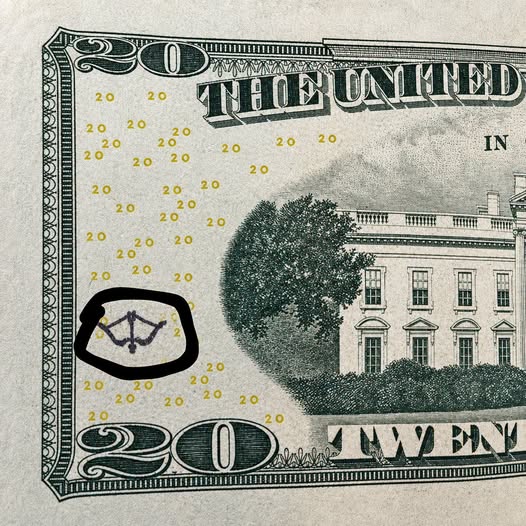
What About a Bow and Arrow?
The phrase “bow and arrow mark” can be misleading when discussing U.S. currency.
If you see a bow-and-arrow-like symbol on a dollar bill, the first step should be determining whether you’re looking at an official design element, a printer’s mark, a serial-number-related feature, a security element, or a later addition.
U.S. currency contains many small details that can look unfamiliar when viewed closely.
These details may include letters, numbers, seals, signatures, symbols, and design elements.
Some are connected to the Federal Reserve System.
Others relate to the Bureau of Engraving and Printing, the production process, or the specific series of the note.
A mark that resembles an arrow or another object doesn’t automatically indicate that someone previously inspected the bill.
Official Features Can Look Mysterious
Modern U.S. notes contain numerous security and identification features.
Depending on the denomination and series, a note can contain elements such as:
- Serial numbers
- Treasury and Federal Reserve identifiers
- Seals
- Signatures
- Microprinting
- Security threads
- Color-shifting elements
- Watermarks
- Fine-line patterns
- Other specialized printing features
Some of these are extremely small.
When viewed without context, they can look like random symbols.
In reality, they may have specific purposes related to identification, authentication, production, or security.
This is why identifying the exact denomination and series of a bill is important before trying to interpret a particular mark.
Why Older Currency Can Look Different
U.S. currency has changed considerably over time.
Designs have been modified.
Security features have been added.
Portraits, seals, serial numbers, colors, and other elements have changed between different series.
Older notes can therefore look very different from the bills people commonly carry today.
A symbol that appears unusual on an older note may simply reflect the design conventions of that period.
Collectors often study these differences carefully.
For them, seemingly minor variations can help identify when and where a note was produced.
Handwritten Marks Are Another Story
Sometimes the explanation is much simpler.
Someone wrote on the bill.
People have been writing on currency for generations.
A cashier might mark a note while checking a transaction.
A business might stamp currency for accounting purposes.
A person might write a phone number, joke, message, or other information on a bill.
Some people even mark bills deliberately so they can track where the money travels.
Those markings don’t necessarily have historical or official significance.
They may simply be evidence that another person handled the note before you did.
Why People Find Marked Currency Fascinating
Money passes through countless hands.
A single dollar can move between customers, businesses, banks, vending machines, cash registers, and individuals.
That makes currency an unusual kind of historical object.
A mark on a bill can sometimes make you wonder where it has been.
Who held it before you?
How many transactions has it passed through?
Was it used in another state?
Was it carried by a traveler?
Did someone intentionally mark it?
Usually, there is no way to know.
But that uncertainty is part of the appeal.
Currency as a Record of Everyday Life
Historical money can provide information far beyond its monetary value.
Collectors study old notes to understand changes in printing technology, banking systems, economic conditions, and design.
Marked coins can sometimes provide evidence of commercial practices and international circulation.
Even an ordinary note can become interesting when it survives for decades.
The object itself may be worth only its face value.
Yet its history can be difficult to replace.
Does a Mark Increase a Bill’s Value?
Not necessarily.
A common misconception is that any unusual mark automatically makes currency valuable to collectors.
In reality, collectible value depends on many factors.
These can include:
- Age
- Rarity
- Condition
- Series
- Printing variety
- Serial number
- Historical significance
- Authenticity
- Collector demand
A random pen mark usually doesn’t make an ordinary modern bill valuable.
In some cases, writing or damage can actually reduce its appeal to collectors.
However, certain documented errors, varieties, or historical markings can be significant.
That is why unusual currency should be identified before anyone assumes it is either worthless or extremely valuable.
What Should You Do If You Find an Unusual Mark?
If you discover an unfamiliar mark on a bill, don’t immediately assume it is rare.
Start by examining the note carefully.
Look at the denomination.
Check the series information.
Look at the serial numbers.
Notice whether the marking is printed as part of the note or appears to have been added later.
A magnifying glass can sometimes help reveal whether a detail is part of the original printing.
If you believe the note may have a collectible feature, consider consulting a reputable currency dealer or professional grading service rather than relying on a social-media post.
The Bigger Story Behind a Small Mark
The most interesting thing about unusual currency markings is not necessarily the mark itself.
It’s the history of money moving from one person to another.
For centuries, merchants and travelers have needed ways to establish trust in currency.
Coins have been weighed.
Notes have been examined.
Currency has been stamped, signed, counted, inspected, and exchanged.
Modern banking systems have made these processes far more standardized, but the basic problem remains the same:
How do we know that the money in front of us is genuine and worth what it claims to be?
Today’s security features are the modern answer.
Historical markings are part of an older story.
A Dollar Bill Can Have a Story of Its Own
The next time you see an unusual symbol or mark on a U.S. bill, take a closer look.
It might be an official feature that has been part of the note’s design all along.
It might be a printing or identification detail.
It might simply be a mark added by someone who handled the bill before you.
And in some historical contexts, unusual markings on currency can reflect the long history of merchants trying to establish trust in money.
But the key is identification.
Not every strange-looking symbol is a secret code, and not every mark has a special monetary meaning.
Sometimes a small detail is simply part of the design.
Other times, it is evidence of the long journey the piece of currency has taken.
Either way, those tiny details offer an interesting reminder that money is more than something we spend.
It is also a record of technology, commerce, and everyday human activity.